Report says Phila. air traffic growth exceeds U.S. average
Passenger traffic at Philadelphia International Airport grew 45 percent in the last decade, nearly three times the national average of 18 percent for the 100 largest U.S. metropolitan areas.
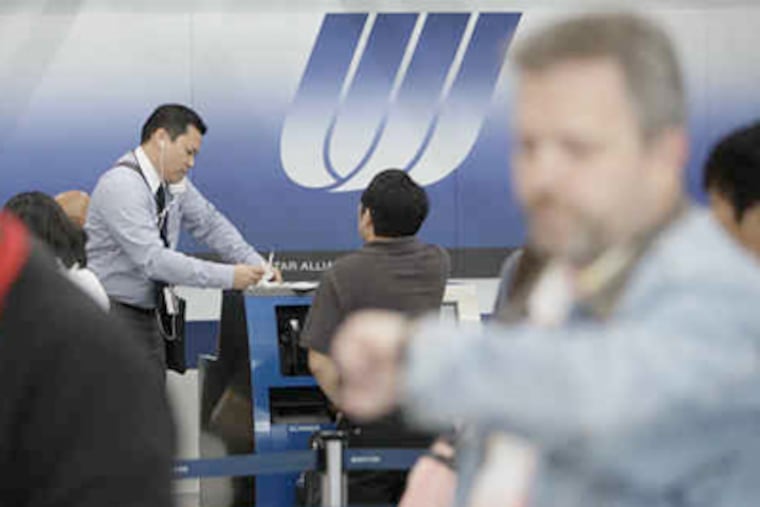
Passenger traffic at Philadelphia International Airport grew 45 percent in the last decade, nearly three times the national average of 18 percent for the 100 largest U.S. metropolitan areas.
While that is a boon for the region's economy and travelers who have more flights to choose from, there is a flip side.
Philadelphia is one of six metropolitan areas - led by New York - with higher-than-average flight delays because of crowded airspace, says a report yesterday by the Brookings Institution.
Brookings researchers found most delays concentrated in 26 cities - especially New York, Chicago, Philadelphia, Miami, Atlanta, and San Francisco.
Congestion in the skies creates problems for business travelers who have somewhere to be, leisure travelers who have connections to make, and the environment, the Washington policy group said.
High traffic volume means planes idle longer on the runways before taking off and circle longer before landing.
The New York-Northern New Jersey metro area is the worst in the country for late flights - only 66.3 percent of flights landed within 15 minutes of schedule between July 2008 and June 2009.
That was well below the national average of 78.4 percent, Brookings said.
In contrast, 73.4 percent of flights at Philadelphia International arrived on time during those 12 months. Put another way, they were late 26.6 percent of the time.
The average landing delay at Philadelphia airport also has increased dramatically - up 27 percent since mid-1999 - to 61.9 minutes, said Adie Tomer, a Brookings research analyst and coauthor of the report.
Delays take a heavy toll on business travelers, said Kevin Mitchell, chairman of the Business Travel Coalition in Radnor. "While sitting on the tarmac, you are not very productive," he said. "And it's unhealthy - delays add to the fatigue of traveling."
Plus, he said, delays in the combined Philadelphia-New York airspace contribute to 75 percent of delays nationally, affecting business travelers everywhere.
What to do?
Brookings said the current "ill-equipped" radar-based air-traffic-control system must be modernized with a satellite-based system, called NextGen. Yet implementation of NextGen is years away. Air-traffic levels are projected to double or triple by 2025.
In the short term, Brookings researchers recommend that the Federal Aviation Administration form a commission of industry stakeholders, including airlines and airport managers, to plan how to address airport congestion.
The report recommends that busy airports consider "congestion pricing," charging airlines higher fees to land during peak travel times so that airlines will spread flights more evenly throughout the day, the report said.
Another idea: Consider privatizing airports and build high-speed rail service across the country to offer alternatives to short flights.
And, Brookings criticized the federal government for spending only 20 percent of recent airport-improvement funds on the 26 busiest metropolitan areas, while most of the $1.3 billion went to smaller underused airports. The FAA should spend more on the busiest airports, the group said.
While the current recession has led airlines to reduce flights, which has improved on-time performance, when the economy recovers, passenger travel will rebound - and delays will increase.
"Now, when travel is down, is the time to figure out what we are going to do, how to move forward, especially when economic growth returns," said Brookings' Tomer.