Center City death shows hazards of aerial lifts
In terms of sheer numbers, construction is the second-most dangerous occupation in the nation, and James Wilson's fatal fall Monday from 125 feet as his aerial lift toppled is another sad example.
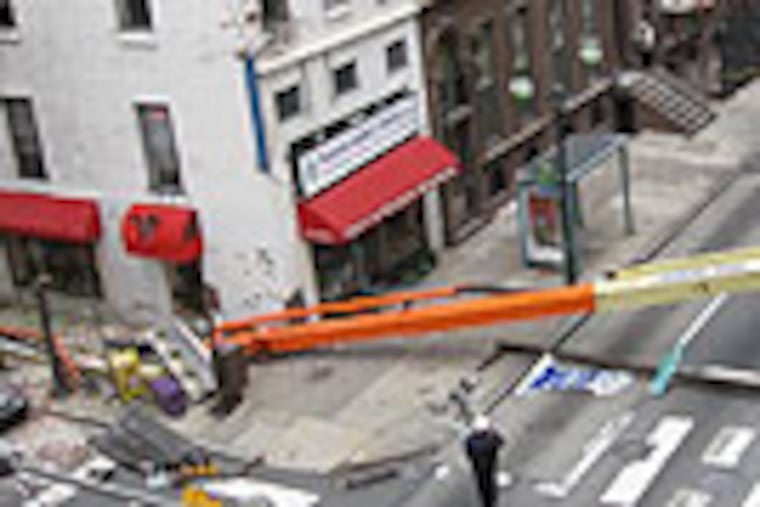
In terms of sheer numbers, construction is the second-most dangerous occupation in the nation, and James Wilson's fatal fall Monday from 125 feet as his aerial lift toppled is another sad example.
Even though Wilson, 41, was by all accounts a highly trained union journeyman with an expertise in high work, the type of equipment he was using in Center City can pose problems on construction sites, experts say.
That's because it carries the risks of any large piece of machinery, yet is used by all sorts of tradesmen - painters, bricklayers, and electricians who often receive only general training in its operation.
"This is the kind of stuff that slips through the cracks," said Patrick Gillespie, business manager of the Philadelphia Building and Construction Trades Council.
"It's a miraculous tool if it is used properly, but otherwise it's a bomb," he said.
Wilson, of Franklinville, had been working on the stone exterior of First Presbyterian Church at 21st and Walnut Streets about 1:15 p.m. when a wheel of his aerial lift broke through a utility panel on the sidewalk.
The lift swayed and then crashed to the street. Wilson, still in his harness, was dead, killed by the impact.
The U.S. Occupational Safety and Health Administration is investigating.
"When something like this happens, there is always a wake-up call about what kind of training there was, about whether corners were cut," said Barbara Rahke, executive director of PhilaPOSH, a union-funded safety organization.
Initial reports described the vehicle as a crane, but it wasn't one. Legislation and oversight for crane operators had increased after recent fatal accidents in New York and Miami. And while cranes are dangerous, they are also often operated by building tradespeople whose main job is to move heavy equipment.
Aerial lifts, such as the one Wilson operated, act as a mechanical and movable alternative to scaffolding, Gillespie said.
Most apprentice programs offer basic training in using the lifts, said Michael Schurr, eastern Pennsylvania chairman of the Pennsylvania Apprentice Coordinators Association for the building trades.
These include routine instructions on being harnessed properly, checking the ground surface, and not moving the lifts while they are extended.
The International Union of Painters and Allied Trades, for example, includes driving lessons. There is even an exercise in which apprentice painters and glaziers have to maneuver the machine through an obstacle course at the union's training facility in Northeast Philadelphia.
"It's a generalization. We go over the dos and don'ts," said John Phillips, president and business manager of Bricklayers and Allied Craftworkers Local 1, Wilson's union. He described Wilson as a good worker and very well-trained.
Specific training on each machine is usually provided by the contractor or rental company. Sometimes the training is spotty at best, a few minutes, experts said.
OSHA regulations do not specify how much training is enough, said Dan Kane, director of safety operations at Diamond Tool, a Philadelphia company that rents lifts.
"The problem is not with the rental company," he said, "but with the contractors" who pressure rental companies to provide cards certifying that training took place when it didn't.
Diamond provides two hours of training for $700, but those costs can add up quickly when different contractors and workers use one machine on the same job.
Kane said that he didn't know whether his company had rented the machine Wilson used, but that it had dealt with the employer, Masonry Preservation Group, in the past.
"Their workers came in on their weekends to get trained," he said, giving the company high marks.
In 2008, 969 workers died in construction accidents nationally, the U.S. Labor Department said. Of those, 332 died in falls and 201 in contact with objects and equipment. Transportation accidents and exposure to dangerous environments killed most of the rest.
In the Philadelphia area, 15 construction workers died in 2008 - five from falls, four in transportation accidents, three from contact with equipment, and three from exposure to dangerous environments.
In this area, the largest group of workers killed on the job are in trade, transportation, retail, and utilities. In that group of 25, 14 died in transportation accidents, and five, including some store employees, were killed in shootings.