Buyers find green Fishtown condo project attractive
Developer James Maransky stood inside a cavernous garage designed to hold 32 cars, inspecting a long row of thick wooden stair treads drying after being treated with preservative.
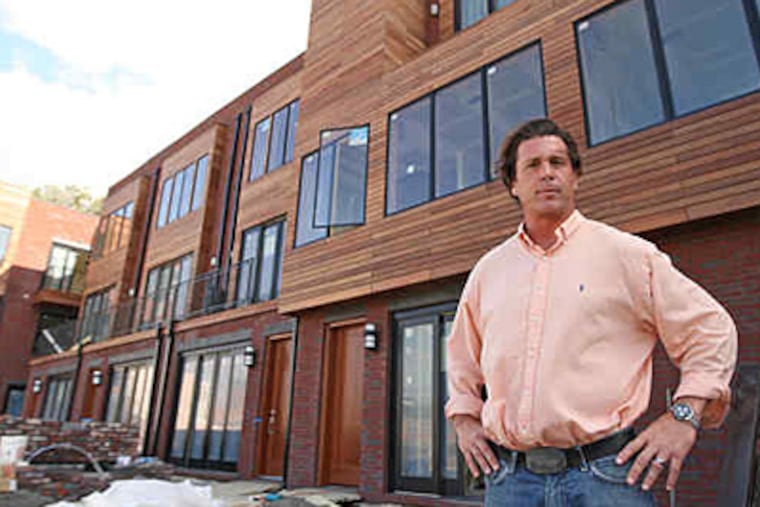
Developer James Maransky stood inside a cavernous garage designed to hold 32 cars, inspecting a long row of thick wooden stair treads drying after being treated with preservative.
Treads milled from the beams of Dooley's Icehouse, which stood for at least a century at Thompson Street and Columbia Avenue in Fishtown.
Treads now being used for stairways at a four-story, 13-unit, environmentally conscious condominium project that, taking a cue from the past, also is called the Icehouse.
"It was expensive to remove the beams and send them to Coatesville for milling into stairs," said Maransky, 41, president of the EnVision Group of Philadelphia.
New treads would have cost $75 each; with the repurposed wood, it was $180 each.
"Recycling does not save money in all cases," he said, "but we recycled as much as possible. In the end, their beauty makes it worth it."
All the bricks from the old Icehouse found their way into the new one as well, incorporated into a rooftop koi pond and other parts of the project, designed by Judith Robinson of Continuum Architecture. The project has been submitted for Leadership in Energy and Environmental Design certification.
If all goes according to plan, a total of 48 units will be built in three phases over three years.
Although the emphasis is heavy on the "green" aspects of the Icehouse - Maransky's first large-scale foray into residential construction - what is remarkable about it is that nine of the first 13 units, ranging from 530 to 1,900 square feet and priced from $159,000 to $479,000, are under agreements of sale. (First move-ins are set for later this month.)
Data from Delta Associates, which tracks the condo market nationally, show sales in metropolitan Philadelphia in the 12 months ended Sept. 30 were about one-fifth the number sold in the same 12 months of 2007, at the peak of the region's housing boom - 412 units this year vs. 2,045 in 2007.
Most of the condo inventory is within city limits. There are 1,995 units for sale in Philadelphia now, about half the 2007 inventory.
So anything new that's selling - at $295 to $315 a square foot, well below the third-quarter city average of $530 a square foot - is a bright spot in this gray housing market.
Fishtown and adjacent Northern Liberties seem to be holding their own during the downturn. Preliminary third-quarter single-family data for the city, compiled by Econsult Corp. vice president Kevin Gillen, show an uptick in sales and prices in the zip codes covering the two neighborhoods.
"Recent data seem to indicate a respectable rebound," Gillen said. "Prices have rebounded from their lows back to their peaks at the top of the boom, and sales have risen back to their historic average level."
Average prices per square foot have risen from a post-boom of $113 in last year's third quarter to $140, based on 157 sales July through September, the data show. Peak sales volume, 245 units, was in the 2006 second quarter. The top price per square foot was $141 in the third quarter of 2007.
Fishtown has always been a first-time buyers' mecca. The $8,000 federal tax credit and FHA financing with as little as 3.5 percent down has sweetened the pot for the Icehouse.
"I liked the project because it was green and it was new," said first-time buyer Jill Longstreth, 28, who decided to act now to get the credit.
Because she is a sales rep "who is on the road constantly," ease of access to the interstates made it "the perfect location for my job," said Longstreth, who had been renting in the Art Museum area.
Living in Fishtown is popular with young professionals and artists "looking for houses that haven't been 'improved' by slapping on new stuff from the home centers," said Dominic Fuscia, a Coldwell Banker Preferred agent.
"A lot of people buying here were priced out of Northern Liberties, just as they had been priced out of Old City before that," Fuscia said.
Getting Icehouse's $2.5 million first phase from concept to construction was not a snap, Maransky said.
Financing from Bucks County Bank was secured when the housing market began to soften and the credit crisis struck, but Maransky continued to rework the project - "value-engineer" it, he said - to reduce costs. Using less steel and precast rather than poured concrete, for example, saved $400,000.
Because the project was four stories, a zoning variance was needed. Opposition was stiff, with Fishtown Neighbors Association zoning committee meetings attracting as many as 150 residents. Among the concerns were building height, traffic, parking, condos proliferating in an overwhelmingly single-family-home neighborhood, and higher property taxes.
Maransky also had to assemble enough land. In all, about a dozen parcels were involved. Owners had to be tracked down, prices negotiated, and titles cleared of liens.
"Fishtown does not have a large amount of vacant land, which precludes large-scale housing development," said Sam Sherman, president of the Philadelphia Building Industry Association. "It is, however, a source of potential middle-class housing. Rehabs and renovations of existing housing stock is probably the best way to look at this market."
Maransky has spent much time fine-tuning his project, paying more for garage lights, for example, to try to cut residents' energy bills 40 percent and condo fees to 25 cents a square foot.
"Everything we've done," he said, "was designed to make buying here as affordable as possible."