Elevated cholesterol problems for Merck
Merck & Co. Inc. scrambled to defend its cholesterol drugs Vytorin and Zetia yesterday after a new study questioned their effectiveness against heart disease.
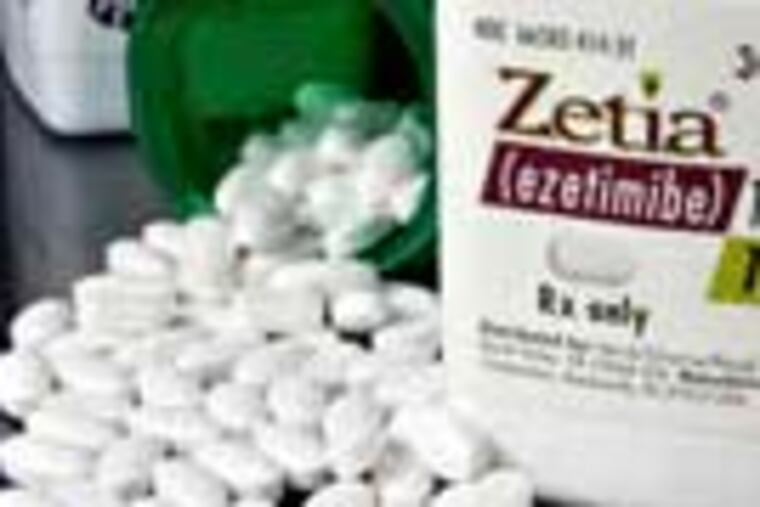
Merck & Co. Inc. scrambled to defend its cholesterol drugs Vytorin and Zetia yesterday after a new study questioned their effectiveness against heart disease.
Sales of the two medicines, for which about 11.3 million prescriptions have been dispensed so far this year, already were flagging when a study published yesterday in the New England Journal of Medicine renewed questions about whether the drugs reduce the likelihood of heart attacks and strokes.
Several doctors cautioned that while the results of the research were interesting, patients taking Vytorin and Zetia should continue doing so and should talk to their medical providers when considering changes. The number of people who completed the trial, 208, was so small that it limited the significance of the results, they said.
But because the research builds on earlier studies on these drugs, doctors closely studied the results.
"It's a small study, but it raises great questions about where we're going in treating people with known coronary heart disease," said David Becker, a Flourtown cardiologist.
The study was designed to compare two strategies for treating heart disease in people who already had coronary heart disease or were at high risk of developing it and already were taking a statin drug to lower cholesterol levels.
Cardiologists at Washington Hospital Center in Washington, D.C., and Walter Reed Army Medical Center divided participants into two groups. One took a statin with Zetia to try to lower cholesterol. The other took a statin with Niaspan, a prescription form of niacin, a type of B vitamin, made by Abbott Laboratories. Niacin increases HDL, or good cholesterol.
In the study, Zetia failed to shrink buildups in artery walls while Niaspan did. Zetia users also suffered more heart attacks and other problems, although the numbers of these events were too small to draw firm conclusions.
The study's lead author, Allen Taylor, stopped the study early, after 14 months, because patients on niacin were doing better than those on Zetia.
Merck's Vytorin combines a statin, a type of drug that inhibits the production of LDL cholesterol in the liver, with Zetia, which reduces bad cholesterol by blocking its absorption in the intestines.
Merck, based in Whitehouse Station, N.J., employs about 12,000 people in the Philadelphia region.
Yesterday's negative result is the third in two years for Zetia and Vytorin. An earlier trial, known as ENHANCE, found Vytorin didn't help arteries more than generic versions. Another trial, called SEAS, found more patients taking Vytorin developed cancer than those on a placebo, but later research contradicted that.
Together, Vytorin and Zetia last year brought in about $4.6 billion in yearly sales.
Merck recently completed its merger with Schering-Plough and is under pressure to boost revenues. Merck shares closed at $33.81, up 2.1 percent for the day. Abbott Laboratories shares rose 1.3 percent to $53.63.
The new study was sponsored by Abbott, and several study leaders have been paid speakers or consultants to the company or to rival drugmakers.
Richard Pasternak, vice president and head of global scientific affairs at Merck, questioned the value of the study because its primary measure of efficacy was changes in the thickness of patients' carotid arteries.
It is not known whether that measure predicts the likelihood of a heart attack or other coronary problem.
"As an indirect measure, it doesn't always relate to a clinical reality," he said.
Merck hopes to complete a study in 2012 that will follow 18,000 patients to see whether Vytorin and Zetia prevent heart attacks.
An editorial accompanying the New England Journal study also noted its limitations but acknowledged that it affirms niacin as a good addition to statin treatment in some patients. Pasternak said Merck also believed in niacin as a treatment and has a drug, Tredaptive, that includes it. Tredaptive is not yet approved for use in the United States. Pasternak noted that some patients can't tolerate niacin's side effects, which include sweating and flushing and said the science behind drugs such as Zetia and Vytorin that lower LDL cholesterol is strong.
Roger Blumenthal, preventive cardiology chief at Johns Hopkins University and author of the editorial, questioned that.
Zetia "has been on the market for about seven years and we still haven't proven that it improves clinical outcomes," he said.
Steve Woloshin, an associate professor of medicine at Dartmouth Medical School, said the study had so many limitations that he didn't find the results valuable.
Measuring changes in thickness of arteries may or may not say anything about heart disease, and the sample size was too small, Woloshin said. Stopping the study early compromised its statistical significance, he added.
"I just don't think it adds a lot to what we know," he said.
Dean Karalis, a partner in Cardiology Consultants of Philadelphia and clinical professor of medicine at Drexel University, said he didn't see the study as undermining Vytorin or Zetia. Instead, it confirms previous research suggesting that fighting heart disease requires focusing on several disease markers, including LDL and HDL cholesterol and triglycerides.