PhillyDeals: 2 votes for Dodd's do-it-yourself bailouts
The U.S. House of Representatives will likely pass Rep. Paul Kanjorski's (D., Pa.) break-'em-up bill, which calls for regulators to split dangerously big and financially complex companies into safer pieces, so they don't have to be bailed out like American International Group Inc. or General Motors Corp.
The U.S. House of Representatives will likely pass Rep. Paul Kanjorski's (D., Pa.) break-'em-up bill, which calls for regulators to split dangerously big and financially complex companies into safer pieces, so they don't have to be bailed out like American International Group Inc. or General Motors Corp.
But "We do not believe it would pass in the Senate," said Scott Valentin and Paul Miller, bank analysts at FBR Capital Markets Corp., of Richmond, Va., in a report to clients yesterday.
"Given the popularity of the issue," they noted, Kanjorski's proposal did pass the House Financial Services Committee earlier this week, 38-29.
And, they concede, a tough "Too Big to Fail/Systemic Risk" law could win over a few conservative Republican senators, such as Richard Shelby (R., Ala.). Shelby challenged the Gramm-Leach-Bliley deregulation law that let the biggest Main Street banks combine with Wall Street investment firms, sowing the seeds for the current crisis.
But, the two analysts wrote, President Obama is likely to "apply pressure on lawmakers not to adopt aggressive legislation," instead settling for Sen. Christopher J. Dodd's (D., Conn.) proposal for "self-designed failure resolution plans."
Self-designed. Why not? Since it's in big companies' interests not to take on too much risk. Or so former Fed chief Alan Greenspan used to tell us, when he backed deregulation.
Health reform?
Aetna Inc. cut 60 workers at its Blue Bell office, and 625 across the United States, yesterday, spokesman Fred Laberge told me. The big health insurer plans to cut another 625 in early 2010.
The cuts follow 530 buyouts at Independence Blue Cross and its affiliates in Philadelphia earlier this month.
Making solar pay
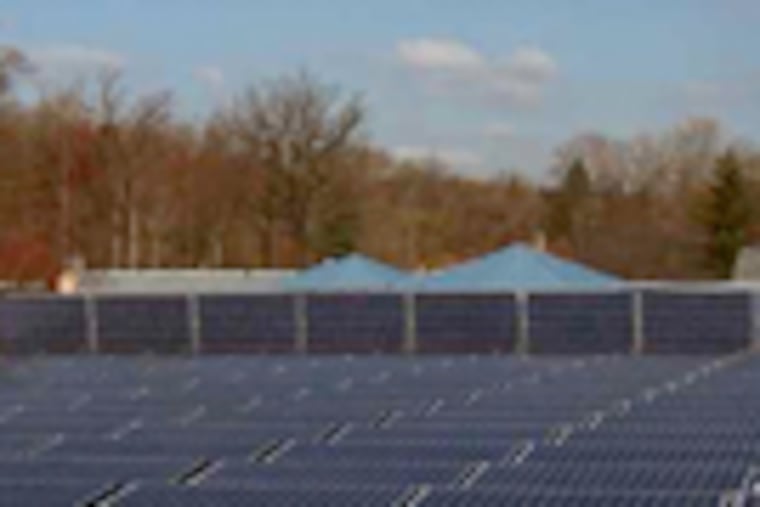
Springside School, a private prep school for girls in Chestnut Hill, wanted to build a solar-electric power system on the gym roof.
It hired Alteris Renewables Inc., a Wilton, Conn., firm that specializes in prep-school solar jobs, to design what Alteris calls Philadelphia's largest solar array. It will power up to 92,000 watts, at an installation cost of $550,000.
Solar power reduces oil and gas burning, which makes environmentally minded people feel good. It may also save money some day, if conventional electric rates go up sharply.
But as of today, solar electric is still way more expensive than the oil, coal, and uranium power Peco Energy sells.
That's why the federal government, betting on solar, subsidizes it with tax breaks and accelerated depreciation. But nonprofit groups such as Springside don't pay taxes, so they don't enjoy tax breaks.
The Alteris system will save Springside a modest $19,000 per year at current electric rates, says Alteris president Ron French. At that rate, the system would take more than 30 years to pay for itself.
But Springside asked for, and got, a subsidy. The school collected a $400,000 "Energy Harvest" grant through the Pennsylvania Department of Environmental Protection.
That cut the cost to $150,000. "We raised it from a parent association fund-raiser" and some alumni class donations, said Frank Aloise, Springside's director of finance. "It's no capital out of our pocket. We're cutting our operating cost by 20 grand a year. When deregulated rates come a year from now, it'll be even more."
Springside estimated the annual savings at just $7,000 a year in its application. Alteris said the final system was more efficient. The state approved it with the lower number anyway, as a "late addition to the list, after the other grants had already been announced," DEP spokesman John Repetz told me.
What if Pennsylvania didn't subsidize prep-school solar systems?
French told me New England preps use another solution: They are letting private investors build and own campus solar plants, apply for the federal tax credits, and pass part of the savings to schools by selling them power at below-market prices.
Private schools could do the same here, he added. Public schools, too? "There's nothing to prohibit it," French told me cheerfully. "Some New Jersey districts are doing it."
Thanks to Harrisburg, Springside gets to use cheap sun power, and own it, too.