Holiday travel robust, but most went by car
Along with turkey, football, and pumpkin pie, Thanksgiving travel figured into millions of people's plans this year. Holiday travel was robust, but no banner year.
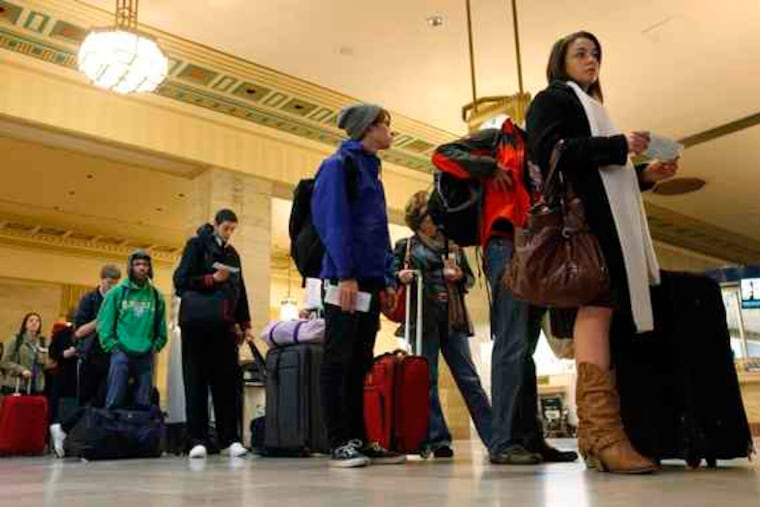
Along with turkey, football, and pumpkin pie, Thanksgiving travel figured into millions of people's plans this year.
Holiday travel was robust, but no banner year.
Some 97,000 passengers went through Philadelphia International Airport on Sunday, the busiest holiday travel day. On Saturday, 93,000 travelers passed through the airport.
"Based on information we received from the airlines, the passenger numbers were averaging out to be about the same as last year," airport spokeswoman Victoria Lupica said.
Amtrak, which does not yet have final train ridership numbers, said bookings across its system were comparable to, and maybe better than, the nearly 660,000 riders at Thanksgiving a year ago. Amtrak counts Thanksgiving travel from the Tuesday before through the Monday after.
About 2.7 million vehicles traveled the Pennsylvania Turnpike during the five-day holiday period. "Our traffic engineer said we were basically the same as last year," said Pennsylvania Turnpike Commission spokesman Carl DeFebo.
More than 38 million Americans had been expected to travel 50 miles or more from home over Thanksgiving, a 1.4 percent increase over 2008, according to AAA. About 33 million went by car, a 2.1 percent increase over last year.
An additional 2.9 million traveled by trains, buses, and other forms of transportation, an increase of 1.2 percent, the auto club said.
But fewer people boarded airplanes - 2.3 million, representing a decline of 6.7 percent because of the economy, AAA said.
"Thanksgiving travel was better than last year, but last year was extraordinarily bad," said Steve Piraino, senior economist with IHS Global Insight, a Boston-based firm that analyzed data for AAA.
"This is still a pretty weak year for Thanksgiving travel," he said.
A national opinion poll conducted by Maritz Research in October found that finances, job losses, and swine flu were uppermost concerns of many consumers, and a majority of travelers planned to get to their destinations by car this holiday season.
Normally, one in four - about 25 percent - Thanksgiving travelers fly, but only 16 percent flew this year, said Rick Garlick, pollster and statistician for Maritz Research based in St. Louis. "We are seeing the same sorts of percentage drops projected for Christmas."
Consumers are more frugal and "are tired of feeling taken advantage of by corporate America," Garlick said. "The travel and hospitality industries need to think about the customer experience in this new landscape to remain profitable."
Airlines have accommodated the decline in air travel by cutting capacity - seats and flight schedules.
Morgan Durrant, spokesman for US Airways Group, Philadelphia's dominant airline, said Thanksgiving load factors on planes "were essentially the same as last year. We, of course, like other airlines had less capacity this Thanksgiving than in 2008."
"Load factors were good - in the 80 percent range on average through last week," though certainly fewer people got on planes, Durrant said.
Philadelphia's second-busiest carrier, Southwest Airlines Co., had "heavy bookings and loads throughout the Thanksgiving holiday system-wide," said spokesman Paul Flaningan. "Our planes were definitely full."
"It's hard to compare to last year because we reduced capacity - seats and flights - this year. There are fewer planes and seats. Since we reduced, you have to take that into account."