Birds vs. airplanes: The menace continues
In the months after geese knocked out both engines of a US Airways jet over New York's Hudson River last Jan. 15, reports of airplanes striking birds have surged.
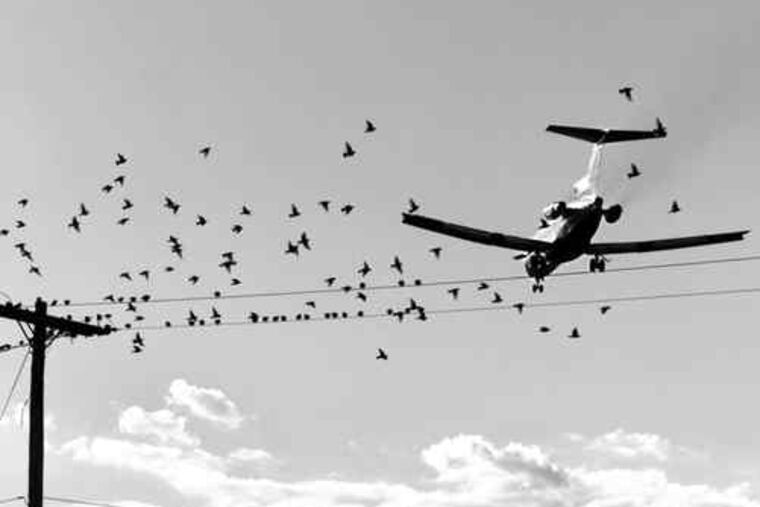
In the months after geese knocked out both engines of a US Airways jet over New York's Hudson River last Jan. 15, reports of airplanes striking birds have surged.
The federal government estimates about 10,000 reported bird strikes in 2009 - a 32 percent increase over the 7,600 reported strikes in 2008.
"We had a dramatic increase in the reporting of strikes in 2009," Richard Dolbeer, wildlife expert for the U.S. Department of Agriculture, said yesterday.
"We've never seen this before," he said. The primary reason: The aviation industry after the emergency landing of Flight 1549 in the Hudson River "recognized birds are a significant threat and more needs to be done to mitigate the risk.
"Flight 1549 sort of changed the landscape. All of a sudden the lightbulb went off: The big jump in the reporting of strikes is due to greater awareness and not a huge jump in the bird population last year," Dolbeer said.
Airplanes struck birds 46 times at Philadelphia International Airport in the first seven months of 2009 during takeoff or landing, or en route, according to Federal Aviation Administration data.
Of the 46, only one was considered "substantial." In that March 21 incident, an Air Wisconsin Airlines pilot reported smelling smoke in the cabin, possibly due to a bird sucked into Engine 2. The flight returned to the airport, where damage caused by a goose or duck was repaired at a cost of $88,300.
Pilots and airline personnel reported 928 bird strikes at the Philadelphia airport in the 19 years the FAA has tracked bird strikes. None resulted in a destroyed aircraft or human fatality.
The FAA last April opened its records on more than 100,000 reports of birds colliding with aircraft since 1990.
The records showed that airplanes struck birds 16 to 78 times a year between 1990 and 2008 at Philadelphia.
Airports, with open fields and grass, are particularly vulnerable to birds, and many of the nation's busiest airports are next to water or wildlife sanctuaries that attract birds.
Philadelphia International, which is surrounded by two rivers and a wildlife refuge that attract birds, has two full-time wildlife biologists and a 35-person operations staff that monitors the airfield 24 hours a day.
The biologists also monitor a five-mile radius around the airport on both sides of the Delaware River, said Keith Brune, acting deputy director for operations and facilities.
Philadelphia airport officials have not seen an increase in bird strikes on airport property. But after the FAA in July asked airlines to be more vigilant in reporting strikes, the airport got an increase in reports by maintenance crews of bird strikes on inspections after planes land.
"They may see blood or feathers on a wing or engine of an aircraft," Brune said. "We have no idea where that bird strike occurred. It could have been departing their last airport. It could have been on arrival here. The flight crew had no indication that they struck a bird at all."
Most strikes involve small birds and no aircraft damage, said Archie Dickey, a professor at Embry Riddle Aeronautical University, who developed the national FAA bird-strike data base.
Collisions most often occur during takeoff and landing, when airplanes are flying lower than 3,000 feet, and often within five miles of airport property, though some take place much farther away.
Bird populations have flourished in recent years with the banning of pesticides and environmental cleanup.
"There are more large birds in the air," Dickey said. "The number of nonmigrating Canada geese has increased drastically. At the same time, airplanes are quieter," Dickey said. "Combine that, and we are going to have more bird strikes."
Until 2008, the FAA saw a decline in bird-plane collisions considered "substantial" - causing structural damage, such as a hole in the wing or a destroyed engine.
But in 2009, with an increase in strike reports, came "a jump in more serious damage strikes," Dolbeer said.
Bird-detecting radar and special lighting on aircraft during take off and landing could alert birds that "something is coming at them very fast," Dolbeer said.