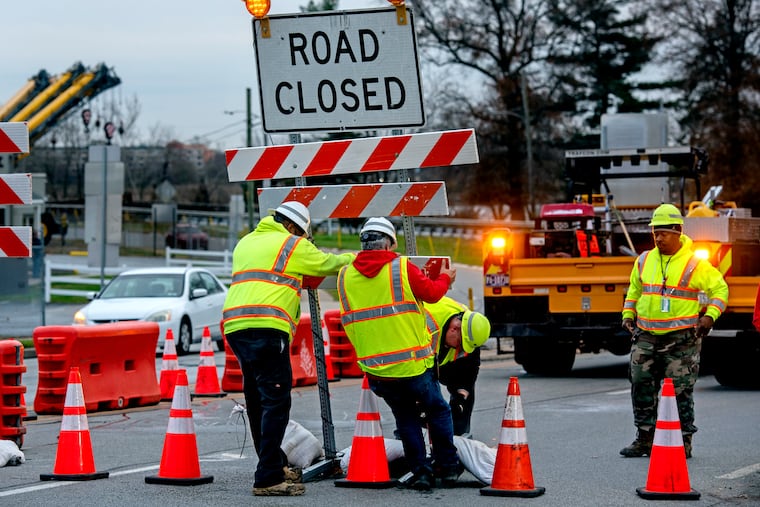
Senate prospects weak on bill to fight job crisis
WASHINGTON - The Senate is where legislation often goes to die, and it's looking more and more like that's the fate awaiting a new job-creation bill sought by President Obama.
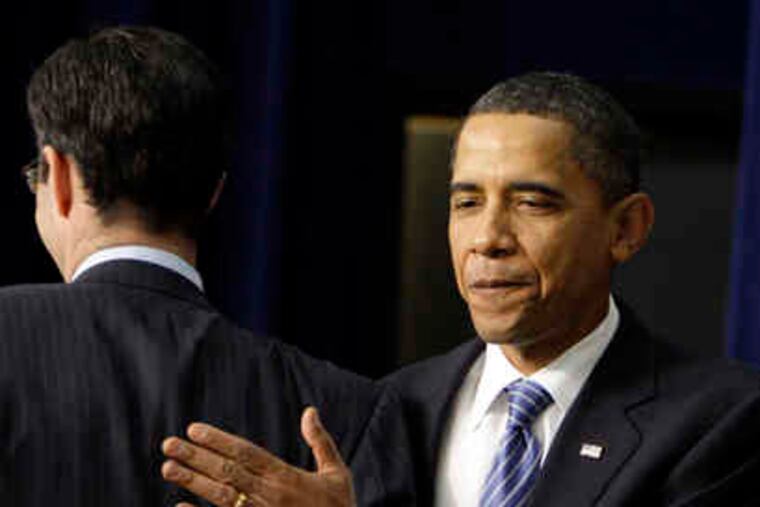
WASHINGTON - The Senate is where legislation often goes to die, and it's looking more and more like that's the fate awaiting a new job-creation bill sought by President Obama.
After barely limping out of the House last month, prospects for a deficit-financed jobs bill appear bleak in the Senate, where it's probably going to take all 60 votes in the Democrats' coalition to pass it.
That's doubtful. About one in six House Democrats voted no when the bill squeaked through the House last month. Moreover, the Democratic seat in the Senate held by the late Edward M. Kennedy is up for election today in what what polls show is a tight race. A win by the Republican candidate, Scott Brown, would cut the Democrats' majority below the 60 votes needed to overcome a filibuster in the Senate.
Prospects for getting the required unanimity among Senate Democrats is especially bleak since the first item of business on the Senate's agenda when it returns this week is a bill to let the government sink itself another $925 billion into debt.
To then take up legislation to spend perhaps $75 billion to $150 billion of that strikes some Democrats as a bad vote.
There's also the issue of Obama's upcoming budget, projecting another record federal deficit atop last year's record $1.4 trillion, adding to the difficulty in passing a new, debt-financed jobs package.
As of the end of December, there were 15.3 million unemployed Americans, more than double the number when the recession began in December 2007.
Sen. Kent Conrad (D., N.D.), supports the idea of a new stimulus measure but acknowledges the hurdles to passing one. Democratic moderates such as Ben Nelson of Nebraska and Evan Bayh of Indiana already have registered concerns.
"It's hard to answer in a vacuum without knowing what's in it, but if it's just a wish-list of spenders' favorite items, that's not going to go through," said Bayh.
"Senator Nelson is very concerned about the level of federal spending and the deficit," said Nelson spokesman Jake Thompson. "He would look at a jobs package, but those factors would weigh heavily in his mind." Nelson also thinks there's plenty of stimulus money still in the pipeline, Thompson said. Congress approved a $787-billion economic aid package last February.
Talk of a second economic stimulus measure - more pleasingly packaged as a "jobs" bill - intensified after the nationwide unemployment rate topped 10 percent last fall. It remained at 10 percent in December.
Obama has proposed new spending for highway and bridge construction, for small-business tax cuts and for retrofitting millions of homes to make them more energy-efficient. He also proposed an additional $250 apiece in stimulus spending for seniors and veterans and billions of dollars in aid to state and local governments to avert layoffs of teachers, police officers and firefighters.
The House responded with an approximately $174-billion measure, accepting many but not all of Obama's ideas. But the 217-212 vote on Dec. 16 vote was hardly encouraging. Speaker Nancy Pelosi (D., Calif.) had to work the floor for a full hour to win the tally, which was held just after Democratic leaders forced through stopgap legislation to raise the debt limit by $290 billion.
In the Senate, Majority Leader Harry Reid (D., Nev.), who has been preoccupied with health care, has handed off the jobs issue to allies Byron Dorgan (D., N.D.) and Dick Durbin (D., Ill.).
They've taken a roster of more than 100 ideas submitted by lawmakers and have tried to winnow them down to about a dozen proposals, including steps to help small businesses create jobs, money for so-called green jobs and funding for infrastructure projects like roads and bridges.
The idea is to enact fast-acting steps that would boost employment before this fall's election. But infrastructure spending is notoriously slow. Projects need to be planned and can require a lengthy contracting process before jobs appear on construction sites.
Democrats muscled through the first stimulus bill almost immediately after Obama took office with high approval ratings in public opinion polls. Now, Obama's numbers are significantly lower. Health care has consumed much of his political capital and his marks with the public on the economy are fading.