IPad's debut tantalizes technophiles
Will it be the next iPod or the new Newton? If there were an app for foreseeing truly revolutionary technology, Apple could have made a bundle in the weeks preceding yesterday's unveiling of its new, tablet-size portable computer dubbed - drumroll, please - the iPad.
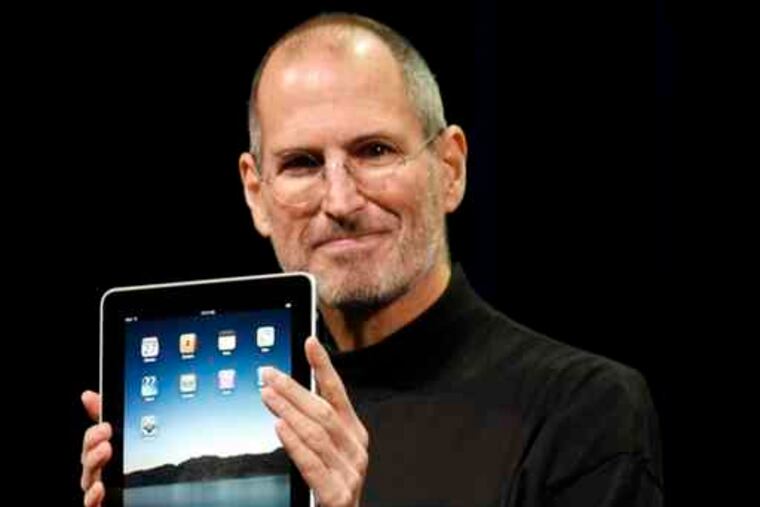
Will it be the next iPod or the new Newton?
If there were an app for foreseeing truly revolutionary technology, Apple could have made a bundle in the weeks preceding yesterday's unveiling of its new, tablet-size portable computer dubbed - drumroll, please - the iPad.
Though no one knew exactly what it would be called or do, techno-pundits gushed that it could "change everything," starting with newspapers, books, and television. One writer called it, only partly tongue-in-cheek, "the most eagerly awaited tablet since Moses."
Yesterday, Apple chief executive officer Steve Jobs came down from the mountain with a device that surprised on some counts - such as its price, starting at $499 - but that fell shy of the hype on others.
"I don't know if it's going to save publishing," said Lance Ulanoff, editor in chief of PC Magazine, after attending the iPad's San Francisco debut. "I think it's too soon to tell whether or not this thing is going to be successful. But I don't think people were disappointed."
Apple, of course, has a devoted following, and a history of Devices That Changed Everything, or at least made a pretty big difference.
The Macintosh computer, famously introduced by a commercial during the 1984 Super Bowl with an anti-Orwellian theme, still owns a singular presence in the personal-computer market. And the iPod, though not the first digital music player, has dominated that product niche since its 2001 debut.
Apple has also had its failures, including its Newton tablet device in the 1990s, and the iPad's trajectory is uncertain. But here is what we know now that it has been put on display in preparation for its March launch:
The entry-level iPad, with 16 gigabytes of memory, will sell for $499. But it will cost $629 to get one that works on AT&T's 3G wireless network as well as on WiFi.
It weighs about 11/2 pounds, half the weight of a MacBook Air, Apple's lightest laptop.
Its battery is supposed to last 10 hours between charges, and a month on standby.
Its screen measures 9.7 inches diagonally, compared with the Air's 13.3-inch display and about the same as Amazon's larger Kindle DX e-book reader.
Contrasts with the Kindle were common yesterday, because Apple hopes to capture a chunk of the emerging market for electronic books as well as lure people who want to read newspapers and other print media online.
"It's very different from the Kindle. It's backlit. It's bright," Ulanoff said. "E-reading on this device was kind of impressive."
But Ulanoff and others said the iPad's greatest strength may lie in its versatility. Rather than simply appeal to consumers who want a new way to read, he said, the iPad "could have a significant impact on how we enjoy content of all types: newspapers, TV, music, books."
Jon Gibs, a vice president at Nielsen Co., said Apple's aim was to expand on the market already established by its popular iPhone, which has spurred the development of tens of thousands of application programs that Apple sells via its online "App Store."
The iPhone can be used in so many ways that it is impossible to describe its range fairly. It can work as a GPS device, start a car remotely, play a virtual guitar.
"In a lot of ways, the iPad is just a really big iPhone," said Gibs, whose focus is on the integration of technologies.
As a large iPhone or an ultracompact laptop, another common comparison, the iPad promises to take portable Internet access to a new level, Gibs said.
Gibs said some people might find the iPad well-suited to watching sitcoms or other shows that do not rely on beautiful video. Others, "not necessarily those who would be tempted by an e-reader," might use it to experiment with e-books.
"It takes what many people like about the iPhone and extends it to a larger device," Gibs said. "The size itself makes it a new thing."