Merck paints rosy picture of merger
Nearly a year after it announced plans to acquire former rival and partner Schering-Plough Corp., Merck & Co. Inc. said yesterday that it ended 2009 well on its way toward achieving the efficiencies and other benefits it had promised shareholders as a result of the $41 billion deal.
Nearly a year after it announced plans to acquire former rival and partner Schering-Plough Corp., Merck & Co. Inc. said yesterday that it ended 2009 well on its way toward achieving the efficiencies and other benefits it had promised shareholders as a result of the $41 billion deal.
Merck completed the acquisition on Nov. 3. Yesterday, it said it had earned $6.5 billion on $10.1 billion in worldwide sales for the quarter that ended Dec. 31, which included two months of combined operations. Excluding certain impacts of the merger, Merck said its quarterly earnings totaled 79 cents per share.
For 2009, Merck reported $13 billion in net income on sales of $27.4 billion. Excluding merger impacts, it said earnings totaled $3.25 per share for the year.
In a conference call yesterday with analysts, leaders of the Whitehouse Station, N.J., company, which employs about 12,000 people in the Philadelphia area, continued to tout the merger's benefits - especially the new Merck's better-stocked product pipeline and the operational benefits of reducing staff.
"We remain absolutely committed to our previously announced target of realizing merger synergies of $3.5 billion in annual savings in 2012," chairman and chief executive officer Richard T. Clark told the analysts.
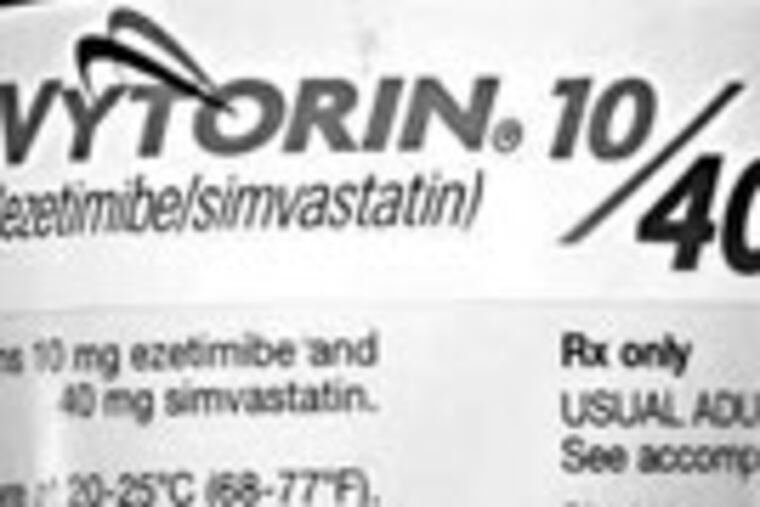
Merck's fourth-quarter results were boosted by a $7.5 billion pretax gain that it said was associated with acquiring controlling interest in its premerger partnership with Schering-Plough, which had headquarters in Kenilworth, N.J. The partnership centered on marketing the cholesterol drugs Zetia and Vytorin, large sellers despite some recent questions over their efficacy and safety.
Even though the merger closed little more than a month into the fourth quarter, Merck reported $151 million in equity income from the partnership for the quarter, and $1.2 billion for the shortened year. Its shares closed up 2 percent yesterday at $37.66.
Analysts praised Merck's commitment to achieving the financial benefits it had predicted from the merger, which it had said would result in the loss of about 16,000 jobs, or about 15 percent of its global workforce.
Yesterday, Merck said it also would cut about 2,500 vacant jobs, though it did not specify where those positions were located. Merck has said it expects few job losses in the Philadelphia area.
"People are encouraged that they're really going to be able to squeeze the costs out of this merger, even in the face of some heavy generic competition for some of their big products," said Jon Lecroy, a pharmaceutical analyst for Hapoalim Securities USA.
Robert Hazlett, an industry analyst at BMO Capital Markets, said Merck's first post-merger earnings statements offered a contrast with those of Pfizer Inc., which recently acknowledged falling short of its performance goals.
"In general, Merck's management team has a demonstrated track record of being able to wring efficiency gains out of its operations," Hazlett said in an interview.
"Dick Clark has with regularity posted efficiency gains with the previous Merck's operations, and we expect him to perform similarly well with the combined operations," Hazlett said of Merck's CEO. "It's the early days, but they have not stumbled out of the blocks."
Top-selling Merck Products
Merck & Co. Inc. and its new Schering-Plough unit reported total sales of $10.1 billion in the fourth quarter of 2009. Fourth-quarter sales for the company's top 10 prescription drugs and other products for that quarter and the same quarter of 2008:
Product (Use) Q4 2008 Q4 2009
Singulair (Asthma, allergies) $1.12 billion $1.26 billion
Cozaar + Hyzaar (High blood pressure) $881 million $955 million
Januvia + Janumet (Diabetes) $533 million $760 million
Remicade (Rheumatoid arthritis) $491 million $635 million
Zetia (High cholesterol) $558 million $614 million
Vytorin (High cholesterol) $566 million $577 million
Temodar(Brain cancer) $242 million $292 million
Nasonex (Allergies) $280 million $286 million
Fosamax (Osteoporosis) $318 million $285 million
Gardasil (HPV vaccine) $286 million $277 million
Animal health products $674 million $759 million
Consumer health products $219 million $232 million
Note: Most-recent figures include sales of Schering-Plough products for the entire quarter, not just since Merck bought Schering-Plough on Nov. 3.
SOURCES: Merck & Co. Inc., Associated Press
EndText