Appeal delays deepening of the Delaware
Deepening the navigation channel of the Delaware River has been pushed back 30 days after environmental groups appealed a federal judge's refusal to halt the start of the 102-mile project.
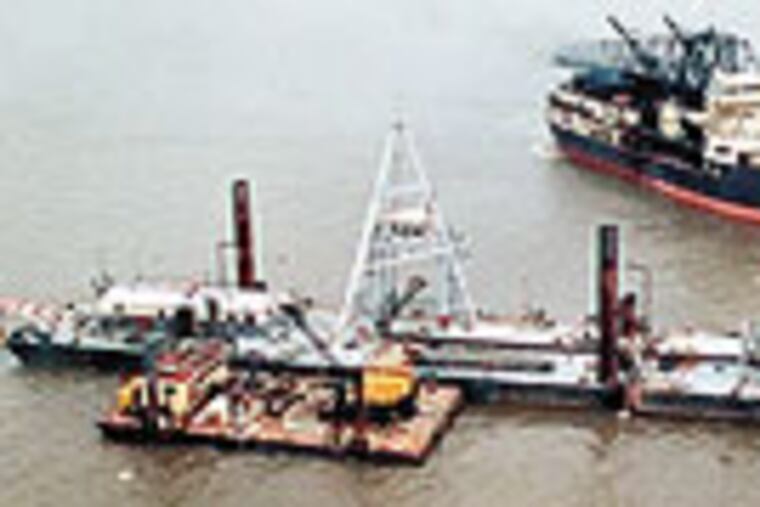
Deepening the navigation channel of the Delaware River has been pushed back 30 days after environmental groups appealed a federal judge's refusal to halt the start of the 102-mile project.
The U.S. Army Corps of Engineers extended its option to begin the deepening with the contractor, Norfolk Dredging Co., of Chesapeake, Va., from Feb. 11 to March 13, Corps spokesman Ed Voigt said.
The Corps now has the money to pay for the first phase, about $25 million from Pennsylvania, the local sponsor, and is ready to dig five additional feet in a 12-mile section off Delaware.
The Delaware Riverkeeper Network, Delaware Nature Society, National Wildlife Federation, New Jersey Environmental Federation, and Clean Water Action asked the Philadelphia-based U.S. Court of Appeals for the Third Circuit on Feb. 8 to stay or block the order of U.S. District Judge Sue L. Robinson in Wilmington, who last month ruled that deepening the shipping channel to 45 feet could begin.
The judge said the "deepening project is one that should be completed, consistent with congressional intent."
Delaware, which had sued and on whose injunction request Robinson ruled, declined this week to join the environmental groups' request to stay the District Court order.
"Delaware has not made a final decision regarding an appeal," Delaware Attorney General Joseph "Beau" Biden 3d wrote in a letter Wednesday to the appeals court.
"Additionally, the state takes no position concerning appellants' motion for a stay," referring to the environmental groups, Biden said.
New Jersey also told the Third Circuit court that it "has not made a final decision" on an appeal but that it supported the environmental groups' motion for a stay or an injunction.
Justice Department attorneys, representing the Corps, said in a 23-page filing with the Third Circuit court that environmental appellants had "failed to demonstrate they were likely to succeed on the merits" of their Clean Water Act and Coastal Zone Management Act claims, or likely to suffer irreparable injury without an injunction.
"The [district] court found that the balance of equities and the public interest favored allowing the project to proceed." The deepening could begin sometime after Feb. 26, the Justice Department said.
Meanwhile, Gov. Christie the New Jersey Department of Environmental Protection's acting commissioner, Bob Martin, yesterday expressed "outrage" that the Corps would begin without updated sediment studies, alternatives to disposing dredged sediments in South Jersey, and measures to prevent polluting the air.
"The Army Corps is using a double standard," Christie said in a statement, "applying tough criteria to protect the environment during the project to deepen the New York-New Jersey Harbor yet failing to provide the same protections to South Jersey's environment during the proposed deepening of the Delaware."
New Jersey officials said that in deepening the New York-New Jersey Harbor to 50 feet from 45 - now about half complete - the Corps updated scientific data and applied project-specific testing protocols. It also worked with the project sponsor to improve air quality. The sponsor purchased low-pollution engines for tugboats and ferries, they said.
For the Delaware River project, the Corps wants to purchase air credits from other polluters to offset smog-causing pollutants emitted by its boats and equipment, the statement said. "The Army Corps refuses to discuss options to credits or update its air-pollution analysis."
New Jersey filed a lawsuit in November in federal court in Trenton seeking to stop the project.
Environmental groups, in a 22-page petition to the Third Circuit court, contend the deepening would harm the environment and human health and economic interests and chip away at the "right of states to protect their vital interests."
Digging deeper would shift the salt line, affect drinking-water supplies and oysters, alter freshwater marshes, erode habitat and marshlands for endangered species and aquatic life, introduce toxics into the river and ecosystems, discharge pollution into the air, and increase dredge "spoils" for disposal, court papers say.
Dredging supporters, including the Philadelphia Regional Port Authority, say a deeper channel is essential to the region's economy to remain competitive with other East Coast ports, already at 45- and 50-foot channel depths, and to attract larger ships and more cargo to the river's ports.
A renewed look at the project's costs and benefits is due next month by the Government Accountability Office.