PhillyDeals: Small businesses make pitch to investors
'We've been running on fumes the past year," said Charles M. "Chip" Carter, silver-haired chief executive officer of Lap Belt Cinch, of Lafayette Hill, as he stood before capitalists yesterday, pitching for their wallets.
'We've been running on fumes the past year," said Charles M. "Chip" Carter, silver-haired chief executive officer of Lap Belt Cinch, of Lafayette Hill, as he stood before capitalists yesterday, pitching for their wallets.
Carter came downtown with other small-company hopefuls, looking for the big accelerant - cash.
Valerie Gaydos, head of the committee that runs the annual "Angel Venture Fair," says 130 small firms, more than last year, paid $250 each to apply for a chance to pitch networks of local investors from Philadelphia, York, Lancaster, Wilmington, and the suburbs, looking for firms to back with investments.
The 50 companies chosen to make pitches paid $1,000 each to present, in a ring of rooms at Morgan, Lewis & Bockius L.L.P. The favorites get to do a more intimate pitch in April.
The investors say they have handed out $16 million in the last 12 years, including $4.4 million, so far, for last year's hopefuls.
Investors - mostly former small-business owners who sold at a profit - heard from, and offered advice to, payment-system developers, distributors of "probiotic" salad dressing, and inventors of robotic stair-climbing machines.
Carter's firm sells infant car seats and belt-tighteners. Even with the firm's tight budget, he says that Pep Boys - Manny, Moe & Jack has sold $40,000 worth and Babies R Us even more, and that he has deals with Buy Buy Baby Inc. and Bed Bath & Beyond Inc.
"We expect this to be our breakout year," Carter said. The company has already burned through more than $1 million, from individual investors and the state-funded Ben Franklin Technology Partners of Southeastern Pennsylvania. "We're looking for half a million to a million" to get the seats into AutoZone Inc., Wal-Mart Stores Inc., Target Corp., and QVC Inc.
After 10 minutes, investor Michele Masterfano cut Carter off and started the questions, joined by investor Bill Moore and Ben Franklin Tech official Bob Thomson.
What's your proprietary position? Two patents. Retail price? About $40. Wholesale? About $20. And your manufacturing cost? About $10. Or less, if we can sell a lot.
And the big question: What's your exit strategy? Sell the firm to booster-seat makers. Toy manufacturers. At 10 times investors' cost. Maybe 20 times.
Polite applause, and the next hopeful took the podium.
When I left, Lap Belt Cinch was rumored to be on the short list of companies that will make it to next month's final round, along with Sterraclimb, the Princeton hump-a-box-up-the- stairs device-maker.
New Jersey has already pledged to back Sterraclimb with public money. If it can raise more on its own.
Flat, or bent?
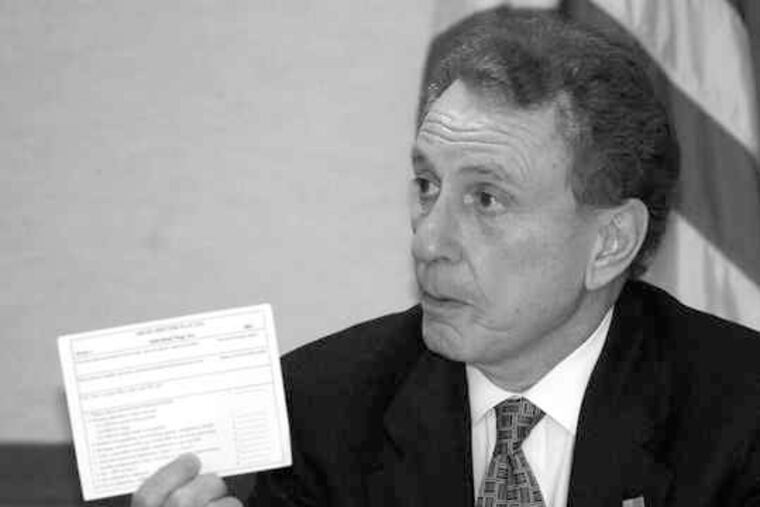
Sen. Arlen Specter is a Democrat now, but he has remained a consistent backer of the 20 percent flat tax on U.S. incomes made popular by millionaire business publisher Steve Forbes and conservative Republicans. Specter also backed a flat tax in his GOP campaign six years ago, when the proposed rate was 19 percent.
Specter laid out his thinking in a 2007 floor speech that still represents his position, aide Kate Kelly told me. Said Specter: "The flat tax is a win-win situation for America because it lowers the tax burden on the taxpayers in the lower brackets," thanks to a family exemption of $40,000. Charitable donations and home mortgages would still be deductible.
Plus, "It would allow us to slash the mammoth IRS bureaucracy of approximately 87,000 employees," not to mention paid tax preparers, freeing them for jobs "elsewhere in the government or private industry."
But this tax is only flat if you ignore another federal tax burden: The 7.65 percent we pay for Social Security and Medicare taxes on the first $107,000 we earn. You don't have to pay Social Security on income above that limit. So the higher you earn in the six-, seven- and infinite-figure range, the lower your effective payroll-tax rate.
Under the flat-tax proposal, the feds would take 28 cents of every dollar from the paychecks of people earning $40,000 to $107,000 a year.
The rich would pay less on high salaries and bonuses, since they don't pay Social Security tax on most of their income.
Specter's primary challenger, Democratic Rep. Joe Sestak, is using the math against him. Easy to see why: If the flat tax ignores Social Security and Medicare, it's not really flat. It's bent.