A day aboard the dredge Pullen
Under a cloudless sky and near-70-degree temperatures, the U.S. Army Corps of Engineers yesterday provided a peek into how the Delaware River shipping channel is dredged.
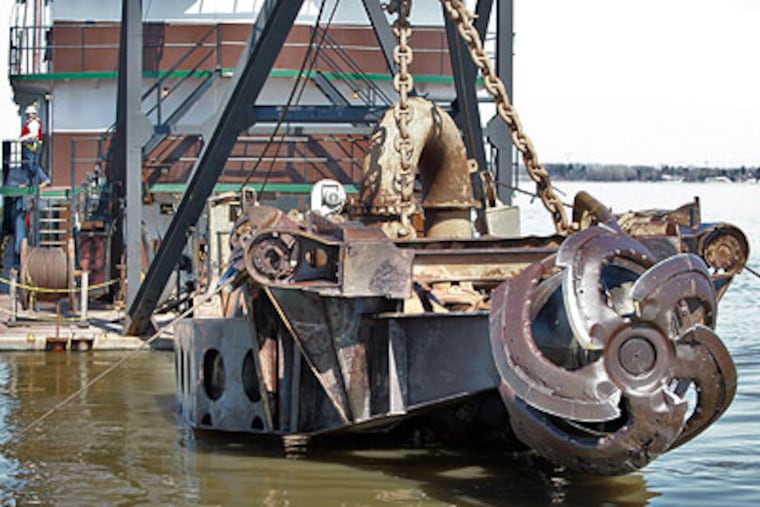
Under a cloudless sky and near-70-degree temperatures, the U.S. Army Corps of Engineers yesterday provided a peek into how the Delaware River shipping channel is dredged.
It was Day 18 of the deepening, which began March 1, in a 12-mile stretch near Delaware City, Del.
The dredging contractor and the corps provided a show-and-tell to news media on how the channel is being deepened to 45 feet, from 40 feet.
Ronnie Wyche, at the controls of a 491-ton steel dredge, swept the river bottom, digging it five feet deeper, while an underwater pump sucked 700 to 800 cubic yards of sediment an hour into pipes that run along the channel bottom to a federal disposal site on land four miles away, called Killcohook, in Salem County.
Wyche, and the 40 crew assigned to the Pullen, work in 12-hour shifts.
The 400-foot-long dredge, which costs $50,000 to $100,000 a day to operate, depending on fuel, crew, and material to be dug, operates 24/7.
The clawlike cutter at the vessel's bow churned the river floor, while a large vacuum cleaner sucked material into a floating pipe that disappears beneath the water to the 1,200-acre disposal area.
So far, the project is going smoothly, with no adverse effects to aquatic life or the environment, said the contractor and the corps.
This first area of the deepening, scheduled to be completed by early August, is the least complex of the 102.5-mile project, officials said.
"Here we haven't seen much difference in the material" from annual maintenance dredging that keeps the channel at 40 feet, said Lucas Diton, superintendent for the contractor. "We've seen some sand, a little bit stiffer material. We anticipate more course material, more rock, more gravel in deeper water."
After Norfolk Dredging Co. completes the current $34 million deepening and maintenance contract, the next section to be dug deeper is near Chester and Marcus Hook.
That work, set to begin in December, calls for blasting 100,000 cubic yards of granitelike rock, which will be taken to Fort Mifflin, said the corps' chief of operations in Philadelphia, Anthony DePasquale.
"Weather is the biggest emergency we find," Diton said. "We don't have ocean conditions, but when the wind picks up, like this past weekend, we just stay in place and pump water rather than dig, for fear of breaking something."
The material removed is taken to federal sites, where dredged material has been hauled for years, mostly in New Jersey, but also Delaware and Pennsylvania.
Some dredge deposits will be used to build wetlands and a horseshoe-crab beach at Kelly Island, and to restore a beach and build a crab-friendly habitat at Broadkill Beach, both in Delaware.
The corps will use river dredge to restore a horseshoe-crab habitat and wetlands at Egg Island Point in Cumberland County.
New Jersey and several environmental groups opposed to the deepening cite threats to the environment, lack of economic benefits, and unfair dumping in the Garden State.
Delaware, which sued to block the project, has lately been working with the corps on procedures and protocol to allow the deepening in Delaware waters to move forward.
Since 1992, the corps has tested sediment in sections to be deepened and said those samples met environmental standards of all three states.
"We are monitoring both the material being placed into the disposal area, and the water exiting back into the river," DePasquale said. "We are testing the water around the dredge to ensure that none of the sediment we are dredging is being stirred up in the river where it might disturb fish or organisms."
The corps said it was monitoring the disposal site at Killcohook to see if fish are vacuumed. "We have not seen any," DePasquale said. "In fact, in the last 20 years of our maintenance dredging, we have seen only one fish that we pulled into a disposal area, onto land."
The corps said it was following Delaware, New Jersey, and Pennsylvania fish migration and spawning directives and deepening only during certain months, adhering to environmental standards and restrictions.
Although opponents are concerned the deepening will disturb oyster beds, DePasquale said this first area of deepening had no oysters.
When deepening begins in the Delaware Bay, the corps will monitor the oyster beds "which are not in the channel, but in shallower parts of the river," he said.
"Everything we are doing in this project is to avoid oyster beds, and, in fact, create habitat down in the bay," DePasquale said.