Going public over local infant-sling tragedy
Since Feb. 20, 2009, Anthoinette Medley has been living a parent's worst nightmare. That was the day Medley tucked her 7-week-old twins into matching SlingRider baby carriers, one on each shoulder, for a trip into Center City. When she ran into a friend at the Gallery, she wanted to show off her baby boys, Nelsir and Timir Scott. But when she opened Nelsir's sling, he didn't seem to be breathing.
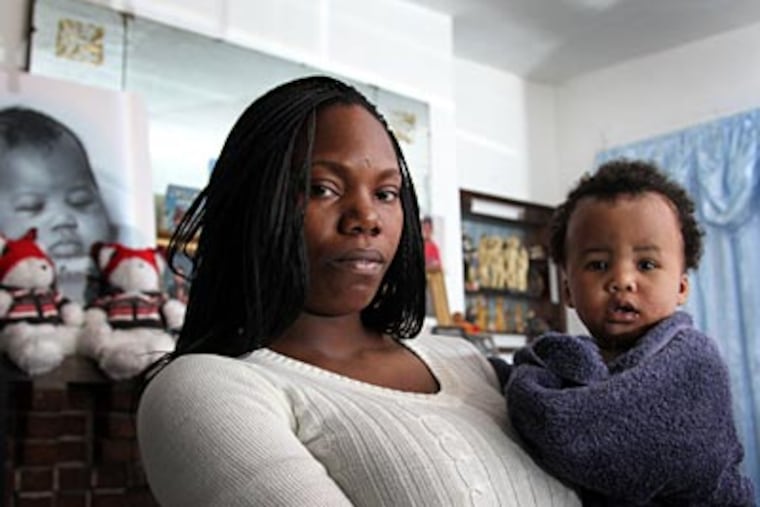
Since Feb. 20, 2009, Anthoinette Medley has been living a parent's worst nightmare.
That was the day Medley tucked her 7-week-old twins into matching SlingRider baby carriers, one on each shoulder, for a trip into Center City. When she ran into a friend at the Gallery, she wanted to show off her baby boys, Nelsir and Timir Scott. But when she opened Nelsir's sling, he didn't seem to be breathing.
Yesterday, 13 months after Nelsir's death, Medley won a small victory: Infantino L.L.C., the San Diego company that makes the SlingRider and the identical Wendy Bellissimo infant sling, said it had agreed to recall about a million of the slings sold in the last seven years at stores such as Wal-Mart, Target, and Babies R Us.
The recall came 12 days after the U.S. Consumer Product Safety Commission took an unusual step: Without naming names, the CPSC issued a general warning about the use of baby slings, saying they posed a particular risk of suffocation for infants under 4 months old.
Consumer advocates say the greatest risk appears to be associated with "bag-type" slings, in which infants can rest in a curled-up position that can restrict the flow of air through their windpipes. Another risk is that the sling material itself can block the baby's mouth and nose.
The CPSC said it had identified 14 deaths in baby slings over the last 20 years, including a dozen of infants younger than 4 months. It said that the risk was greatest for babies with weak neck muscles and that many who died had been premature "or had breathing issues such as a cold."
Yesterday, the CPSC said it knew of three such deaths in the slings recalled by Infantino, including a 3-month-old in Cincinnati and a 6-day-old in Salem, Ore.
In a statement announcing a "voluntary replacement program" for the carriers, Infantino president Jack Vresics said the company's "top priority is the safety of infants whose parents and caregivers use our products."
Vresics said Infantino had been working with the CPSC to develop safety standards for slings, which the agency required earlier this year.
Even before the CPSC's warning, consumer advocates had raised questions about the dangers of slings, and about the Infantino sling in particular.
In November, Consumer Reports sent a letter to the agency citing two deaths and said it believed the SlingRider "poses a substantial product hazard" and should be considered for a recall. It repeated its recommendation after the third death, on Dec. 23.
Medley, whose name was withheld by the Philadelphia Medical Examiner's Office, said she had tried to warn other parents about the risks of baby slings through a Facebook page. She decided to speak publicly after the CPSC issued its general warning March 12.
"My theory was that it was the carrier" that caused her son's death, Medley said in an interview. "Unfortunately, more babies had to die before my theory could be proven."
Infantino did not respond to questions yesterday, except to direct attention to its replacement program.
"Consumers should stop using the recalled slings immediately and contact Infantino to receive a free replacement product," the company said on its Web site. (To contact Infantino, call 1-866-860-1361 between 11 a.m. and 7 p.m., Philadelphia time, on weekdays.)
Alan Feldman, a Center City lawyer who represents Medley and is considering filing a lawsuit on her behalf, criticized Infantino for offering a replacement product - another carrier, a shopping-cart cover, or an activity gym - rather than offering refunds to have the slings returned and taken out of circulation.
"I'm concerned that they may be kept in homes and may be used by other parents," Feldman said.
He also criticized Infantino's packaging, which he said claimed the slings met specific safety standards.
"That's simply untrue - there are no safety standards that apply to this product," he said.
Medley, who said she had struggled with depression since Nelsir's death, said she was speaking out to warn other parents about the risks of carrying young babies in Infantino and similar slings.
"I still question myself over that day - whether I could have done something different," she said. "You try to protect your child as much as possible. You want to protect them against all odds."