Brady talks with union leaders in Temple strike
As the strike at Temple University Hospital continued into its second week, Rep. Bob Brady met Monday with a dozen leaders of the union.
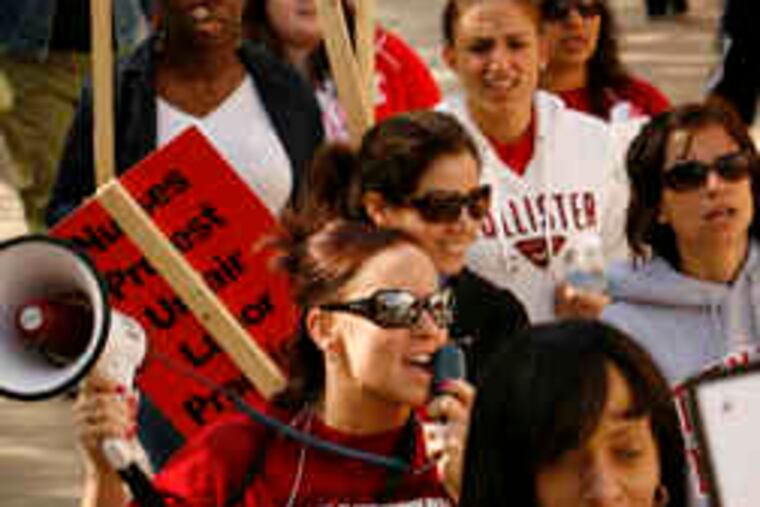
As the strike at Temple University Hospital continued into its second week, Rep. Bob Brady met Monday with a dozen leaders of the union.
Several members of the hospital's board had reached out to Brady and asked him to meet with the hospital's management, said a spokesman, Ken Smukler, who works with Brady as a political consultant.
The Democratic congressman, a union carpenter, agreed to meet with management but told the board members he would need to talk to the union first, Smukler said.
Brady "is learning about the situation," said Bill Cruice, executive director of the Pennsylvania Association of Staff Nurses and Allied Professionals, the union that represents 1,500 nurses, therapists, social workers, and others at the hospital.
The meeting with Brady lasted about an hour and took place around noon at the union's satellite office on Park Avenue near the North Philadelphia hospital.
"We have been keeping all elected officials fully briefed on the labor situation at TUH," hospital spokeswoman Rebecca Harmon said Monday.
Union members plan to hold a rally outside the hospital Tuesday at noon.
There have been no bargaining sessions since well before the strike began at 7 a.m. Wednesday.
Employees had been working under the terms of a contract that expired Sept. 30. At issue are wages, benefits, scheduling, tuition reimbursement for employees' children, and a work rule that would prohibit workers from making "disparaging" comments about the hospital.
"We remain in daily contact with the mediator, but there are no new talks scheduled," Harmon said. She said the hospital remained open and was continuing to provide all services.
The hospital has hired replacement workers, flying them in from around the country and putting them up in area hotels.
Meanwhile, employees who belong to other unions at the hospital are continuing to work.
However, said the leader of one of the unions, they have no intention of abiding by a memo Sandy Gomberg, the hospital's interim executive director, sent to union employees the day after the strike began.
The memo reminded workers that their contracts do not allow them to "condone or lend support" to the strike, "both while on the job and off-duty."
It goes on to say, "to avoid jeopardizing your employment at TUH, we recommend you do not engage picketers in any way as you enter and exit the hospital. If you are found to have engaged or participated in any way with strike-related activities, you will be subject to discipline - up to and including termination," the memo said.
"Our members aren't going to abide by that. They're going to talk to whomever they want. Our members won't be bullied by anybody," said Henry Nicholas, president of District 1199C of AFSCME's National Union of Hospital and Health Care Employees.
The union represents 610 Temple nursing assistants, operating-room and labor-and-delivery technicians, clerical staffers, and environmental-service workers.
"We'll tell them to go fly a kite," he said.
Nicholas said that Edmond F. Notebaert, chief executive of the Temple University Health System, had joined two area legislators in Nicholas' Center City office last week to discuss the hospital's management-labor dispute.