Designing venues with vibes for the casino industry
Floss Barber goes through a mental ritual before creating one of her signature casino restaurants. It's a process that served her well when she set out to design dining spaces at Sands Casino Resort in Bethlehem and Rivers Casino in Pittsburgh.
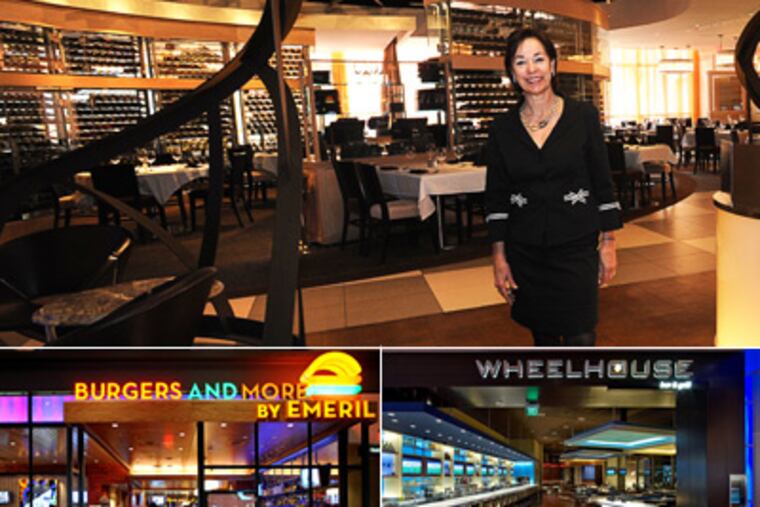
Floss Barber goes through a mental ritual before creating one of her signature casino restaurants. It's a process that served her well when she set out to design dining spaces at Sands Casino Resort in Bethlehem and Rivers Casino in Pittsburgh.
"You must psych a city," said the Philadelphia interior designer, chief executive officer of Floss Barber Inc. "You must feel the pulse of it."
Last year, Barber "psyched" the City of Brotherly Love, where she is currently designing SugarHouse Casino, including all of its food and beverage venues and its gaming floor.
Her assessment: "Philadelphia is a blue-collar, gritty city," she said. "You have to do something quirky - something it can call its own.
"If the brand, marketing goal, and vision are not in sync, you send a mixed message to the customer, and it's wasted energy," Barber said. "You end up needing more signs and staffing to overcome the disconnect."
Her methodical approach and uncompromising attention to detail have put Barber in high demand in an industry in transition.
These days, casinos in resort towns such as Las Vegas and Atlantic City are pushing their restaurants, shopping malls, and hotel rooms more than ever to draw business as increased competition from nearby states eats into their overall gaming revenue.
Last year, non-gambling attractions accounted for almost 62 percent of total revenue for the Las Vegas Strip's 38 casinos, according to the Nevada Gaming Control Board. Ten years ago, that figure was 54 percent.
The paradigm is shifting, although not as quickly, in Atlantic City, too. Nongaming attractions now account for about 15 percent of total revenue, the New Jersey Casino Control Commission said. In 2000, 8.4 percent came from those sources.
"People are more passionate about food and wine than ever," said celebrity chef Emeril Lagasse. "Our belief is that a restaurant has to have heart, soul, and hospitality."
Lagasse and Barber hit it off immediately after they were introduced by Sands Bethlehem Casino president Robert DeSalvio two years ago. Floss worked with DeSalvio in the mid-1990s, when he was vice president of marketing at the Sands Hotel Casino in Atlantic City and she redesigned its rooms.
"Her work is fabulous," DeSalvio said in an interview last week at the Sands in Bethlehem. "Emeril wanted a certain look and a certain feel for his two restaurants here."
Barber landed both gigs: Chop House, a midpriced steakhouse, and Burgers and More, a brightly lit burger joint.
Chop House is enclosed by a pricey, crystal-clear glass that heightens its transparency to the casino floor.
"I wanted interaction between the two," said Barber, "so customers don't forget about the other."
The restaurant, where a prime steak costs $32 to $40, is done in curvilinear forms and a palette of vanilla and dark brown, with softly lit chandeliers and flooring that combines leather and a porcelain checkerboard pattern "to create different energy points and to reflect a timeless classic design," Barber said.
Burgers and More features a wood-slat ceiling, hardwood floors, orange brick, and an open kitchen. Patrons are seated at laminated-wood French park benches and polyurethaned tables for durability. A grid of windows looks out onto the casino floor.
"The steel guy's lunchroom" was her original vision for the burger place, Barber said. Later, she went for the middle ground between retro and avant-garde.
"Her team really hit it out of the park," Lagasse said. "She understood the vibe we were going for."
The customer wants to eat, be entertained, gamble, and be able to buy something, Barber said. "The name of the game is to keep them on the property - whichever way you can."
These days, word of mouth about a restaurant alone can draw newcomers to a casino - as it did Dawn Schaffer, 42, of Lower Mount Bethel, Pa.
Schaffer visited the Sands in Bethlehem for the first time last week with her sister, Kathy Kyne, 45, and her mother, Rose Border, 62. The trio lunched at Burgers and More.
"I usually don't go to casinos. Today, we came to eat," Schaffer said between bites of her $14 crab burger, which came with onion rings.
The decor reminds her of the city's steel era, Schaffer said, and goes nicely with the overall casino design blending the past with the present.
Barber, 61, started her business in 1986, opening a studio at the Pier at Penn's Landing under the big No. 3 sign and doing tenant planning for real estate companies. She moved on to designing Center City law firms (Saul Ewing L.L.P., among others) and corporate offices.
In 1992, she designed her first restaurant, Girasole, first located on Locust Street and later on Spruce. That was a turning point, she said: "I got more acclaim for that than 50 other corporate jobs."
Two years later, she began working at Atlantic City casinos, designing rooms for new hotel towers at the Sands, Harrah's Resort, and Showboat. She remodeled the high-roller suites at the Atlantic City Hilton and public spaces at the Trump Taj Mahal.
More gaming work came her way, in Florida and at Dover Downs in Delaware. But designing casino restaurants really appealed to her.
"You're designing for the traveling public," Barber said. "It's more show biz and theater."
Since 2003, Floss Barber has had its headquarters in a 4,000-square-foot office space at Academy House near Broad and Locust Streets. The company has a staff of 10, including two architects. She counts French interior designer Andrée Putman, who designed the Morgan Hotel in New York City, as her idol.
"The designer is a listener to all of these parts and components, which, when they work together, results in a winner," Barber said in a recent interview at her office, where she showed sample materials for SugarHouse Casino, set to open in the fall.
In SugarHouse's design, street (gritty, urban) meets sweet (winning, glamorous), and "balancing those two energies." Her mandate, Barber said, is to make the casino "unique, interesting, warm, comfortable, and easy to maneuver, with some aspect of it being 'wow.' "
With any project, "maintaining the design all the way to the end" is the biggest challenge, she said. "People want to value-engineer" and substitute materials that are less expensive.
She rose to that challenge in Pittsburgh, said Greg Carlin, CEO of the Rivers and SugarHouse casinos, both of which are owned by Chicago billionaire Neil Bluhm.
At Rivers' Wheelhouse Bar & Grill, floor-to-ceiling windows and two outdoor decks overlook Heinz Field, home of the Steelers, and the Ohio River.
"Floss and her team brought a strong vision and forward thinking . . . and delivered a successful contemporary sports bar, which has proved to be one of our casino's most popular venues," Carlin said.
Bill Conrad, 52, a postal worker from North Hills, a suburb of Pittsburgh, who recently had dinner there with his wife, agreed.
"For something that sits in the middle of something very expensive [the casino floor], it's reasonably priced and has very good food," said Conrad, who was finishing off a beer at the bar and watching the Penguins on the multiple TV screens.
Later, he headed off to join his wife for a little slot-machine action.
For more images of Floss Barber-designed restaurants, go to http://go.philly.com/barber EndText