Green Pa. business eyes greener pastures abroad
In a Western Pennsylvania town, a defunct lead-acid battery plant found new life, its success cited by Gov. Rendell as proof of the green economy's potential for powering a manufacturing revival.
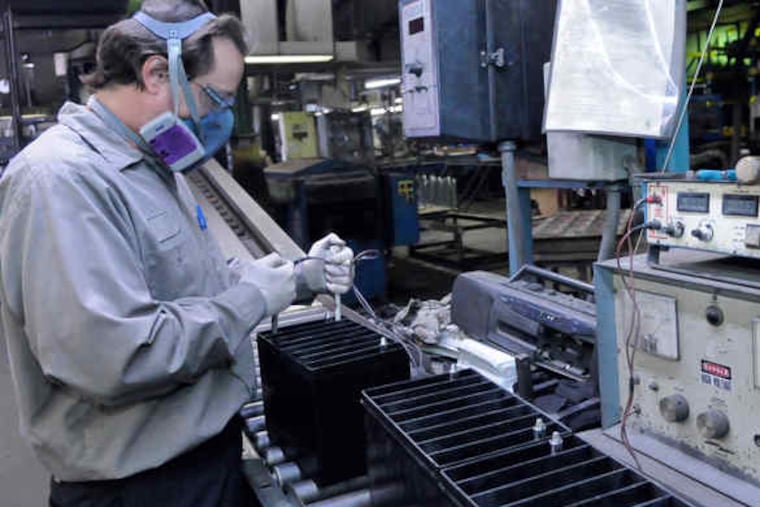
In a Western Pennsylvania town, a defunct lead-acid battery plant found new life, its success cited by Gov. Rendell as proof of the green economy's potential for powering a manufacturing revival.
Yet just four years after $2 million in state aid helped Axion Power International bring the former New Castle Battery operation back from the dead, the company now says it might have to leave not only Pennsylvania, but the United States, to realize its full business potential.
Axion's more environmentally sensitive product line, lead-carbon batteries, are in heavy demand from European automakers under pressure to meet stricter emissions standards by 2015.
To meet that demand, which could mean orders for millions of batteries a year, Axion needs a $52 million production-line expansion, said chief executive officer Thomas Granville. The company does not have the money for it.
Its application for a $26 million stimulus grant from the U.S. Department of Energy did not make the cut for what a spokeswoman described last week as a "significantly oversubscribed" program.
That is a familiar scenario as U.S. industries eager for a piece of the emerging green economy encounter a competitive, and very tight, funding environment.
Indeed, as Axion is contemplating foreign offers of financial assistance - which come with the condition that the company relocate - a legislative debate rages on in Harrisburg over how much aid is appropriate to help fledgling alternative-energy companies get their footing.
"It's those kinds of innovative companies that are really transforming Pennsylvania's manufacturing economy and creating the green-collar jobs that are going to define this century," Rendell spokesman Michael Smith said.
Though he asserted that talk of Axion's leaving was premature, Smith said that the state would continue to do what it could to help keep the company, which has 59 employees and posted nearly $2 million in revenue last year.
What would help, Smith added, is passage of long-stalled legislation that would significantly increase Pennsylvania's requirements for use of alternative energy. He noted that Axion also makes batteries that can store energy generated by windmills and solar panels.
But House Bill 2405, introduced last month by State Rep. Eugene DePasquale (D., York), will face significant opposition, as its predecessor, House Bill 80, did all last year. The Pennsylvania Chamber of Business and Industry has said it is against government's creating a market for just certain types of energy.
At the federal level, stimulus funds earmarked for clean-energy initiatives have fallen far short of demand.
Energy Department spokeswoman Jen Stutsman said the $2.4 billion program from which Axion hoped to get the cash to expand its production line attracted applications seeking "four times the amount we had" to give. Grants went to 48 projects, all involving electric cars - the type of vehicle Axion's batteries are made to power.
"This was a group of highly competitive projects," Stutsman said, suggesting that applicants such as Axion were no less worthy. "It was just a matter of being oversubscribed and not having enough funding."
She dismissed implications that the stimulus was inadequate, saying it was always intended as "a down payment for our clean-energy future but won't get us all the way."
Which is why Axion, profiled in an Inquirer special report in August on the greening of Pennsylvania's economy, now finds itself considering offers from abroad.
"This isn't a threat or anything of the kind," Granville said last week. "But we are being realistic."
The most aggressive overture has come from Rusnano, a state-owned Russian corporation that invests in nanotechnology, he said. It has offered $50 million to partner with Axion if the New Castle, Pa., company moves to Kaliningrad.
German car manufacturers he would not identify also "would like us to locate over there, close to their factories," Granville said. Chinese government officials, too, have visited the Axion plant.
Georgia is another option - Axion's partner, Exide Technologies, has a manufacturing presence there, he said.
Axion would prefer to remain in Pennsylvania, Granville said, but that is not possible without financial help for an expansion that likely would boost its workforce to 500.
"We anticipate we're going to have to make some decisions by the end of summer," he said.
RoseAnn Rosenthal, president and chief executive at Ben Franklin Technology Partners of Southeastern Pennsylvania, a Philadelphia economic-development agency, said international-partnership opportunities for alternative-energy companies would become common.
"Our ability to retain the companies is really going to depend on the business environment that enables them to grow and prosper," she said.
Government needs to play a role, Rosenthal said, because "it's hard for these companies to secure totally private financing," largely because of the technology and market risks associated with their work.
Keeping Axion has lawmakers' attention.
"I believe it is critical that government programs . . . work to keep technologically innovative industrial manufacturing businesses within the United States, in addition to spurring innovation and cultivating new jobs," U.S. Sen. Bob Casey (D., Pa.) wrote in a March 10 letter to Energy Secretary Steven Chu. He urged Chu to "give Axion's . . . grant application fair consideration" for remaining stimulus funds.
On Thursday, the Energy Department's Stutsman said, "We are continuing to work with them to see if additional funding would be available, but at this point there aren't other [programs] under which it would fit."
Casey noted that the largest initial markets for Axion's lead-carbon batteries were in Europe, where automakers were working under stricter environmental-protection regulations than those in place in the United States.
"By helping Axion serve the European market now, [the Energy Department] not only helps establish an export flow," Casey wrote, "but more importantly, helps position the company to serve American manufacturers as they move toward greater compliance with higher [fuel-efficiency] requirements by 2016."
Last month, Granville came to Philadelphia to make a personal appeal to Chu, in town to visit the Energy Coordinating Agency Green Jobs Training Center. While here, he also solicited help from U.S. Sen. Arlen Specter (D., Pa.). An aide said Specter's office was familiarizing itself with the issue.
Rendell also sent the Energy Department a letter in support of Axion's application.
Granville, asked whether he would feel guilty moving out of a state that had helped with the company's rebirth, gave a mixed response.
"Personally, absolutely," he said. "To me, loyalty runs deep." Then again, he has a responsibility to see that the company does not "miss the wave" of demand the European auto market will soon create for lead-carbon batteries.
"We're a public company," Granville said. "We have to do what's best for the shareholder."