A large-scale turnaround
It was party night at the Aria, and David Murray was in the thick of the boisterous crowd at a spacious condominium 33 stories above 15th and Locust Streets.
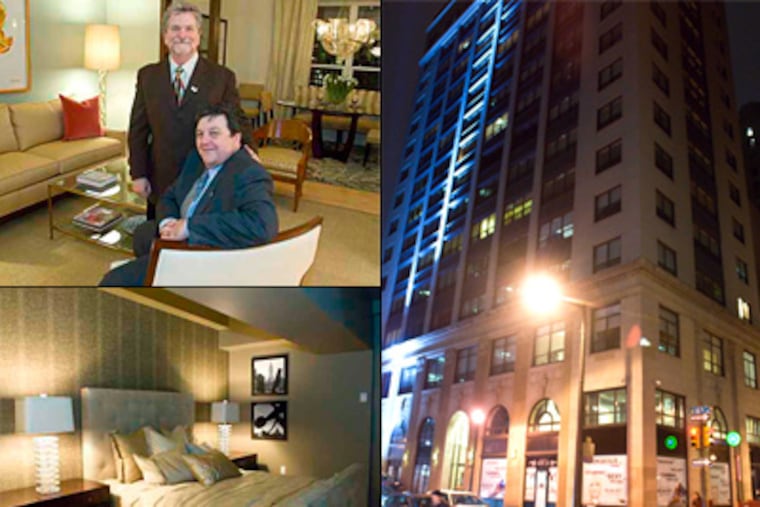
It was party night at the Aria, and David Murray was in the thick of the boisterous crowd at a spacious condominium 33 stories above 15th and Locust Streets.
Leaning against a wall, an empty plate in one hand, Murray raised his voice so he could be heard above the din, racing to finish his thoughts before a string quartet a few feet away resumed playing.
"I never lost faith in this building," he said.
Not even when Urban Residential L.L.C., of New York - the developer that sold Murray and his wife, Carolyn Jantsch, their condo in 2007 - defaulted on its loans, ultimately sending the 105-unit Aria into receivership for a year.
"I certainly never thought of selling," Murray said. "We were so happy with what we bought and the location that we've just settled on another unit - we've upgraded to a bigger one and are renting the first."
What got them through, he said, was the "sense of community" they felt in a building only half-full, and not completely finished.
If Richard S. Oller and Jeffrey Goldstein had heard the conversation, they likely would have been even more pleased than they seemed that night, when they shook scores of hands and led tours of what Oller called their "fabulously exciting" venture.
What that venture has done, real estate observers say, is just this side of miraculous: turn around a Center City residential project that, for months, looked doomed.
At a sheriff's sale in November, after prolonged and often difficult negotiations with the project's lender, IStar Financial Inc., GoldOller Aria Partners L.L.C. acquired for $6 million the 50 unsold condos and the commercial spaces at the former Lewis Tower building at 1419 Locust St.
"I was familiar with the property and the fact it was in receivership," said Oller, who is chairman of Multifamily Management Services Inc., of Philadelphia and New York City, which manages 30,000 apartments on the East Coast, and of Madison Parke, which provides those services to the Residences at Two Liberty Place.
The reason for his familiarity: The Wentworth Group, a property-management group Oller founded and later sold, was managing the Aria for U.S. Equities Realty L.L.C., of Chicago, the court-appointed receiver.
Despite the housing market's slowdown and the fact that none of the Aria's units sold while it was in receivership, 21 of the 50 condos Gold/Oller acquired sped to settlement starting Jan. 4.
The total sold now stands at 28.
"Right now, we are selling two a month without marketing and advertising, and at that pace, we should be finished by the end of the year," Oller said.
"We haven't been in a hurry to sell out, so there hasn't been a need for ultra-deep price discounting," he said. "We priced it to the market. Philadelphians are sophisticated buyers. They know what the right price should be."
Before receivership brought sales to a halt in January 2009, 55 units had been purchased at prices some say were too high for the market. That alone made the Aria look like a good investment to Oller and Goldstein.
Some investors may find themselves shut out of the market by tightfisted lenders. Oller's fiscal conservatism meant he had the money to buy the Aria's assets without going to the banks for much beyond some "low-leverage loans."
"It was a good place to bring our resources," he said.
Many observers of the Center City real estate scene say they think the Aria's original developer was among the "last to the party," as Prudential Fox & Roach's Mark Wade put it, and therefore asked more for the units than the 2008 market would bear.
Oller said he and Goldstein brought down prices at the Aria by almost one-third. Units now range from $320,000 to $1.5 million.
"[The] price adjustment has been in line with what today's market has suggested and puts the building in a new light as far as attractiveness and salability are concerned," said Wade, who has brought some of his clients in to look at the units.
Despite the financial problems Urban Residential endured, "the condos were in good condition," Oller said, "and they had done a great job on the infrastructure."
Gold/Oller did some "cosmetic improvements" in common areas such as the lobby and the fitness center and gym, as well as adding a lounge for the residents' use, and relandscaping the front of the building.
Oller also brought in a new "customer-oriented" staff from Madison Parke.
The first priority was the existing owners: Murray, Jantsch, and others who had spent almost a year with the building in limbo.
"We began by introducing ourselves, then listened to the residents and addressed their concerns about the property," Oller said. "The residents are our number-one asset. If they are happy, they are our best sales tool."
Given the uncertainty of receivership, lowering prices did not seem to be a major concern to the owners, he said. "At the end of the day, it will be fine. As the building takes in its second breath of life, values will rise as the economy heals."
The Aria venture has gone so well, GoldOller is looking to invest in other distressed buildings as rental apartments, especially in Philadelphia.
"I'm a historic suburbanite who has become a city snob," Oller explained.
Pickings are slim right now, but that does not bother Oller much.
"We find that a lot of lenders these days are willing to work with developers who have to deal with a slower market," Oller said.
"I think it is great that lenders want to do that."