The road to overhaul's final approval
All along the way, the White House took a hands-on approach with legislators.
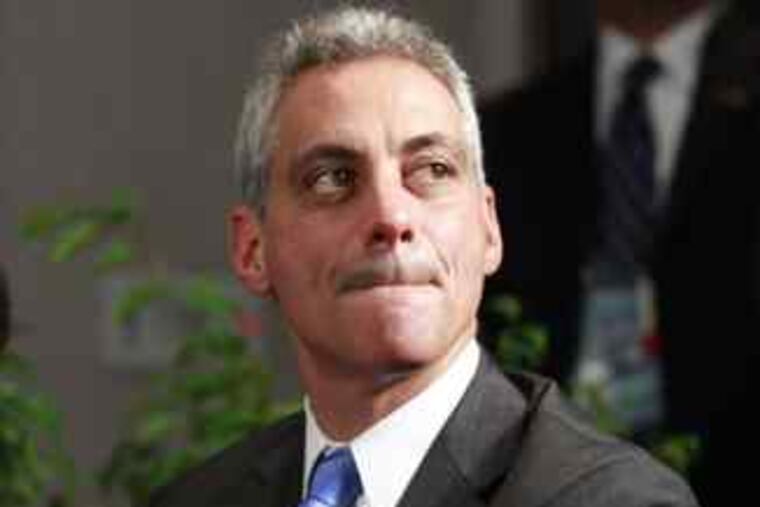
Three days after congressional lawmakers completed negotiations on the financial-overhaul bill last month, Rahm Emanuel called an emergency meeting of top administration officials in the White House's Roosevelt Room.
The deal was unraveling as three Senate Republicans whose votes were needed for passage were balking at a $19 billion fee to be imposed on banks. So Emanuel, President Obama's chief of staff, needed a new way to help pay for the legislation.
Among the options offered by Treasury Secretary Timothy Geithner: Wind down the $700 billion bank-bailout fund Congress set up in 2008, to save billions of dollars and end a program unpopular with voters.
"I don't want to hear anything else," Emanuel said, according to people in the room. "That's it. Just do it."
The finance bill, which Congress sent to Obama on Thursday, benefited from key elements lacking in the yearlong health-care debate. Among them: a more active White House role, and two Democratic lawmakers with a combined 65 years in Congress who steered the bill through with little Republican backing.
The effort was also boosted by public anger, stoked at a crucial moment by a government lawsuit against Goldman Sachs Group Inc., that overcame an industry lobbying blitz.
"Public opinion kicked big money's [butt]," said House Financial Services Committee Chairman Barney Frank (D., Mass.), one of the two main legislative architects of the bill, along with Senate Banking Committee Chairman Christopher J. Dodd (D., Conn.).
As a result, the toughest set of market rules in seven decades will soon become law. And Goldman Sachs on Thursday agreed to pay $550 million and change its business practices to settle the suit, which alleged that the firm misled investors on securities linked to subprime mortgages.
The overhaul legislation mirrors a plan Obama proposed in June 2009, based on a 90-page white paper drawn up by White House and Treasury officials.
It creates a consumer financial protection bureau with independent authority to write and enforce rules for banks, sets up a council of regulators to police financial companies, and establishes a mechanism to wind down failing firms whose collapse would roil markets.
The White House suffered some setbacks, such as the exemption of auto dealers from consumer agency supervision.
"Nobody here is happy about that," said Diana Farrell, deputy director of the White House National Economic Council.
Also, the overhaul won't shrink banks deemed too big to fail, industry leaders said, and it leaves largely intact a financial industry dominated by six banks with more than $9 trillion of combined assets. And rather than prohibit federally insured banks from trading complex securities called derivatives or investing in hedge funds and private equity funds, the law just limits such activity.
Still, the overhaul gives Obama an opportunity to make the case as November's congressional elections approach that he took on an industry that brought the economy to the verge of collapse, aides said.
Other key players shaped the bill. Dodd, a Connecticut Democrat, singled out Sheila Bair, chairwoman of the Federal Deposit Insurance Corp.
She pressed for new FDIC authority to liquidate "systemically important" financial firms and collaborated with Sen. Susan Collins (R., Maine) on an amendment to require big banks to meet stricter capital standards.
Throughout the process, White House officials took a hands-on approach with lawmakers.
As House and Senate negotiators went into conference last month, Emanuel, Dodd, and aides met in Frank's Capitol Hill office to set priorities for the talks, with Game 7 of the NBA finals airing on a flat-screen TV in the background.
With the game continuing and the meeting over, Emanuel and Dodd headed to Tunnicliff's Tavern nearby, where they watched the Los Angeles Lakers rally to defeat the Boston Celtics and win the title.
It was Obama whose role was often central. On March 24, the day after he signed the core of the health-care overhaul, the president met at the White House with Dodd, Frank, and other officials to determine how strongly Republicans would oppose the finance bill.
The legislation, which the House initially approved in December, had just emerged from the Senate Banking Committee without Republican support, and the policymakers were concerned they would have to make "all kinds of compromises," Frank said in an interview this week.
Obama, relaying a recent conversation with a Senate Republican leader, allayed those concerns. While that Republican leader would oppose the Democrats' efforts, he would not fight as hard as with health care to try to block it, Obama told the group.
Dodd reflected that newfound confidence after the meeting: "The outcome there, I think, has strengthened our hand in reaching out to people who would like to be part of the solution," he told reporters.
Senior White House adviser David Axelrod, White House communications director Dan Pfeiffer, and press secretary Robert Gibbs started a media campaign, using Obama's April 17 weekly radio address to focus on regulations and sending advisers, including National Economic Council director Lawrence Summers, to the airwaves.
The timing coincided with the SEC's April 16 announcement of the lawsuit accusing Goldman Sachs of fraud tied to derivatives.
Democrats capitalized on the momentum when the suit was announced. Obama gave a speech in New York on financial regulations and called on the industry to back his efforts.
The pressure began to wear on Republicans, who had been holding off Democrats' attempts to begin considering the bill on the Senate floor. In late April, Collins, the Maine senator, told her colleagues in a meeting that she could not keep voting against efforts to start debate.
That cleared the way for a deal that allowed lawmakers to begin debating and amending on the legislation.