PhillyDeals: Despite economy: Pilot Freight is growing
The U.S. economy is still weak, but Pilot Freight Services, based in Lima, Delaware County, says its shipments from U.S. distributors, manufacturers, and retailers are up sharply.
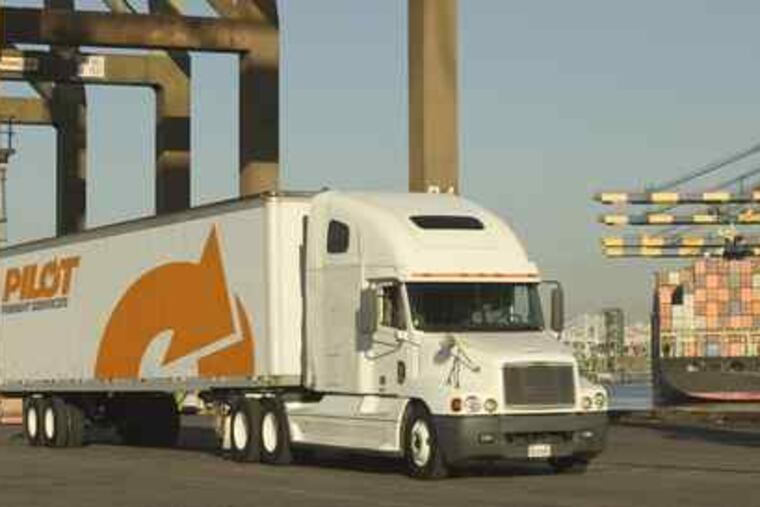
The U.S. economy is still weak, but Pilot Freight Services, based in Lima, Delaware County, says its shipments from U.S. distributors, manufacturers, and retailers are up sharply.
Sales rose 28 percent, to $95 million, for the quarter ended June 30. So far in July, "We're growing at the same clip" - unlike most summers, when sales slow, says chief executive officer Richard G. Phillips Jr.
That's double the increase reported for the past three months by FedEx Corp.'s U.S. freight business in June.
Phillips credits Pilot's status as a family-owned company big enough to handle heavy equipment but small enough to fill special orders - move an MRI machine from a Chicago warehouse to a Philadelphia hospital, for example - and still make money. "We hired through the recession. We knew it would end, so we used it to grab people, and market share," he told me.
By contrast, "The publicly traded companies were laying off in droves," he said, to avoid showing big losses that could drive down share prices.
Pilot's largest client is General Electric Co. Others include Philips Electronics, Dell Inc., Best Buy Co. Inc., Ingersoll-Rand Co. Ltd., medical-equipment sellers, online retailers, and U.S. military bases sending heavy equipment to the wars in Iraq and Afghanistan.
Pilot's chairman is Phillips' father, pugnacious West Philly-bred, prosecutor-turned- union-lawyer Richie Phillips, who made headlines leading the failed 1999 walkout of Major League Baseball's umpires union.
What's the connection? "Pilot handled the Major League baseball umpire gear," John Hill, the firm's head sales executive, recalled. "Umpires would tell him [Richie Phillips], 'There's this company in Philadelphia that's amazing. You end at midnight at Fenway Park in Boston, you have to get your trunks to Comiskey in Chicago for the next day's game, they can do it.'
"So Richie knocked on their door, and the owners, Tom and Bill Edwards, said, 'We could use a lawyer.' " Phillips picked up their legal work, raised money to buy Pilot from the Edwardses in 1996, and turned it profitable by franchising territories to local managers.
The younger Phillips joined Pilot in the mid-2000s after six years as a lawyer trying national security cases for the U.S. Justice Department. Earlier he served as counsel to Sen. Ted Kennedy (D., Mass.) and to Sen. Patrick Leahy (D., Vt.). He's been CEO since 2007. His sister, Stephanie, is chief marketing officer.
Unlike UPS Inc. or FedEx, Pilot doesn't own its planes. Instead, it arranges space on scheduled and charter flights. The company and its franchisees employ 2,000 at 65 U.S. facilities, including 150 at three Philadelphia-area offices.
Pilot's Hong Kong office is among the fastest-growing outposts of a Philadelphia-area company, that city's U.S. trade representative, Donald Tong, told me last year. Another office is planned in Europe.
Sell off
Three Philadelphia-area banks are among the seven U.S. lenders most likely to attract buyers in "a wave of bank consolidation" over the next 18 months, analyst
Christopher McGratty
and his colleagues at Wall Street bank-advisory firm
Keefe, Bruyette & Woods Inc.
told clients in a recent note.
The local banks on Keefe Bruyette's "takeover list" include Abington Bancorp Inc., Susquehanna Bancshares Inc., and Wilmington Trust Corp. These banks have "legacy asset" issues (bad loans), but also "attractive" customers and "strong" fee income. That makes them easier for buyers to digest than the more troubled institutions the Federal Deposit Insurance Corp. is trying to unload.
Who's buying? McGratty names PNC Financial Services Group, Pennsylvania's largest bank, North Carolina-based BB&T Corp., and U.S. Bancorp, as likely buyers.
What about past serial acquirers Bank of America Corp. and Wells Fargo/Wachovia? Not likely, says McGratty: They're now U.S. government-certified as "too big to fail" and likely to run afoul of President Obama's bank-reform law if they keep buying more.