HELP program now needs help
It is running out of cash to allow low rates for energy-efficient home repairs.
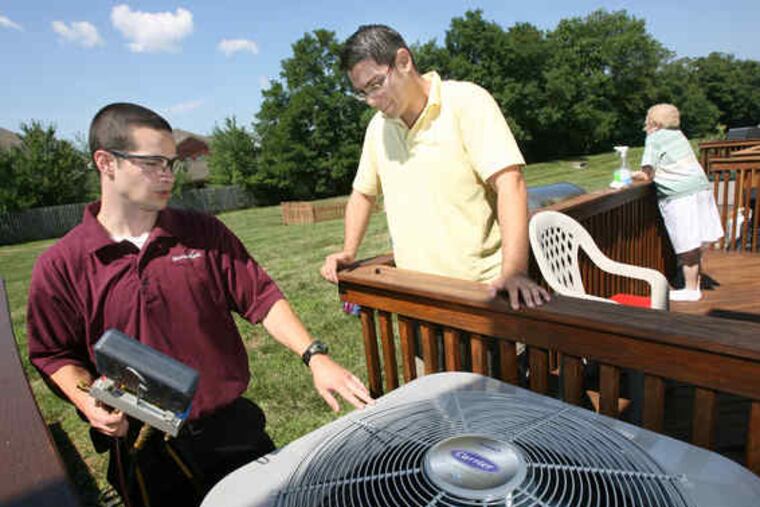
This is a story about a business whose aggressive growth can, in large part, be explained by a simple truism:
When the sickening discovery is made that the furnace is dead, typically a homeowner's first call is to a contractor, not a lender.
From that observation, lender Peter J. Krajsa set out to transition what had been his family's mortgage business into one offering financing for energy-efficient heating and cooling systems. Given what he had deduced about human nature in a home-improvement crisis, his plan was not to build a following with sales pitches to consumers, but rather to contractors.
The goal was to educate them on what was then a new financing alternative to what homeowners usually resorted to when given the crushing news that a heating or air-conditioning system was a goner - a credit card or a home- equity loan.
Krajsa figured that if contractors were perceived as well-informed and reliable by their customers, they could effectively steer them not just to new comfort systems for their homes, but also to the low-interest loans Krajsa's company was offering to help pay for them. But the systems had to be energy-efficient.
His hunch appears to have been sound.
AFC First Financial Corp., of Allentown, established by Krajsa's father, John, in 1947, now issues between 400 and 500 energy loans a month, and expects to have a total portfolio valued at close to $37 million by the end of this year.
AFC First's monthly volume is up from 100 loans in 2006, the first year of a partnership with Pennsylvania that has cast the company into a national leadership role on energy-efficiency lending. It is a niche that recession-squeamish banks by and large still avoid.
AFC First's innovative partnership is with Pennsylvania's Treasury and Environmental Protection departments and the Pennsylvania Housing Finance Agency.
Together, their Keystone Home Energy Loan Program, or HELP, had issued 7,100 loans totaling $54 million through June for heating, cooling, and weatherization improvements. Geothermal systems and whole-house audits will soon qualify for HELP loans, too.
Yet, as other states begin to copy HELP, with the assistance of AFC First as program manager, Pennsylvania's HELP is in need of some aid of its own. With the recession having upended state spending plans and the Treasury Department adhering to prudent investment limits, other funding sources are needed to ensure that HELP loans can still be offered at what makes them popular - low interest rates - beyond 2010.
Enabled by a variety of federal and state subsidies, rates currently range from 4.99 percent to 6.99 percent on loans of up to $35,000 offered at three-, five-, and 10-year terms. The discounted rates would be available somewhat longer in the Philadelphia area - possibly two to three years, Krajsa said - because of a $25 million Department of Energy grant awarded in April to the city for energy retrofits in the five-county Pennsylvania region.
"Absent some [new] external source of funding, the prospect is clearly glum," said Keith Welks, a deputy and senior policy adviser in Pennsylvania's Treasury Department. "The next six months are pretty important."
In late 2005, the Treasury Department was looking for an energy-efficiency investment opportunity when, Welks said, he became aware of AFC First and a pilot program the company had recently launched with a utility in Western Pennsylvania. That program, with capital provided by the West Penn Power Sustainable Energy Fund, offered fixed-rate, low-interest loans for energy-efficient home improvements.
What resulted from Welks' talk with Krajsa was essentially a statewide version of the West Penn program. Treasury committed $20 million over three years as capital for the HELP loans. AFC First would originate and service those loans.
The promise of more funding came in 2008, when the legislature approved the establishment of a $650 million Alternative Energy Fund by the Department of Environmental Protection to help promote energy efficiency.
Maureen Guttman, executive director of the Governor's Green Government Council, said the DEP decided to invest $4.5 million in Keystone HELP "and capitalize on a system that's already in place."
"The real hidden jewel in this program is the transformative nature it's had . . . toward a much more professional home-improvement industry," Guttman said of HELP in an interview last week.
She credited Krajsa's requirements that HELP loans go only to projects that will be installed by trained and certified contractors vetted by AFC First. The total is up to 1,500 contractors in Pennsylvania.
Now that the state, bowing to financial pressures, can no longer fulfill its promise for an eight-year dedicated funding source for the energy fund, "we're full steam ahead trying to figure out what our next life support [for HELP] is going to be," Guttman said.
Treasury's commitment to HELP, now at $25 million, is not a substantial portion of the department's $11.6 billion investment portfolio. But it is the limit "we can have committed" to such an asset class, Welks said.
The department is exploring ways to establish a secondary market in which to sell the HELP loans and generate new capital for the program, he said.
Meanwhile, opportunities continue to grow for AFC First, which recently opened a training center for contractors, branched into solar leasing, and is about to roll out energy-efficient mortgage products.
Krajsa is hopeful HELP will remain a good portion of AFC First's business. He is expecting demand for those loans to increase as electric rates increase when state-imposed rate caps expire at the end of the year.
The upside of energy-efficient purchases, he said, is that "consumers really realize a savings of money."
After the loan is paid off, of course.