Developing park ranger skills in an urban environment
What kind of person would want to be a national park ranger? An outdoorsy type? Someone who loves to tramp through the woods, scale mountains, ford streams?
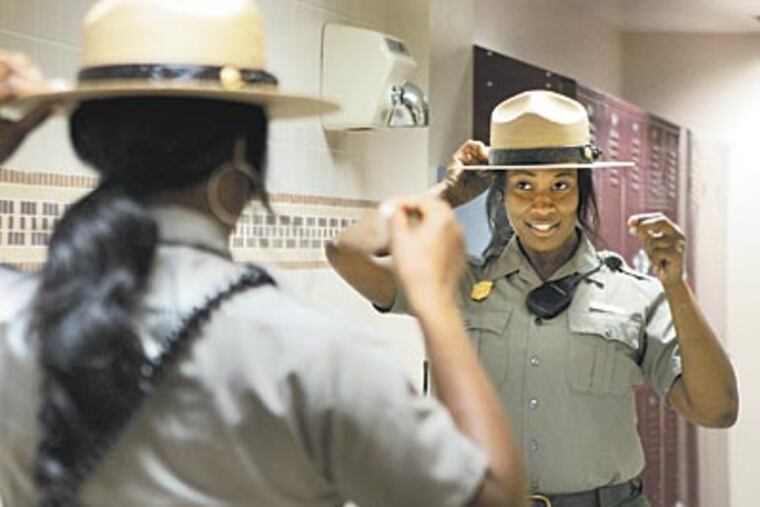
What kind of person would want to be a national park ranger? An outdoorsy type? Someone who loves to tramp through the woods, scale mountains, ford streams?
That's not Melissa Burch.
Her name may sound like a tree, but "I never even went hiking," said Burch, a park ranger intern who clearly wasn't all that eager to start communing with nature (or bears) on a regular basis.
That makes her perfect for the job.
Burch is one of 13 Temple University students involved in a pilot partnership with the National Park Service to cultivate and train gun-carrying law enforcement rangers who want to work in urban parks such as Independence National Historical Park in Philadelphia.
"Most people who want to be park rangers want to be in places like Yellowstone National Park," said Burch, who interns at Independence Park. "I think they want to get on a horse and ride around. But I love the city. I love that you can leave here and get on a bus."
If only chief regional ranger Jill A. Hawk (another appropriate park name) could have a forest of Burches.
Hawk, who is stationed in Philadelphia, says she struggles to keep the law enforcement park ranger positions filled in cities like Philadelphia, or downtown Boston, where the national park includes Faneuil Hall.
"That's why we are going after students who like the urban environment and want to stay here," said Hawk. Temple was a perfect fit, she said, because its graduates tend to remain in the area. The student body is also diverse, another plus for the primarily Caucasian park service.
"There's a myth that being a park ranger is all about the big western parks," said Hawk, who supervises 230 to 250 law enforcement rangers in the region, which includes Acadia National Park in Maine and Shenandoah National Park in Virginia.
Burch said she had heard people say that they did not become park rangers to deal with the homeless. "But that's an issue you have to deal with because we live in a city."
At a time when unemployment stands at 9.3 percent in the Philadelphia area, filling these jobs should be easy.
But the requirements are tough. Rangers must pass an annual physical, in addition to background and drug tests.
The job includes search and rescue, police work, forest and building firefighting, and emergency medical response.
Unlike other park service jobs, law enforcement officers must retire by age 57 and can't be hired after age 37. "We need a young and rigorous workforce," she said.
Hawk says 55 percent of her crew are eligible to retire in the next five years.
The ranger jobs start at $33,400 with the potential to earn as much as $65,800.
Temple's ProRanger Philadelphia interns earn $13 an hour in a program that can begin after their freshman year. The first summer, they are exposed to all facets of park management, from interpretation to maintenance. (Yes, they clean toilets.)
The second summer, they focus on law enforcement, followed by firearms training in a law enforcement program similar to a police academy in the third summer. When they graduate, they are guaranteed jobs. All majors can apply.
Burch, 35, a criminal-justice major from Upper Darby, already had experience as an armored-truck guard. A senior this fall, she will barely finish the program in time to be hired before she turns 37.
"I had never thought about the national parks," she said.
Her park partner is Giancarlo Graziani, 21, an urban-planning major who plans to complete the ranger program, but he is not sure whether law enforcement is for him.
He sees it as a possible doorway to working in planning in the park system.
Hawk said the park service had tried various experiments with internships, but many had not been successful, partly because the park system, a paramilitary organization, failed to understand the sensibilities of college students.
The service would assign them to remote locations where there were no other young people and no Internet. In the Temple program, most students work in pairs, some living in dorms near the eight participating parks, she said.
The Temple student assigned to Gettysburg National Military Park lives with students from other universities involved in other internship projects at the park. "She's having a great time," said Anthony J. Luongo, director of Temple's Criminal Justice training programs and one of the creators of the internship.