The Pier Shops' Fading Star
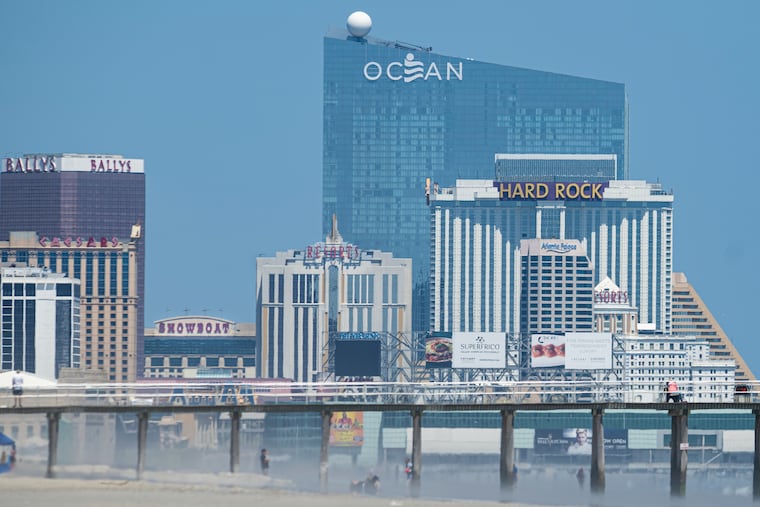
ATLANTIC CITY - On its debut here four years ago, the Pier Shops at Caesars was heralded as a new dawn of luxury retailing for a resort town where shopping opportunities were more mom-and-pop T-shirt store than glittering jewelry emporium.

ATLANTIC CITY - On its debut here four years ago, the Pier Shops at Caesars was heralded as a new dawn of luxury retailing for a resort town where shopping opportunities were more mom-and-pop T-shirt store than glittering jewelry emporium.
Jutting out over the ocean, ablaze in LED lights, the Pier offered high-style designer brands - Gucci, Louis Vuitton, and Tiffany, to name a few. Even better, it was connected to a high-end casino, an inextricable link between gambling and shopping.
But the economy took a turn for the worse, and competition from the Walk, value-oriented outlet stores just blocks from the Boardwalk, took the wind out of the Pier Shops' sails. Taubman Centers Inc., of Bloomfield Hills, Mich., which owns the mall, defaulted in April on a $135 million mortgage. A foreclosure sale is expected, and last week, the company said the Pier could have a new owner by year's end.
That uncertain future has new relevance now as New Jersey lawmakers review Gov. Christie's recommendations for a takeover of Atlantic City's casino and entertainment district - recommendations that view attractions such as shopping as critical to the resort's revival.
"We need to . . . expand nongaming entertainment in the city, so families have a number of reasons to come here and for Atlantic City to become the destination resort it was meant to be," Christie said in announcing his proposal July 21.
Indeed, Atlantic City needs high-end retail to turn the corner from a purely gaming-centric destination, said Joel Naroff, of Naroff Economic Advisors in Bucks County.
"The Pier, in concept, is exactly what is needed to help Atlantic City grow," Naroff said. "There must be some upscale shopping to attract wealthier visitors. There needs to be quality restaurants that are not just in the casinos, that are destination restaurants. To a large extent, that is what the Pier has."
In the future, said Cory H. Morowitz, of Morowitz Gaming Advisers L.L.C. in Galloway Township, the key for the Pier Shops will be aligning its offerings to the Atlantic City visitor.
"The majority of visitors . . . generally stay for a very short duration," Morowitz said. "I think the Pier needs must-see attractions, entertainment, and stores that visitors cannot find nearer to their homes and at price points that make sense.
"That does not necessarily mean low-end," he said. "It means value relative to the price. There still may be room for luxury goods in Atlantic City, since, aside from the Borgata, most of Atlantic City is positioned toward the midscale. . . . Ultimately, the catchword for everything in Atlantic City today should be differentiation relative to other tourist and gaming destinations."
Gaming analysts say the Pier's predicament reflects gambling's decline in Atlantic City over the last four years, as Pennsylvania casinos stole its bread and butter - revenue from slot machines - then hit again hard with this summer's start of table games. Net gaming revenue declined 23 percent from the second quarter of 2007 to the second quarter of 2010.
How the Pier performed in the second quarter of this year could not be determined. "We don't share individual mall sales," Taubman Centers spokeswoman Karen MacDonald said Friday. "We report for our company as a whole."
The Pier Shops property itself is now worth about $52 million, according to some estimates, about one-fourth its original value, paralleling the slide of real estate values all around town. Last month, Resorts casino sold for $35 million in a fire sale. In summer 2009, the Tropicana sold at auction to Carl Icahn for $200 million, less than a fourth of what it was expected to fetch just a year and a half earlier.
"There is a lot of uncertainty about Atlantic City right now, and this makes it hard for investors to formulate an understanding about the future of the city," Morowitz said. "That . . . translates into low real estate values."
Right now, MacDonald said, "it's business as usual for guests who visit the Pier Shops at Caesars."
Yet some here do not even venture in, it seems.
"The shopping does not interest me at all," Emma Corbett, 86, an Atlantic City regular from North Bergen, N.J., said last week as she worked a quarter slot machine at Caesars, less than 10 yards from the Pier's main entrance.
The luxury-mall concept looked promising enough early in the decade, as Atlantic City embarked on a mission to glamorize itself.
The highly successful Borgata, modeled after a Vegas megacasino, was credited as being the first to bring a touch of glam when it opened July 3, 2003. The Quarter, a retail-entertainment-dining complex modeled after the Forum Shops at Caesars on the Vegas Strip, debuted in November 2004 at the Tropicana.
The $200 million Pier Shops opened in summer 2006. It, too, was modeled after the Forum Shops and even used the same developer - Gordon Group, of Greenwich, Conn. It seemed like a sure bet to attract wealthy New Yorkers on weekends, a crowd Atlantic City coveted.
But the crowds never met expectations. Nor did sales.
These days, analysts say, visitors are more inclined to spend their discretionary dollars on the casino floors and at the restaurants and bars.
A peek inside the Pier Shops on a recent weekday told the story. There was far more window-shopping than actual shopping going on. Many sales clerks stared through the windows, eager for customers.
Signs declaring sales of 30 percent to 50 percent off were taped to several storefronts - unusual for luxury retailers, which often frown on discounting.
One shop, Shoe Be Do, closed its doors Monday.
The first two levels of the Pier are stores; the third level is strictly restaurants, including Phillips Seafood, Sonsie, and The Trinity, and an outdoor deck where Benito Slepian, 35, of Center City, relaxed last week.
"Once I lose, I'm done," said nonshopper Slepian, who'd just finished four hours at the slots at Trump Marina. He said he had spent his $200 gambling budget and was tapped out by the time he arrived at the Pier - all he could afford were the free ocean views and the sun.
As visitors downsized spending here, Naroff said, "the Walk siphoned off business."
The Walk, a 13-block, 100-store outlet mall in the heart of downtown Atlantic City that opened in August 2004 and expanded in summer 2007, features many of the same stores found at the Pier, including Brooks Bros. and Coach. The difference: The Walk offers at least 30 percent or more off on designer merchandise.
"Our retailers and our center did a phenomenal job in adjusting to the economic climate," said Gary Block, vice president of Cordish Co., which built the Walk.
Baltimore newlyweds William and Tanika Payne found what they were looking for there Wednesday, including clothes and a watch.
At the Pier, the couple bought only candy. "The prices are better" at the Walk, said Tanika Payne, 21.
Yet Jim Haynes, of North Beach, Md., said he was rooting for the Pier.
"I like it," said Haynes, 48, who visits Atlantic City twice a year with his wife, Jennifer, 45. "It's just something else besides the gambling. Everyone loves to shop. No matter where we go on vacation, whether in Ocean City [Md.] or on cruise ships, we're always shopping."
Not so for Joan Turf, 73, of Chicago, who attended the Pier's Water Show, fountain entertainment set to music and lights, with friend Louise Schulz, 68, also from Chicago. The pair left soon after, carrying no bags.
"Gambling is what brought us here," Turf said. "If the economy gets better, then people will start shopping."