Ford is betting on its redesigned Explorer
The Ford Explorer, the two-ton road beast that tailspun from superstar SUV to B-list behemoth as the economy sank, is reentering the limelight with the automotive industry's equivalent of a new agent and a new face.
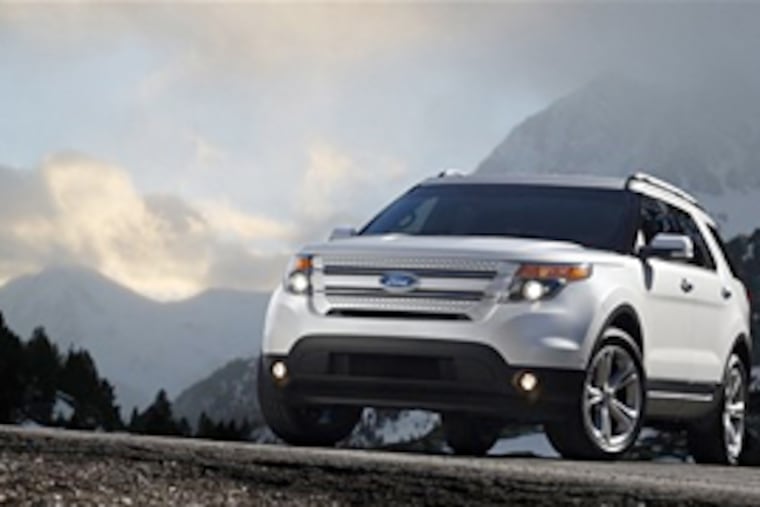
The Ford Explorer, the two-ton road beast that tailspun from superstar SUV to B-list behemoth as the economy sank, is reentering the limelight with the automotive industry's equivalent of a new agent and a new face.
Ford Motor Co., which only a few years ago debated whether to keep the sport utility alive, is looking to generate buzz for a new fuel-friendly and stylish version of the once wildly popular vehicle that many consumers abandoned as times got tough.
A shiny red 2011 Explorer, which hits showrooms this winter, rolled onto the pavement at Philadelphia's Water Works Restaurant near the Art Museum on Wednesday as part of a coast-to-coast publicity blitz that began in July.
The only other time Ford promoted a redesigned model with visits to cities was last year for its Taurus - another popular name reinvigorated after having languished, said Jason Mase, a Ford marketing manager on hand for the event with local dealers.
"Both vehicles have a tremendous story for us about reinvention," Mase said.
Reinvention may not be overstating things, given how Ford has managed to twist and contort with the raucous economic upheaval that caused annual U.S. auto sales to shrink by many millions as consumers cut spending. Ford was the only one of Michigan's Big Three automakers to avoid bankruptcy last year.
Mase credited a relatively new man at the top - former Boeing bigwig Alan Mulally, who became chief executive of Ford in 2006 - with much of the decision-making behind the new Explorer.
At the time of Mulally's arrival, Mase said, officials at Ford already were eager to give the Explorer new life by improving it in two ways that stuck out in the minds of its owners: fuel economy and style.
But Mulally, an engineer who demands rigorous analysis of data, wanted to know why, if Ford already had a Flex SUV in the pipeline (for 2008 introduction), it needed the Explorer at all anymore.
Mase and top executives said surveys with countless owners led them to believe that a newer, better version would sell. The Explorer name was powerful, they said; it delivered size and functionality that smaller crossover SUVs did not, and owners liked the Explorer overall.
Four million Explorers were still on the road - a powerful incentive, they argued, for Ford to invest in an SUV whose best days had become a memory.
Mulally, whose orderly and decisive management style is not, Mase pointed out, "a dictatorship," was won over.
"He was balanced in his decision-making," Mase said. "It was really cool, because I remember nervous nights, thinking, 'How do we go in and convince Alan that we need this product?' "
As much as possible, engineers and designers aimed to produce a new Explorer that would be palatable even if gasoline prices rose again to uncomfortable levels.
The new version has aerodynamic curves rather than a boxy look. It drives more smoothly, Mase said, because it sits atop a car - not a truck - platform, and is offered with new engines that, once fuel ratings are in, should consume 20 percent to 30 percent less fuel than previous models.
Its interior is only a few cubic feet smaller than the old Explorer, and the entire SUV is an inch shorter in height, Mase said. But it is still high off the ground and has a touch-screen dashboard that evokes the iPhone.
Gone is the choice of just eight-cylinder or six-cylinder engine. Buyers will choose either a V6 billed to be as powerful as a V8 (and easier on gasoline) or a new V4 "EcoBoost" engine that delivers six-cylinder power only when needed (another fuel-saving move).
David Champion, senior director of the auto-testing division at Consumer Reports, said, "It's a very bold step by Ford to do it this way, to try to get more fuel economy out of what will be a relatively large vehicle with basically a four-cylinder engine."
Considering the Explorer's lucrative heyday, it's little wonder that, even in this era of compact-car frugality, the automaker has placed another bet on it. In 2000, at the height of its popularity, the four-door Explorer made up almost 9 percent of U.S. Ford brand sales, according to J.D. Power & Associates.
So far this year, sales of its four-door model account for only 2.5 percent of all Ford brand sales, J.D. Power says.
"If you go back to the '90s and early 2000s, the Explorer was [Ford's] moneymaker in many ways," Champion said. "But the Explorer never really kept pace with the changing needs of the competition."
Michael Kennedy, who runs the John Kennedy family of dealerships across the region, used to sell 50 Explorers a month. Now, the factory sends him only four a month.
Kennedy can't wait for the 2011 models to arrive because, he said, customers not interested in minivans or small crossover SUVs still ask for Explorers.
"As dealers, we're really excited about getting our hands on it and selling it," he said.
Someday, Kennedy may find Angela Bunch walking into one of his Ford showrooms. The Germantown property manager and newly licensed mortgage broker loves her 2003 Explorer, even though it was no joyride when gasoline cost a fortune.
"I'm happy with the Explorer overall for the performance of the vehicle," said Bunch, 55, who recently loaded its capacious cargo area with groceries from a ShopRite in Roxborough.
She would definitely buy another, she said. But with this Explorer already paid off and still in good shape, Bunch is in no rush to check out the 2011 version, even though she said its improved fuel economy was attractive.
The economy is still shaky and Bunch has only recently changed careers.
"I'm holding on to it as long as I can," she said. "As long as it's not costing me."