A strategy in pieces
SEATTLE - Instead of unveiling an elegant response to the iPad, Microsoft came to the tech industry's premier gadget show in Las Vegas this week with a collection of exposed computer guts.
SEATTLE - Instead of unveiling an elegant response to the iPad, Microsoft came to the tech industry's premier gadget show in Las Vegas this week with a collection of exposed computer guts.
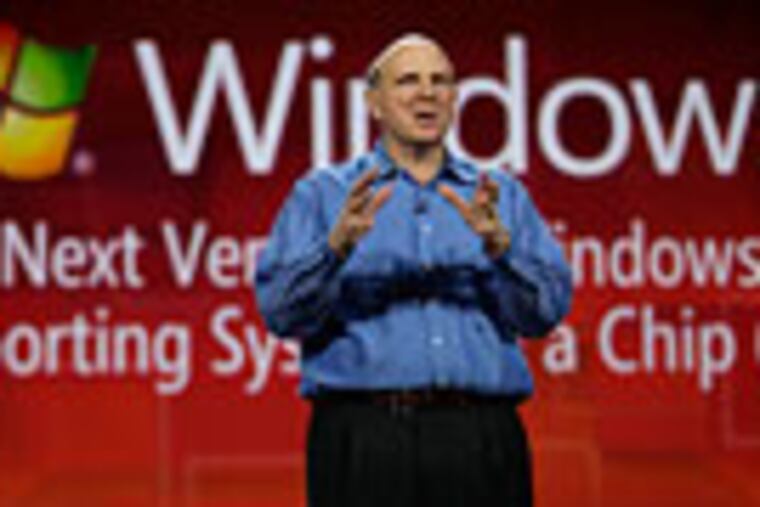
The company's biggest news was that the next version of its Windows operating system would run on the style of cell-phone chips that power the iPad and other tablets today. The company proved it with a series of demonstrations on half-built computers; on the monitors hooked up to those machines, the software was indistinguishable from the current Windows 7.
Microsoft Corp.'s missing tablet served as a reminder that the world's largest software-maker remains years from a serious entry into this new category of devices. It also raised more doubts about whether Microsoft will ever be able to grab a meaningful piece of this fast-growing segment. If it can't, the company's dominance of personal computers may become increasingly irrelevant as people embrace ever-sleeker portable devices.
Chief executive oficer Steve Ballmer mostly lingered on what went right last year when he gave the company's customary keynote on the eve of the International Consumer Electronics Show on Wednesday. He had his share to boast about. Xbox 360 and the Kinect motion-sensing controller that's racked up more than $1 billion in sales in just two months, a ground-up overhaul of the Windows smart-phone software, and rapid adoption of Windows 7 on PCs are all legitimate successes.
Still, it's hard for anyone to applaud Microsoft without noting the threats posed by the growing popularity of Apple Inc.'s iPad tablet. It's also hard to see Windows as a tablet contender amid an onslaught of new tablets running Google Inc.'s Android software, which has already helped turn mobile phones into mini-computers.
Those concerns have been weighing on Microsoft stock, which has hovered in the $20-to-$30 range for the last decade. It closed Friday at 28.57, down less than 1 percent for the day.
Apple, on the other hand, has seen its share price more than triple since the first iPhone was announced in early 2007.
Microsoft has not been absent from the tablet discussion - Windows tablets have been around for years, but the devices never caught on with the mainstream. At last year's gadget show, Ballmer demonstrated a sleek "slate" from Hewlett-Packard Co. that runs Windows 7, and today there are several iPad-esque tablets that use Microsoft's operating system.
But those gadgets have none of the iPad's cachet, and Microsoft has done little to market them. Also, many analysts and design experts say Windows 7 is doomed to fail as a tablet system because it was created with the keyboard and mouse in mind. At best, technology industry analyst Rob Enderle said, Windows 7 tablets are a stopgap measure while Microsoft pushes ahead on what will likely be called Windows 8.
Given the rudimentary proof-of-concept work Microsoft demonstrated this week, and the difficulty of the task of building a multiplatform operating system, analysts don't expect a new Windows to arrive for at least two years. Microsoft moved late in part because it didn't take tablets seriously.
The factor Microsoft apparently failed to take into consideration was Apple, which took the tablet very seriously. When the iPad launched, Apple's design and marketing savvy tipped tablets into the mainstream.
"Now, they recognize that they've got a problem," Enderle said of Microsoft.