US Airways introduces paperless boarding passes in Philadelphia
So you are among the legions of US Airways Group Inc. passengers in Philadelphia, and you don't like paper, airport kiosks, and lines at the ticket counter.
So you are among the legions of US Airways Group Inc. passengers in Philadelphia, and you don't like paper, airport kiosks, and lines at the ticket counter.
Now Philadelphia's largest airline is offering customers here and in eight other cities paperless boarding.
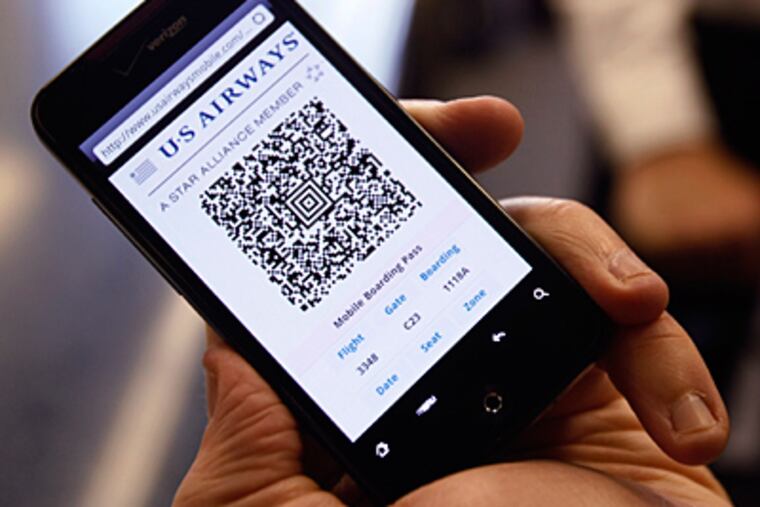
Travelers who go to US Airways' website within 24 hours of their flights can get their boarding passes e-mailed to a cell phone or personal digital assistant, such as a BlackBerry or iPhone.
The paperless boarding pass has an encrypted, tamperproof bar code identifying the passenger, flight, seat assignment, gate, and departure time. "It's just one other option for folks," said US Airways spokesman Todd Lehmacher.
"It really works well for people who aren't checking a bag, and time is of the essence. That's the majority of the people who are using it."
US Airways went to mobile boarding in Philadelphia and Pittsburgh two weeks ago, and it plans to add more cities.
Business traveler Dan Green, on his way Tuesday to Burlington, Vt., said he liked having his boarding pass sent to his phone.
"It's easier. I like to use my laptop, but I don't have a printer," said Green, a health-care consultant who lives in Philadelphia. "Especially in hotels, where sometimes you don't have access to a printer, it makes not having a printer easier for those of us on the go."
The technology works on any cell phone or PDA that can receive and open attachments.
Continental Airlines was the first U.S. carrier to debut paperless boarding in December 2007. Today, it offers the electronic passes at 70 U.S. and international airports.
Nearly six million Continental customers have used it, including more than 10 percent of passengers in some airports, said Continental spokeswoman Mary Clark.
Seven airlines offer the option, including American, Delta, United, Virgin America, and Alaska Airlines, at 85 U.S. airports, working with the Transportation Security Administration, which screens all boarding passes at security checkpoints. Airlines scan the paperless passes again at the gate.
The TSA said the technology heightened the ability to detect fraudulent boarding passes, while improving customer service and reducing paper use. Airlines pay for the portable scanners.
US Airways launched paperless boarding in Las Vegas in November, and later in Dallas-Fort Worth, Denver, Phoenix, Charlotte, Reagan National in Washington, New York LaGuardia, and Boston. So far, 58,278 US Airways boarding passes have been sent to mobile devices, including 9,900 in Philadelphia.
"It's definitely a cost savings," Lehmacher said. "We are printing less paper, and passengers are saving paper at home."
Chalk it up to concern about the environment - saving trees - as well as the electronic age, in which a growing number of people have cell phones and mobile devices connected to the Web.
Here's how it works:
At the airport, instead of showing a piece of paper, the passenger pulls out a phone or mobile device. A TSA officer still checks a government-issued photo ID, while the traveler places the phone or PDA on a scanner about the size of a lunch box, which displays the electronic ticket.
Then, at the gate, the boarding pass is scanned again at a "gate reader" before the passenger gets on the plane.
Passengers traveling on US Airways said Tuesday that they liked the idea.
"I fly several times a week. It's one less piece of paper," said Joseph Clay, a salesman from Upper Darby who was flying to Charlotte, N.C. "It's convenient. There's nothing extra that I have to do."
Jeff Xander, who coordinates clinical trials for a King of Prussia biotherapeutics firm, flies once or twice a week and has seen paperless boarding at other airports.
"I definitely think I will do it," said the Perkasie resident, headed to Boston. "They scan the paper boarding pass and give it right back to you. I never know what to do with it, so I end up throwing it out."