Consumer 11.0: Lawsuit hits Apple over free apps' charges
Cindy White still marvels at how easily her daughter, Katie, blew through $174 two months ago while playing a Smurfs' Village game on White's iPad tablet computer.
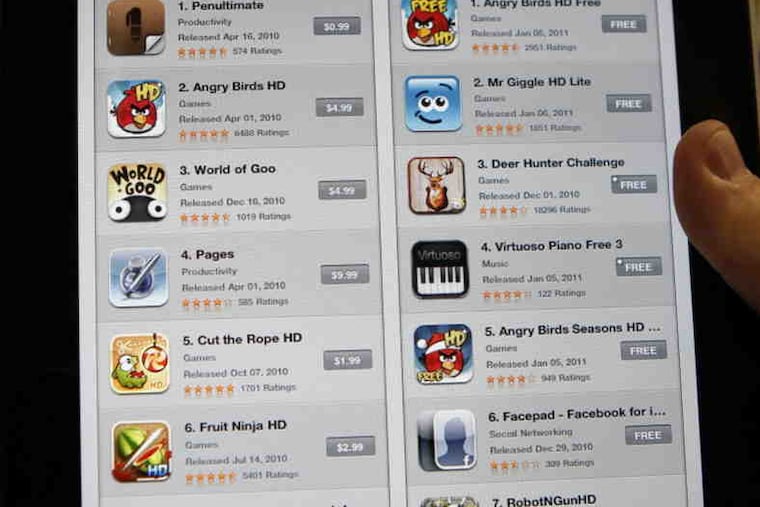
Cindy White still marvels at how easily her daughter, Katie, blew through $174 two months ago while playing a Smurfs' Village game on White's iPad tablet computer.
One day she was enjoying the popular iPad and iPhone application - a "free app," in smartphone and tablet lingo. The next day, the little girl was revealed as a big spender - and the free app as anything but free - courtesy of an iTunes receipt e-mailed to her mom. The 4-year-old's largest purchase? A Wagon of Smurfberries for $99.99.
White got the charges quickly reversed when she called Apple to question how a 4-year-old could have rung up such large fees simply by hitting buttons on an iPad touchscreen. "They refunded everything," said the Newtown Square mother of three. "They were very easy about it."
But other app customers - and their parents - haven't been so lucky, according to a class-action lawsuit filed April 11 by Philadelphia and Massachusetts lawyers.
The lawsuit contends that Apple customers have lost millions of dollars because their children have been lured to purchase virtual items needed to succeed at games - items like Katie's Smurfberries. The suit describes the purchases as "virtual supplies, ammunition, fruits and vegetables, cash and other fake 'currency' " sold via the iTunes platform.
The plaintiffs acknowledge that Apple tightened its procedures last month after a flurry of complaints, including from members of Congress who asked the Federal Trade Commission to investigate. Fueling the attention was a Washington Post report that a second grader had spent $1,400 on Smurfs' Village.
Unfortunately, the problem wasn't necessarily solved by Apple's fixes. Nor is it limited to a single children's game - or the fault of lax parenting, as some ugly comments in the blogosphere have suggested.
The main plaintiff in the April 11 lawsuit, Garen Meguerian of Phoenixville, says his 9-year-old daughter racked up $200 in fees for game currency while playing other free apps, such as Zombie Cafe and City Story.
Meguerian says he has spoken to parents who faced charges of $600 or $700 before they noticed - almost always on free games that he says were worth little more than their price tags.
"If that money was charged up front, nobody in their right mind would pay what they're charging for these in-app purchases," Meguerian says. "These games are like a slot machine for kids. These are applications specifically designed to make kids blow through money."
Meguerian, by the way, wants it known that he's "not an Apple hater." He mostly loves what Apple sells - including gaming apps that don't pitch costly in-app purchases. "My older daughter buys $1 games that are great," he says.
Apple spokesman Tom Neumayr says the company won't comment on pending litigation. But he touts Apple's "industry-leading parental controls," which he says have been bolstered by the latest software update for iPads, iPhones, and iPod Touches, iOS 4.3.
Although a password was already required to purchase an app or download a free one, before the update that password also opened a 15-minute window for "in-app purchases" - no further authorization necessary.
With the March 9 update, users now have to reenter a password to authorize such purchases.
Warnings about in-app purchases have also become more prominent - sometimes. Smurfs' Village iTunes page cautions that the app "is free to play, but charges real money for additional in-app content. You may lock out the ability to purchase in-app content by adjusting your device's settings." But City Story, another game rated for ages 4 and up, lacks such a warning, and charges as much as $99.99 for a wad of City Cash.
Bala Cynwyd lawyer Michael J. Boni, lead counsel in the lawsuit, says Apple's fixes sidestep an unpleasant truth: Some of the third-party apps it sells are little more than Trojan horses designed to extract dollars from kids and unwitting, or unfathomably profligate, parents.
Boni says players can't achieve the main objects of Smurfs' Village, such as growing a garden or building a village, without Smurfberries. "You can wait 24 hours to grow a few berries, but I assure you that's not enough for an impatient child," he says. As the onetime grandparent of a 1990s-era Tamagotchi pet who didn't last a week, I know whereof he speaks.
Meguerian says his daughter was taken the same way by Zombie Cafe, which sells Zombie Toxin as an antidote to keep players' characters alive.
"You're telling a 9-year-old kid that their character is going to die unless you pump it full of toxin," Meguerian says. "What kid could resist?"
Ironically, Apple's age restrictions may help fuel the problem.
Meguerian's 9-year-old saved up two years to buy her own iPod Touch, and then asked her dad to set aside other money - allowances, earnings from chores - so she can buy music and games.
But she was too young to have her own iTunes account, even one funded only with gift cards - a strategy that parents can use to limit unexpected charges for children 13 and older. So her iPod had to be linked to Meguerian's account, and thus to his credit card.
Meguerian got burned by the initial 15-minute window, before Apple fixed it, because he had trusted that any purchase required his password. "I just assumed that when I make a purchase, that's it," he says.
But even after the fix, parents have to be vigilant if they reenter their passwords - say, to fund a more modest Bucket of Smurfberries, for a mere $4.99. That's because the purchase window, once cracked, stays open for 15 minutes - enough time for nimble little fingers to get into a whole mess of financial trouble.
"The average parent would not have been aware of this until they were burned. There's just too much else going on," Meguerian says.
But Apple should be - now that it's been burned by bad publicity.
The company that Steve Jobs built has given the world some awesome inventions. Does it really want "purveyor of Smurfberries and other overpriced virtual stuff to children" to be one of its legacies?