PhillyDeals: Ecospan of Calif. opening operations center near Exton
California-based Ecospan, which says it has developed technology for turning organic waste into clear plastics - "compostable," though not "biodegradable," under U.S. guidelines - has leased 20,000 square feet at 753 Springdale Dr. in Whitelands Park near Exton, for its East Coast operations center and research lab.
California-based
Ecospan
, which says it has developed technology for turning organic waste into clear plastics - "compostable," though not "biodegradable," under U.S. guidelines - has leased 20,000 square feet at 753 Springdale Dr. in Whitelands Park near Exton, for its East Coast operations center and research lab.
"The offices are being renovated," new low-energy lighting added, "an R&D lab will be added to the property, and eventually the balance of the building will be converted to manufacturing," Thomas O. Bailey, the CB Richard Ellis Group Inc. broker who closed the deal for Ecospan, told me. Ecospan won't name its clients, who it says are electronics manufacturers.
The site is a Keystone Innovation Zone, where employers are eligible for state tax breaks and subsidies of up to $100,000 a year, says zone director Mary Fuchs.
Ecospan, headed by real estate-developer-turned-electric-vehicle-promoter Greg Hoffman, will house research, design, development, testing, manufacturing, and sales staff, initially employing 12, growing to 30 by the end of next year.
Two of the company's five senior managers will also be based in Exton: marketing boss Paul Cannon, a graduate of La Salle University and Widener's M.B.A. program and a former executive at Chester County-based VWR International L.L.C.; and operations chief John Vandenbergh, a Villanova graduate and former Conair Corp. manager.
Close to home
DuPont Co.
says trees on its own country club and at its
Stine-Haskell
laboratories, each a short drive from the global chemical-maker's Wilmington headquarters, are being treated for damage associated with exposure to
Imprelis
, DuPont's new herbicide.
Agricultural extension services in Pennsylvania and other states have noted that spruce and pine trees at nurseries, golf clubs, and private homes have turned brown and lost their needles, as I reported last month in this column.
Similar damage is visible at DuPont Country Club. The company had no immediate comment, but after I posted photos of the damaged trees on the PhillyDeals online site, DuPont issued this statement:
"Some of our customers have observed damage to sensitive trees associated with the use of our new herbicide Imprelis - and so have we.
"We applied Imprelis at Stine-Haskell and the DuPont Country Club this spring, and several white pine trees there are showing signs of injury.
"We have provided our customers information on how to care for trees showing signs of stress, and we are using those same methods ourselves. Some of our trees are responding positively to this care."
Ford and India
Two stories from the Reuters news service last week show what has happened to U.S. auto manufacturing as Asia has replaced North America as a leading market for cars and trucks.
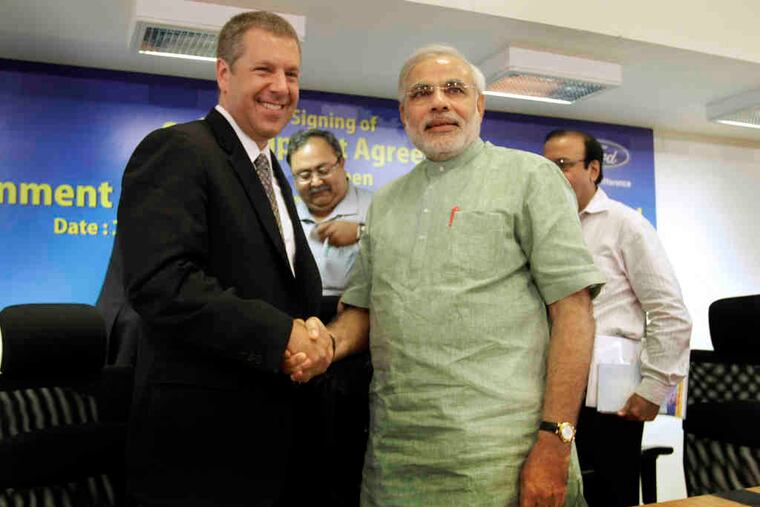
Ford Motor Co., the U.S. automaker that didn't need a bailout from Washington, said it was investing $1 billion and hiring 5,000 workers for a new factory - in Gujarat, India, where the rising middle class is buying more cars and where skilled labor is priced to world markets (that is, cheaper than in the West).
Separately, Reuters wrote that Goldman Sachs Group Inc., JPMorgan Chase & Co., and other Wall Street firms that maintain commodities-trading desks have found a new use for vacant warehouses in the auto center of Detroit: They are using them to stockpile aluminum, as prices for the basic metal soar.
So much aluminum is piling up that metal buyers are accusing the owners of speculating at their expense. The firms denied wrongdoing.
Alarming
LifeShield Security
, the Yardley home-alarm company that's trying to compete with neighbor
Tyco
and other industry giants in the wireless digital-alarm market, said last month that it had raised an additional $8 million in venture capital, upping the total since 2009 to $20 million.
Investors include Mike DiPiano's Radnor-based NewSpring Capital Inc.; Associated Group; Novitas Capital, Mike Bolton's Wayne-based outfit; CenterPoint Ventures; First Round Capital L.L.C., Chris Fralic and Josh Kopelman's West Conshohocken company; MHS Capital; and LifeShield CEO Mike Hagan, who previously ran NutriSystem Inc.