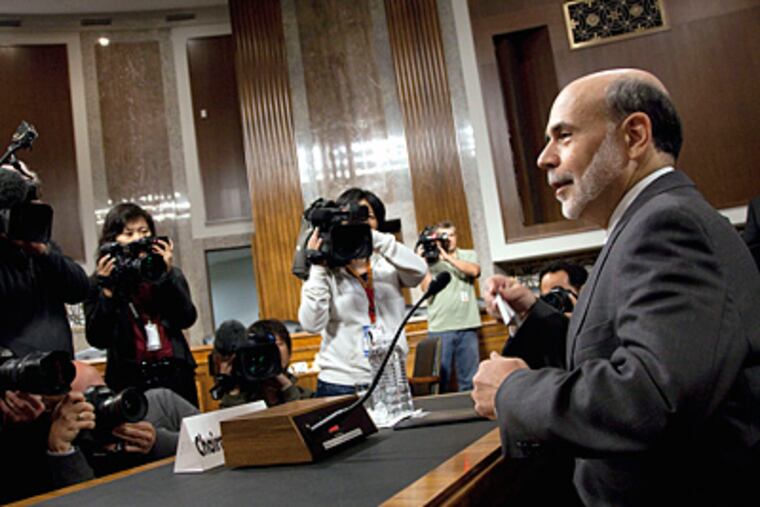
WASHINGTON - Federal Reserve Chairman Ben S. Bernanke said Tuesday that the nation's economy "is close to faltering" and that the central bank was prepared to take further steps to support the recovery.
In a day of volatile swings, stocks came off their morning lows after Bernanke implied that the Fed could adopt additional stimulus measures in the coming months.
In the early afternoon, share prices trended down again on continuing fears about the economy and Europe's debt problems - but they surged into positive territory in the last 45 minutes of trading on reports that European officials were working on a joint effort to prop up the region's struggling banks. The Dow Jones industrial average ended up 153 points.
In all, the Dow swung by more than 420 points from its low early Tuesday morning to its high just before the 4 p.m. close.
In his remarks to the congressional Joint Economic Committee, Bernanke said the economy was growing more slowly than the Federal Reserve had expected, adding that the biggest factor depressing consumer confidence was poor job growth.
"We need to make sure that the recovery continues and doesn't drop back and that the unemployment rate continues to fall downward," Bernanke said.
The Fed chairman warned lawmakers against cutting the budget too sharply with the U.S. economy still weak and facing new stresses from the European debt crisis.
The central bank chief also expressed some empathy with protesters who have marched on Wall Street and in other cities in recent days complaining of the role of big financial institutions in creating the current economic mess.
"Very generally, I think people are quite unhappy with the state of the economy and what's happening. They blame, with some justification, the problems in the financial sector for getting us into this mess, and they're dissatisfied with the policy response here in Washington," Bernanke told the committee.
"On some level I can't blame them," he said. "Like everyone else, I'm dissatisfied with what the economy is doing right now."
Bernanke noted the difficulty for Congress to rein in the long-term federal budget deficit while trying "to avoid fiscal actions that could impede the ongoing economic recovery" from the recession. Though the recession officially ended in June 2009, the housing and job markets continue to be weak and a drag on the whole economy.
But the Fed chairman said that one factor weighing down the U.S. recovery was "the increasing drag" from cutbacks in government spending.
He admitted that addressing the long-term budget deficit without further hindering the weak recovery was "a complex situation." And he had unusually sharp words for the bitter debate over raising the U.S. debt ceiling this summer, which led Standard & Poor's Corp. to downgrade the nation's credit rating, hurting market confidence.
"Unfortunately the brinkmanship of the summer . . . I think was a negative for the financial markets," Bernanke said. "It's no way to run a railroad, if I might say so."
Bernanke offered his grim assessment after the economy barely grew in the first half of the year and it created no net jobs in August. Consumer confidence fell this summer to the lowest point since the recession. Europe's debt crisis has also intensified.
The central bank's next policy meeting is scheduled for Nov. 1-2. Because the economy is still struggling to grow, many private economists think the Fed will take some further step to try to reduce the risk of another recession.