Prescription for nation's shortages
The Obama administration moved Monday to address shortages of dozens of prescription drugs - particularly injectable medications and cancer chemotherapies - that experts say are disrupting hospital practices, spurring dangerous and even fatal errors when doctors use unfamiliar substitutes, and depriving patients of lifesaving treatments.
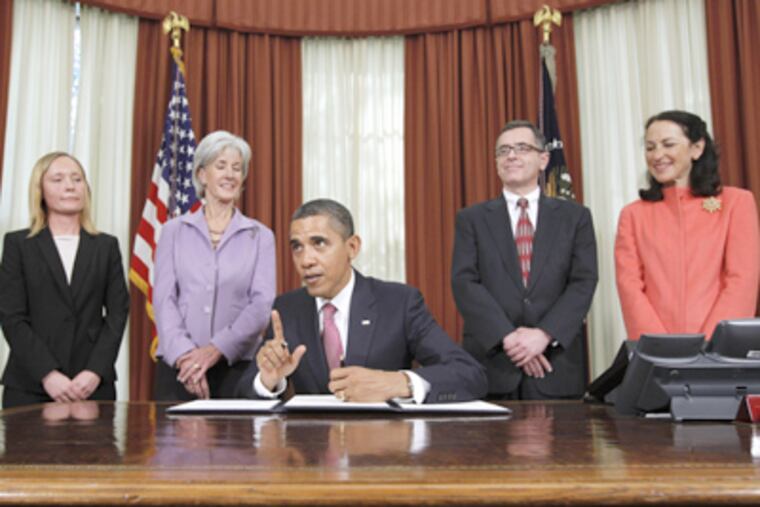
The Obama administration moved Monday to address shortages of dozens of prescription drugs - particularly injectable medications and cancer chemotherapies - that experts say are disrupting hospital practices, spurring dangerous and even fatal errors when doctors use unfamiliar substitutes, and depriving patients of lifesaving treatments.
President Obama, saying he was responding in part to congressional inaction, signed an executive order directing the Food and Drug Administration to require earlier warning from manufacturers before they cease production of medications "that are life supporting or life sustaining, or that prevent debilitating disease."
Obama also ordered the FDA to speed its regulatory reviews to help limit the impact of drug shortages. He directed it to notify the Justice Department of "any findings that shortages have led market participants to stockpile the affected drugs or sell them at exorbitant prices" - a concern of hospital officials who complain about attempts at price gouging by "gray market" firms that capitalize on drug shortages and may even contribute to them.
During a conference call Monday with reporters to announce the order and other steps, Health and Human Services Secretary Kathleen Sebelius and FDA Commissioner Margaret Hamburg said advance word about potential supply disruptions was crucial to limiting patient harm.
Last year, the FDA reported shortages of 178 drugs, nearly three times as many as in 2005, although Hamburg said it had been able to prevent shortages of 38 other medicines. So far this year, the agency has averted potential shortages of 99 drugs. As of Monday, though, the FDA website listed 83 medications as unavailable or in short supply, including preparations used for intravenous feeding and Fentanyl, a short-acting anesthetic widely used for surgical procedures.
"There are patients who are now in therapy regimes where they don't have access to drugs," said Sebelius, who was joined during the news conference by Jay Cuetara, who said that he missed a chemotherapy treatment this spring at the University of California, San Francisco, because of a shortage of a drug that has been delaying the progression of rectal cancer.
Although Hamburg said the drugs in short supply represent a small fraction of the thousands in use, the FDA said some were especially important because they "lack an effective alternative."
Shortages also lead to increases in medical errors, as doctors and hospitals scramble to find substitutes. A report last year by the Institute for Safe Medication Practices, based on a survey of 1,800 health-care practitioners, cited dozens of examples, such as two deaths at an unidentified hospital blamed on a dosage error when hydromorphone was substituted for intravenous morphine.
Michael R. Cohen, a pharmacist and president of the Horsham-based institute, said Monday's announcement "gives us hope" that the FDA can take steps to address a problem he said has reached crisis proportions.
"This is the United States of America, the greatest country on earth, and here we are contending with a shortage where our leukemic children can't get some of the drugs they need," Cohen said.
Hospitals have reported receiving e-mails or faxes offering scarce drugs at prices that are hundreds or even thousands of times more expensive than usual, Cohen said. "More than half of them told us they buy from the gray market," a term that describes legal but unofficial channels for distributing goods that leave their origins and quality harder to determine.
After Monday's announcement, the New England Journal of Medicine suspended its usual embargo on a piece due to be published Thursday about a shortage of "essential chemotherapy drugs."
Its authors blame the shortages largely on economic factors such as low prices for some generics and a reimbursement formula for medical oncologists that bases their compensation on a percentage of a drug's cost, prompting some doctors to shift to higher-priced brand-name drugs.
Richard F. Demers, director of pharmacy services at the Hospital of the University of Pennsylvania, said HUP has faced repeated challenges from drug shortages.
"Has it been stressing the system? Yes. Does it introduce the chance for errors? Yes. Does it take a lot of people and a lot of focused effort to do these changes on the fly? Yes," Demers said.
He said that HUP had avoided shortage-induced mistakes but that other harm was "harder to put a finger on."
"We have not had errors, thankfully," Demers said. "We have had to change therapies on a number of occasions where we can't get the product that we would typically use for a patient."