Joining forces to help fine-tune wind technology
Testing turbines made by Bucks- based Gamesa, U.S. scientists aim for cheap, efficient energy.
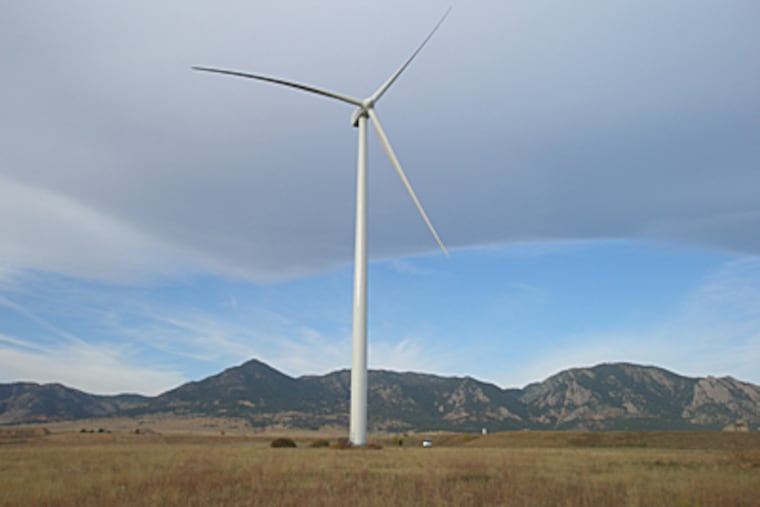
Wind-turbine manufacturer Gamesa, a Spanish company with U.S. headquarters in Langhorne, is working with the Department of Energy to transform wind-power technology, making it cheaper and more reliable.
Gamesa has sent a turbine to the department's National Renewable Energy Lab in Colorado, where scientists will load it with sensors to verify how much power is produced at certain wind speeds and otherwise check the accuracy of computer models used to design the equipment.
With all the instrumentation, one might compare the turbine to a heart patient, except "this is more like an athlete," said Jeroen van Dam, senior engineer at the lab.
By better understanding how the turbine works, engineers can design closer to the limits, he said. They can, for example, get more power with smaller blades.
"The idea is to continue to drive down the cost of wind energy to make these units operate more reliably, more efficiently, and to be competitive with other forms of energy," said David Rosenberg, Gamesa's vice president of communications.
"We're getting there," he added. "We're getting there much more quickly than we thought."
Wind still produces just a fraction of the nation's electricity - 2.3 percent for 2010. That year, with the recession and other factors, installations slowed. Even so, wind power represented 25 percent of all new generation capacity in 2010 in the United States.
Last year, the industry rebounded, installing 30 percent more wind capacity than in 2010.
Aside from conventional hydroelectric dams, wind remains the dominant form of renewable energy, ahead of solar and geothermal.
Pennsylvania ranks 16th in the nation in the wind capacity installed, according to the American Wind Energy Association, an industry group.
The state's wind farms produce enough electricity to power 180,000 homes. Projects that would add more than four times that amount of power have been proposed, according to the association's data.
New Jersey, which has few wind farms, is nevertheless on course to have the nation's first offshore wind project.
Fishermen's Energy of New Jersey L.L.C. is developing a demonstration project in state waters 2.8 miles off the coast of Atlantic City - a less-complicated process than installing turbines farther offshore in federal waters, which it also plans to do.
With several permits in place, the company has installed sophisticated wind-measurement devices atop a Margate apartment building to gather data. Final state approval is needed before construction of the wind farm can begin.
On Thursday, the potential for wind projects in federal waters got a boost from Interior Secretary Ken Salazar, who announced that several "priority" offshore areas - including about 500 square miles off New Jersey - had cleared a broad environmental review.
Developers will still have to do further environmental studies for specific projects, but Thursday's announcement means the developers can begin seeking leases.
Gamesa entered the North American market in 2005 and has since supplied turbines to 27 wind farms in the nation. It recently opened an offshore wind-technology center in Chesapeake, Va.
Gamesa has a manufacturing facility in Fairless Hills at the former U.S. Steel site. There, it builds nacelles, the bus-size housings that contain the gearbox and generator. Each one weighs 80 tons and sits atop the tower.
In November, the facility shipped its 1,000th nacelle - to a wind farm in Ohio.
Gamesa's partnership with the National Renewable Energy Lab, which is near Boulder, is focused on developing new components and rotors, testing how new control strategies perform, and coming up with better models for offshore wind installations.
Just a few years ago, the tallest towers were 68 meters high, measured from the ground to the hub. Now, Rosenberg said, the industry is building towers that are 100 to 120 meters high.
The industry is also looking at concrete towers, which are cheaper than steel.
The new blades are no longer made of fiberglass, but lighter-weight carbon. They also are getting longer. Several years ago, the circle the rotors form when they spin was about 80 meters across. Now, it's pushing 100.
With each increase in size comes an increase in power.
But the huge blades still have to be transported - and must navigate tight highway curves. So some of the longer blades, Rosenberg said, are being transported in two segments and assembled on-site.
Likewise, the nacelles are being transported with only the basic components inside, and then fitted on-site with generators and gearboxes.
Other efficiencies in assembling turbines are being developed, Rosenberg said. In one recent installation on the Cayuga Ridge in central Illinois, 150 turbines were erected in 90 working days.
Such improvements are being instituted across the industry, said Liz Salerno, director of industry data for the wind association. In the last three years, the cost of turbines dropped 33 percent.
But, she said, the gains could be threatened by the elimination of a production tax credit, put in place in 1992 and set to expire at the end of 2012. In the last four years, the credit has led to $17 billion in private investment for wind energy, the wind association has determined.
To buffer the market unpredictability that the potential tax expiration is causing, Gamesa has begun exporting components and, in 2011, was named the U.S. Export-Import Bank's "Renewable Energy Exporter of the Year."
Gamesa itself has committed to a 30 percent reduction in the cost of wind energy by 2030. "That's big. That's huge," Rosenberg said.
Wind energy remains a turbulent issue in other areas.
Some rural neighbors are disputing its image as a silent, benign form of energy.
Last week, a 2010 Gasland-style documentary about wind power, Windfall, was released by First Run Features. The film focuses on complaints by nearby residents about the noise and the "strobe effect" of the shadows made by the blades. So far, the film is not scheduled to play in this region.
Bird advocates still have concerns. "Preventable bird deaths at wind farms keep occurring," said Robert Johns, a spokesman for the nonprofit American Bird Conservancy.
The organization has conceded that wind power and birds can coexist, but only if the industry is held to mandatory standards that reduce bird mortality and loss of habitat.
Recent guidelines written by the Department of the Interior are insufficient, Johns said, because they are voluntary and because they have no provision for prosecuting companies whose turbines kill federally protected birds, such as eagles.