N.J. fight for sports betting is back in court
With Atlantic City's diminishing gaming returns, the resort - all of New Jersey, really - is desperate for something to boost tourism and raise revenue. The proposed solution: betting on pro and college sports.
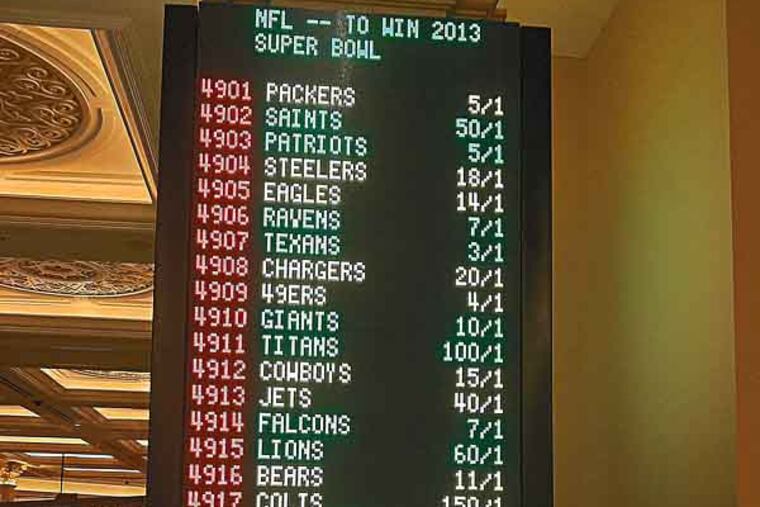
With Atlantic City's diminishing gaming returns, the resort - all of New Jersey, really - is desperate for something to boost tourism and raise revenue. The proposed solution: betting on pro and college sports.
Lawyers for the state, and for the four major professional sports leagues and the National Collegiate Athletic Association, return to federal court Wednesday to argue over giving New Jersey the same right as Nevada with respect to sports gambling. The case is being heard in the U.S. Court of Appeals for the Third Circuit in Philadelphia.
At stake: a multibillion dollar sports wagering market and potential lifeline for Atlantic City, which has hemorrhaged $2 billion in casino revenue since 2006 in the face of growing regional competition.
Gov. Christie said he would take the issue to the Supreme Court if the state lost its appeal. It's a fight that several states are watching closely, since a New Jersey defeat could stifle their own chances.
A federal judge ruled for the four sports leagues - Major League Baseball, the NFL, the NHL, and the NBA - and the NCAA on Feb. 28, and quashed New Jersey's attempt to overturn a federal ban that limits some forms of wagering on professional and collegiate sports to Nevada, Oregon, Montana, and Delaware.
"We will win at the Court of Appeals," New Jersey Sen. Raymond Lesniak (D., Union) said this week. Lesniak has been the Legislature's biggest proponent of sports betting at the dozen casinos and the state's four racetracks.
"To our casinos, it means packed houses during big events, like the Super Bowl, NCAA basketball tournament, every Saturday and Sunday during football season," he said. Atlantic City's revenue slumps when the weather turns colder.
The NCAA and the leagues oppose any expansion of the 1992 Professional and Amateur Sports Protection Act (PASPA), which limits sports betting to four states, with Nevada having by far the most freedom.
"The NCAA maintains that the spread of legalized sports wagering is a threat to the integrity of athletic competition and student athlete well-being," said Emily Potter of the NCAA.
Added NFL spokesman Brian McCarthy: "The position of the NCAA and the leagues has been spelled out and reaffirmed in the most recent decision."
Christie says the PASPA "is inequitable, violates New Jersey's rights as a state, and is unconstitutional." New Jersey voters approved sports betting in a referendum in 2011, and Christie signed the measure last year. "We are confident that the federal Court of Appeals will conclude that New Jersey should be treated equally with other states," Christie said March 1 after the federal court's ruling.
Delaware is allowed under PASPA to offer parlay betting, in which bets on three NFL games must be correct to win the wager. The state went to court to offer single-game wagering - the kind only Nevada enjoys, and the most lucrative - four years ago, but lost.
This time, the legal joust is different. New Jersey is now challenging the law's constitutionality.
Lawyer Stephen Schrier of Blank Rome in Philadelphia said New Jersey should not be dismayed by the Third Circuit's ruling in Delaware's case.
"That case did not involve the constitutionality of the PASPA law and did not address the fundamental unfairness created by allowing one state to reap financial gain to the detriment of other states that wish to carefully engage in the same activities," Schrier said.
State Assemblyman John Amodeo (R., Atlantic) said, "Let's face reality - it's a $380 billion industry annually throughout the country, and most of that is done illegally. In that huge market, just under $2.8 billion is wagered in Nevada.
"With our location on the East Coast, it could be a $100 billion industry here."