Cable consulting group thrives on Phila. as base
Imran Shah launched IBB Consulting Group in 2003 with one client - Comcast Corp. - and an office at the cable company's headquarters at 1500 Market St. IBB later leased space at that address.
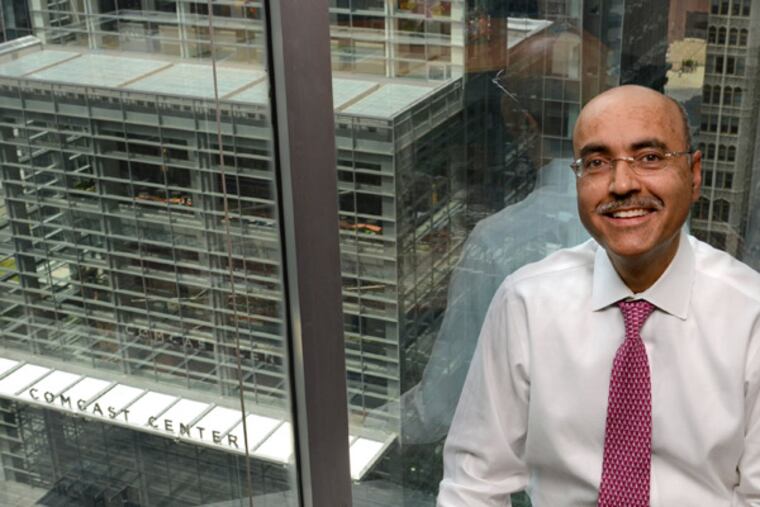
Imran Shah launched IBB Consulting Group in 2003 with one client - Comcast Corp. - and an office at the cable company's headquarters at 1500 Market St. IBB later leased space at that address.
Then, in 2008, Comcast danced over to its gleaming new high-rise on the 1700 block of John F. Kennedy Boulevard. Shah's IBB Consulting followed to a building on the 1600 block of JFK.
"We keep a real close eye on our clients," Shah, IBB's managing partner, said with a smile and a glance out his window toward the silvery Comcast Center.
Philadelphia isn't considered the center of the pay-TV industry today, as Denver was in the 1990s. But the city is part of a concentration of big cable-TV companies in the Northeast - an area between here and Stamford, Conn., - that's very advantageous to Shah's IBB Consulting, which now employs 80 people.
The city is only an Amtrak ride away from companies with millions of TV and Internet subscribers: Charter Communications in Stamford, and Cablevision and Time Warner Cable in New York City.
Then, of course, there's the industry giant here.
Sometimes it's faster, Shah said, to walk across JFK Boulevard between his office and the Comcast lobby than it is to travel between floors in the Comcast Center itself when there's a rush on the elevator banks.
"Philly is a great place to be. It has all the advantages one can imagine without the challenges of New York," Shah said.
Shah, 51, who earned a doctorate in video compression from Columbia University, finds himself in demand these days as cable-TV companies look to boost the speed and capacity of their networks to deliver more video and increase revenue.
Despite periodic doomsday scenarios that the $150 billion pay-TV industry will be eclipsed by new technologies, Shah said he does not see the cable companies' networks being replaced or being unable to compete for at least a decade - or as far as he can project.
"Fiber is shinier and Google is sexier, but in terms of outcomes, there is no difference. The [cable] network is not archaic," Shah said. It's a "sustainable network. It's extremely sound and flexible."
For an engineer, Shah speaks in vivid language. "The DNA of the cable guys," he said, makes them "very good businesspeople. They have always found innovation that can drive growth."
Historically, the cable industry grew with big new products: phone and high-speed Internet. "Finding the next billion-dollar opportunity is getting more difficult," Shah said.
Growth is likely to be incremental through home security and cloud storage and services.
"You have to play small ball instead of long ball," Shah said. "You have to think about a portfolio of businesses that could amount to a billion dollars."
Mark A. Coblitz, senior vice president of strategic planning at Comcast, said Shah understands how emerging technologies can translate into new business. "You hear about some technological breakthrough and you want someone to explain what it means to you," Coblitz said. "You would go to Imran for that."
There are bigger consulting firms, McKinsey & Co. and the Boston Consulting Group. But, Coblitz said, "Imran is closer to the coal face. He is right there where things are happening in the business."
Shah, who launched IBB with colleagues Afzaal Akhtar, Steve Griffin, Dan Dodson, and Phil Knightbridge, said the cable industry needs "frictionless authentication" of wireless devices - tablets, laptop computers, and smartphones - so that when a person wants to watch streamed TV entertainment, it's as easy as turning on the TV in your living room.
Shah also believes that distributors and content providers need to control the inflation of a customer's bill.
"Over the long term, the situation is untenable and a moment of rationalization will have to come," Shah said. "You are almost encouraging people to find the Aereos [a new competitor] of the world." He expects smaller channel bundles.
But Shah says of the cable companies, "We're still bullish. No question about that."