Verizon-Vodafone deal called 'natural next step'
Verizon Communications Inc. disclosed the details Tuesday of its $130 billion deal to acquire Vodafone Group Plc's 45 percent stake in Verizon Wireless.
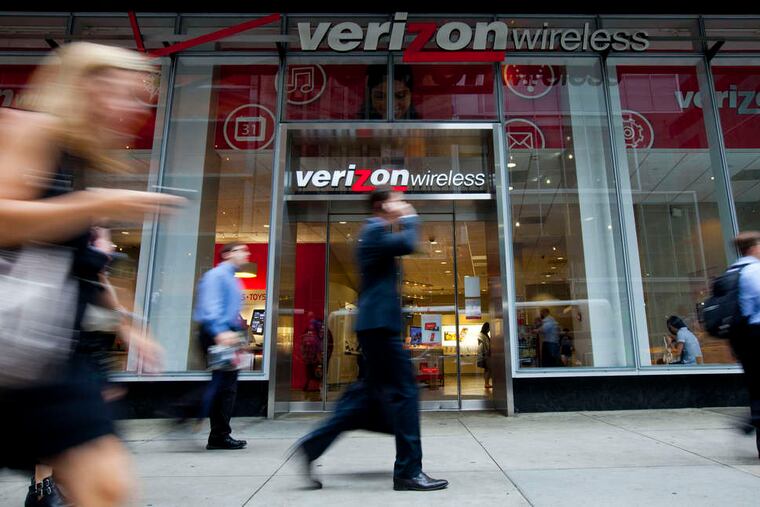
Verizon Communications Inc. disclosed the details Tuesday of its $130 billion deal to acquire Vodafone Group Plc's 45 percent stake in Verizon Wireless.
Verizon, the phone-service provider in the Northeastern United States, has operated Verizon Wireless in a joint venture with London-based Vodafone since April 2000. The transaction will give Verizon full control of the nation's largest wireless provider, with slightly more than 100 million subscribers, even as Wall Street speculates about other telecom deals.
Verizon will pay Vodafone $58.9 billion in cash and $60.2 billion in Verizon stock - one of the largest mergers in U.S. history. The stock issued for the transaction will be valued, based on the negotiated deal, between $47 and $51 a share.
The deal will load Verizon with debt, and its shares fell $1.37, or 2.89 percent, to $46.01 Tuesday.
"This is really a natural next step for Verizon," chief executive officer Lowell McAdam said in a conference call with analysts. "Full ownership of our wireless asset marks a major milestone."
One motivation to complete the deal now is low interest rates. Those rates could climb in the coming months, as the Federal Reserve eases its economic-stimulus bond-buying program, and higher interest rates would add expenses to the mega-transaction.
Verizon has been transforming its corporation to focus on the wireless business and away from the legacy wireline phone business.
It also has halted a significant expansion of its FiOS TV and Internet businesses.
Even though so many people now have mobile phones, McAdam said there was room for growth because of a 64 percent penetration of smartphones. There are still about 30 million basic mobile phones that could be upgraded, he said.
In the telecom industry, cable-TV pioneer John Malone has talked about the need for smaller cable companies to merge and attain "scale" to negotiate with entertainment programmers.
Malone's Liberty Media owns 27 percent of Charter Communications. Published reports have linked Charter with Time Warner Cable, the nation's second-largest publicly traded cable system.
On Monday, Time Warner Cable and CBS resolved a bitter dispute over the fees that the cable company will pay to carry programming on its system. CBS programs had not been available to Time Warner Cable's subscribers in New York and Los Angeles for about a month.
Time Warner Cable stock rose $1.90, or 1.77 percent, to $109.25. CBS stock rose $2.40, or 4.7 percent, to $53.50, on expectations of higher fees for its programs.
Comcast Corp., the nation's largest cable operator with about 22 million TV subscribers, is not believed to be among those that could participate in a new round of cable mergers because it is so large already and carrying $48 billion in debt.