Musk's SpaceX readying reusable astronaut capsule for 2016
Elon Musk's Space Exploration Technologies Corp., the first private rocket maker to deliver cargo to the International Space Station, said its reusable capsule would be ready to take astronauts there within two years.
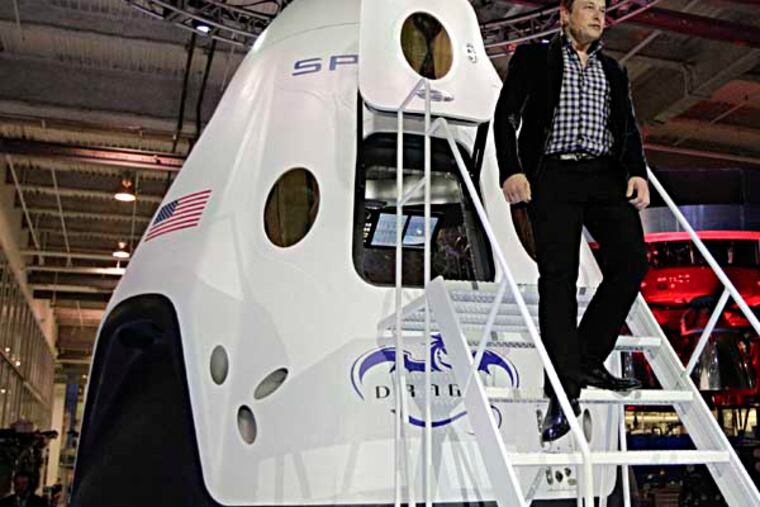
Elon Musk's Space Exploration Technologies Corp., the first private rocket maker to deliver cargo to the International Space Station, said its reusable capsule would be ready to take astronauts there within two years.
The closely held company's Dragon V2 spaceship can carry as many as seven people and as much as four tons of cargo, Musk said late Thursday at the SpaceX factory and headquarters in Hawthorne, Calif. It's also being designed with legs and reentry engines to let it land anywhere on Earth, he said.
"We actually expect to be able to transport crew by 2016, a year before NASA needs it," said Musk, 42, a billionaire who also leads electric-car maker Tesla Motors Inc. "We feel fairly confident we'll be ready."
Musk disclosed his ambition as he is trying to expand SpaceX's business with the U.S. beyond NASA missions and get a piece of the $67.6 billion Defense Department budget for satellite launches. SpaceX sued the Air Force last month, accusing the service of creating an illegal monopoly for that business.
United Launch Alliance, a joint venture of Lockheed Martin Corp. of Bethesda, Md., and Chicago's Boeing Co., has a lock on that work.
Since the retirement of NASA's space shuttle fleet, Russia's Soyuz rockets are the sole method of getting astronauts into space. Though Russia is charging as much as $76 million per mission, SpaceX intends to be able to deliver passengers for less than $20 million, Musk said.