PhillyDeals: Surgeon: U.S. and Penn should admit wrongs against India's new premier
Before Narendra Modi became India's prime minister last week, he was a familiar face to Aseem Shukla, a surgery director at Children's Hospital of Philadelphia, associate professor at Penn's medical school, and cofounder of the Hindu American Foundation.
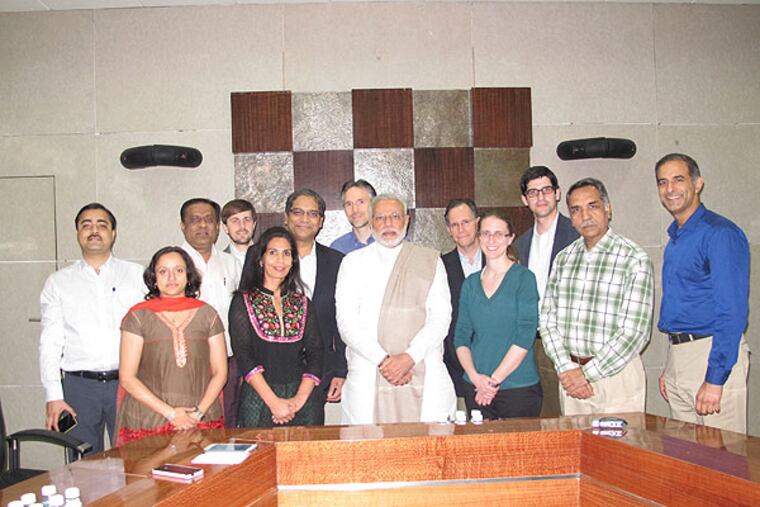
Before Narendra Modi became India's prime minister last week, he was a familiar face to Aseem Shukla, a surgery director at Children's Hospital of Philadelphia, associate professor at Penn's medical school, and cofounder of the Hindu American Foundation.
Shukla visited Modi, then chief minister of Gujarat state, in January, with Douglas Canning, chief of pediatric urology at CHOP, amid their annual U.S.-India children's surgery project.
They talked insurance and public health at Modi's austere home, under a picture of Swami Vivekananda, who visited U.S. religious leaders in the 1890s. It's significant, to Shukla, that Modi chose as a model a Hindu monk who pioneered engagement with the world.
Shukla says the past U.S. denial of a visa to Modi, on the rare grounds that he was accused of religious discrimination, was little protested at first, "as the details of who was responsible or not for the 2002 [anti-Muslim riots in Gujarat] were not available." But after the Indian Supreme Court investigators in 2012 absolved Modi, Shukla felt "we should normalize our relationship with Modi."
So it was "a shock," Shukla adds, when the State Department, pressed by an unusual coalition of Indian leftists, Muslims, and Christian critics in Congress - led by U.S. Rep. Joe Pitts (R., Chester) - said Modi would have to reapply to visit the United States. Penn's Wharton School rescinded a student invitation for state leader Modi to appear by video.
Will Modi now rush to accept President Obama's new invite to Washington? "People say Modi should refuse, the first time," said Shukla's visiting colleague, Rakesh Joshi, head of pediatric surgery at the 2,000-bed Civil Hospital in Ahmedabad, Gujarat.
The U.S. and Penn should admit "that the treatment of Modi was wrong, and such an error should not be allowed to recur," said Shukla. "This decision to disinvite Modi was capricious and insulting. He was a global leader on the rise."
Modi and his politics should have been debated, not banned, Shukla added.
Under Modi's rule in Gujarat, "in the last 12 years, peace has prevailed in Ahmedabad. There have been no more riots, which is actually incredible," said Joshi. Religious groups still live strictly apart, but "the thought process has changed. It's now for growth."
Pitts still has "unanswered questions" from 2002, but he "is not going to oppose [Modi's] coming to the United States," Andrew Wimer, Pitts' spokesman, told me.
Pitts said Obama needed to insist that Modi's Hindu- backed Indian People's Party "demonstrate that they have broken free of their record of tolerating this kind of violence," Wimer added. But, he agreed, "the recent election that brought Modi to power wasn't about religion, but about economics, jobs, and prosperity. That is encouraging."
215-854-5194
@PhillyJoeD