For DRPA watchdog, a contentious tenure from the start
Thomas Raftery III, the first inspector general of the Delaware River Port Authority, seemed headed for the exit almost from the day he arrived.
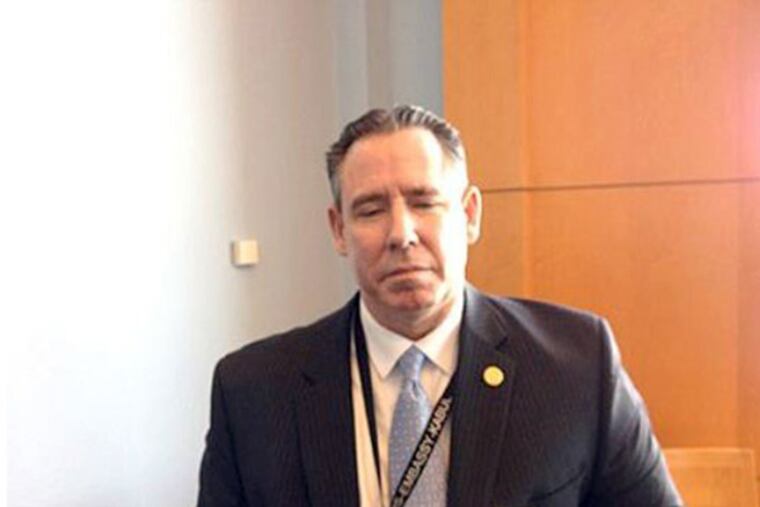
Thomas Raftery III, the first inspector general of the Delaware River Port Authority, seemed headed for the exit almost from the day he arrived.
He finally got there this week, when he submitted his resignation after a contentious two years and eight months on the job. He said the resignation would be effective Oct. 17.
A former FBI agent and an investigator of construction fraud in the Afghanistan war zone, Raftery was hired in January 2012 to eliminate fraud, waste, and abuse at the DRPA, an agency steeped in politics and patronage. His position was created as part of changes instituted in 2010 to try to make the DRPA - which operates four toll bridges and the PATCO commuter rail line - more transparent and accountable.
But Raftery, son of a Philadelphia police officer, soon collided with DRPA management and staff as he sought to examine the inner workings of the agency. Raftery complained that his independence was being undermined and that board members were interfering with his investigations.
Many on the DRPA board said Raftery spurned oversight, and was heavy-handed and intimidating in his approach.
Now, the dysfunctional relationship is likely to lead to a lawsuit, more revelations about the agency, and more legal bills for the toll payers who fund the DRPA. Raftery has hired a lawyer to pursue his complaints of a "hostile" workplace.
On his way out, Raftery suggested that he was willing to reach a financial settlement with the agency.
In an e-mail sent with his resignation letter Monday to several DRPA commissioners, including Pennsylvania Lt. Gov. Jim Cawley, who chairs the board, Raftery wrote: "I have no interest in airing some of what has occurred within the authority during my tenure as IG. However, I am prepared to do so, if necessary, to protect my reputation."
He threatened to "pursue all legal remedies" if he had not heard from the DRPA by Oct. 10.
Raftery's acrimonious departure was foreshadowed by months of conflict.
He clashed with then-chief executive John Matheussen over his insistence on reporting to the board, not the CEO, about his investigations. And he angered some board members with what they described as selective targeting of subjects for his investigations.
Raftery, who was hired for $130,000 a year, asked within six months for raises for himself and his staff. The board argued that Raftery could not expect more money when the DRPA's nonunion staff had gone half a decade without a raise.
He asked for permission to do outside consulting. The board said no, citing Raftery's unwillingness to identify his clients.
When a federal grand jury last year began an investigation of economic-development spending by the DRPA, Raftery said several board members blamed him.
Amid the acrimony, little got done.
Standard operating procedures for his office were never approved, because Raftery and the board's audit committee could not agree on them.
Only two audits, both critical of DRPA operations, were released by Raftery's office during his 32 months. Other reports remained in limbo. Raftery blamed board interference; the board said Raftery refused to incorporate agency responses into his reports.
New Jersey State Sen. Joe Pennacchio (R., Morris), who has sponsored legislation to revamp the DRPA, on Thursday called Raftery's resignation "especially troubling, as DRPA officials pretend that nothing needs to be done to prevent mismanagement of transit resources, waste, fraud, and abuse."
In his resignation letter, Raftery said, "It has been clear during my tenure that the authority never wanted or intended to support an independent IG. The authority wanted the public appearance of independent oversight without allowing it to occur."
Raftery declined to talk about specific issues beyond those outlined in his resignation letter.
"It's time for a change," Raftery said this week. "It's been very difficult."
In his resignation letter and in a May memo complaining about DRPA Commissioner William Sasso, Raftery portrayed himself as the victim of meddling commissioners intent on derailing his investigations.
In the memo, Raftery asked that an outside lawyer be hired by the DRPA to investigate his complaints against Sasso, a prominent Philadelphia lawyer. No action was taken on Raftery's request.
Sasso on Thursday blasted Raftery as "incompetent."
"He's unfair, he doesn't do his job, and he's a bully," said Sasso, who was appointed to the board by Gov. Corbett. "And the overwhelming majority of the board agrees with me.
"He wants a raise, and he wants to work two days a week for firms he won't identify?
"And to add insult to injury, he doesn't get anything done," Sasso said. "He's produced, what, one report since May 2012?"
Sasso said the payroll for the six-member inspector general's office was $480,000 a year.
"Compare that to accounting, who actually does do a lot of work for us, and their payroll is $540,000 a year."
Rick Taylor, a Pennsauken Township committeeman who is on the DRPA board, also was critical of Raftery's version of events.
"No one was trying to hide anything," said Taylor, vice chairman of the DRPA audit committee, which oversees the inspector general. "We told Tom that if anyone wasn't cooperating, give us the names. He never did that.
"He wanted to make the decision if something was right or wrong solely on his own. . . . We would say, 'That's your opinion? What's their response?' and he didn't want to get that."
Raftery became a lightning rod for controversy within months of his arrival. In August 2012, five New Jersey board members boycotted a board meeting to object to a proposed $35,000 raise for Raftery, preventing the board from taking any actions, including installing a new chairman to succeed Corbett.
Raftery contended that the boycott was in retaliation for his investigation of the labor agreement that governs work on a $103 million Benjamin Franklin Bridge repair project.
He accused New Jersey board members who are union officials of a conflict of interest because their unions were subject to its terms.
After Hurricane Sandy badly damaged Raftery's Ocean City, N.J., home, he increased his efforts to supplement his income with outside work, but the board rejected his request.
Raftery lost an important ally on the board when Chairman David F. Simon, executive vice president and chief legal officer of Jefferson Health System, resigned in March.
The last straw for Raftery may have been a decision by the board Sept. 18 to table, once again, his request for permission to work outside the DRPA.
Now, he is setting up his own consulting business, Falcon Consulting Group International, in Linwood, N.J., near his home.
This week, DRPA officials said they would begin an immediate search for a replacement for Raftery.