Luggage gets a long ride with TSA at the airport
So, where does your checked bag go after you drop it at the airline ticket counter? Like many passengers, bags may have a quarter-mile journey from the ticketing lobby to the aircraft.
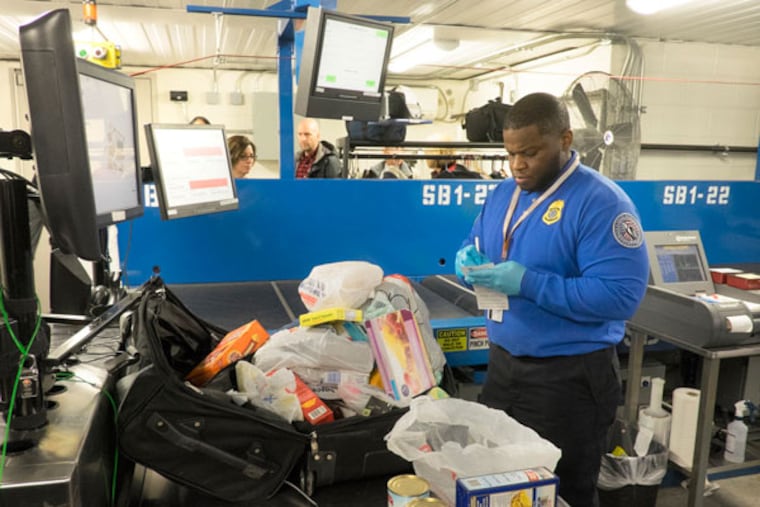
So, where does your checked bag go after you drop it at the airline ticket counter?
Like many passengers, bags may have a quarter-mile journey from the ticketing lobby to the aircraft.
The Transportation Security Administration (TSA) Wednesday offered a rare glimpse behind the scenes at how baggage is screened at Philadelphia International Airport, where an in-line system of conveyor belts and explosive-detection machines can process up to 1,000 bags an hour.
"Some people think the TSA opens and physically screens every single bag," said TSA spokesman Michael McCarthy. "That may have been the case immediately following 9/11, but not today."
After the Sept. 11, 2001, terrorist attacks, Congress mandated explosive-detection screening of all checked bags at 450 commercial airports in the United States.
Philadelphia International was one of the first airports to get automated in-line explosive-detection equipment, with the opening of the new international Terminal A West in 2003.
Next door, Terminal A East, which has Frontier, Spirit, US Airways, and American Airlines, built an in-line system that cost $34 million in 2012.
The TSA paid 90 percent of the cost of the screening equipment. The airport, through revenue bonds supported by the airlines, paid for the rest.
At the A East ticket counter, checked bags embark on a 15-minute ride through a series of conveyor belts and screening equipment. Under crosswalks, the conveyor belts twist and turn; on most of the route the luggage never is handled by a person.
Each bag goes through a CT scan. If an alarm rings, the bag is scrutinized by a TSA officer looking at computer monitors. If cleared, it goes on its way to the aircraft.
If TSA wants a closer look, the bag goes on another conveyor belt to an inspection station, where it is physically searched. Security officer Jonathan Emery examined a bag Wednesday that turned out to be filled with food and groceries, including peanut butter and soup cans.
When officers open a bag, they put a "notice of inspection" inside to tell passengers the bag was opened. If given the all-clear, the bag goes back on a conveyor belt to the aircraft.
The electronic screening cuts down on the number of officers required to fill shifts, reduces injuries from lifting heavy bags, and may reduce chances that something will happen to a traveler's property.
At the inspection stations when bags are searched, "there are cameras all around," McCarthy said.
"We can say conclusively that a theft did or did not occur," he said. "With the in-line system, in many cases there's just no interaction with the bag. It eliminates any chance of the item breaking, or allegations of theft."
Since 2003, more than 400 TSA officers have been terminated for theft - not just theft from baggage, but any type of theft.
"TSA continues to install surveillance cameras in baggage screening areas that are not open to public view," McCarthy said. "We take any accusations of theft very seriously and we investigate them immediately."
Lost checked luggage is usually the bailiwick of the airlines, which handle bags between the TSA conveyor and planes, from plane to plane, and from planes to baggage claim.
An automated baggage system for Terminals D and E has been the subject of construction lawsuits in Common Pleas Court. The system has been installed and is being tested, with final TSA testing expected in August or September, airport spokeswoman Mary Flannery said.
Among the future improvements to Terminals B and C will be improved baggage screening. Now, the bags are screened manually. "The benefits are, the bags can be screened in a more efficient and uniform manner," Flannery said. "We can screen a higher number per hour."
BY THE NUMBERS
$34M
Cost for the in-line system, which was installed in 2012 in
A East terminal.
1,000
Bags that can be processed each hour using two in-line scanners.
15
Minutes it takes for a checked bag to travel from the ticket counter to the airplane on the in-line system, assuming the bag is not tagged for inspection.EndText