LocoRobo: Shorthand for low-cost robot
Drexel professor hopes his startup can pique students interest in science, tech, engineering and math through user-friendly robotics.
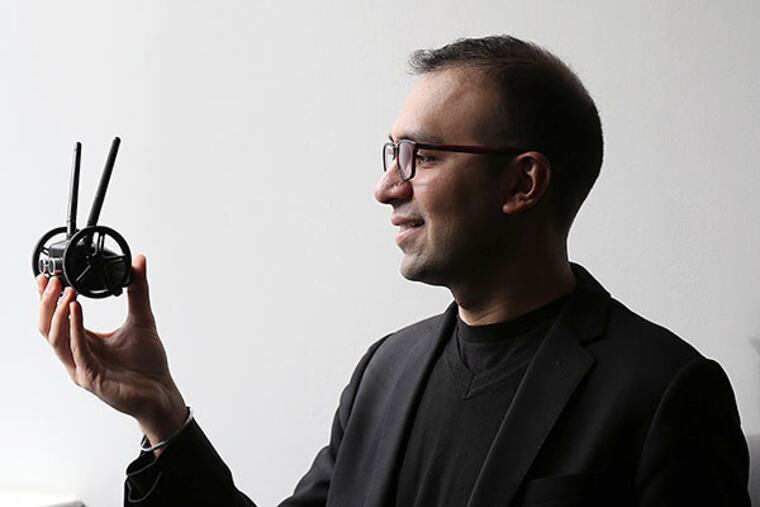
PRAMOD ABICHANDANI, 30, of Fairmount, is a Drexel University professor and founder of LocoRobo, a low-cost, ed-tech robot. The nonprofit is operating out of DreamIt Ventures' accelerator in University City. Abichandani hopes the robot gets students excited about STEM - science, technology, engineering and math.
Q: How'd you come up with the idea for LocoRobo?
A: When I was working on my Ph.D., I realized there was not much on the market to enable college and K-12 students to get a robot and use it because there was a barrier, which was the programming part. So the idea was to develop a robotic ecosystem with intuitive programming.
Q: The startup money?
A: The first investment is from DreamIt [Ventures], which has put in $25,000.
Q: The value prop?
A: It's not just a physical robot but related programming and educational resources. We provide three pillars: One is a high-quality but low-cost model relative to LEGO, the ubiquitous standard of physical robotics. Second, we have created an app that allows you to easily move the robot back and forth. It runs on IOS, Android and a Web browser. Then we provide a pathway to one of four programming tools. LEGO has a proprietary ecosystem; ours is open-source, meaning the software is free through a nonprofit. The open-source commands make it easy for you to learn programming and enter the world of robotics. Lastly, we break K-12 into four parts, with small, introductory modules for younger kids while older children would get introduced to scientific concepts.
Q: Why nonprofit?
A: I'm an educator at heart. We want to provide as much opportunity and enable as many people as possible to get knowledgeable about STEM, and being a nonprofit will help us keep the costs low because there's minimal overhead and no taxes. For example, we envision the robot costing no more than $150 to $200. We are in advanced discussions with about 10 K-12 schools in southeastern Pennsylvania and North Jersey who are interested in what we want to do, and we are finalizing contracts for a pilot program.
Q: Do you have competitors and what differentiates you?
A: There are for-profit robotics manufacturers. I think being a nonprofit definitely differentiates us. There are other nonprofits doing robotics, but I'm not aware of any that want to manufacture their own robots or have open-source programming.
Q: Biggest challenge?
A: We did an Indiegogo crowdfunding campaign last year and realized the chances of success depended on promoting it before it started, but we didn't have the funds. We raised $45,000 but fell short of our $113,000 goal and had to return what we raised.
" @MHinkelman
Online: ph.ly/YourBusiness
