Pastors puzzle over selling off vacant parish properties after mergers
The Rev. Thomas M. Higgins, pastor at Holy Innocents Roman Catholic Church in Juniata Park, is not just the spiritual leader of a vast area of Lower Northeast Philadelphia. He's also a busy property manager.
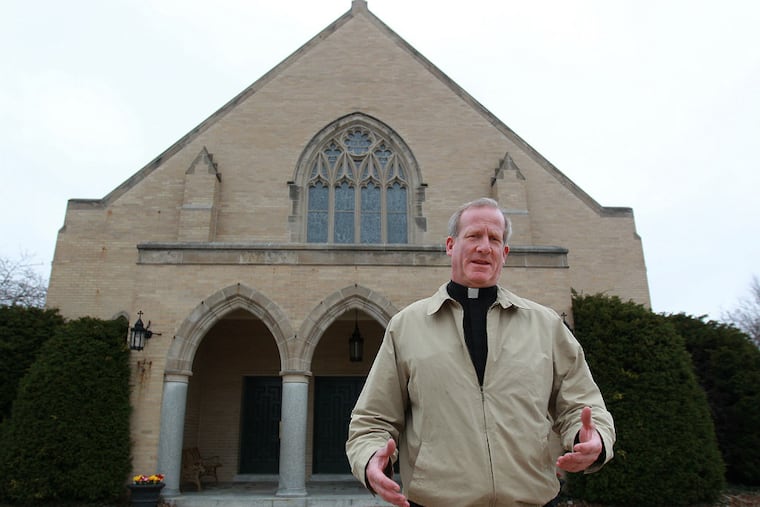
The Rev. Thomas M. Higgins, pastor at Holy Innocents Roman Catholic Church in Juniata Park, is not just the spiritual leader of a vast area of Lower Northeast Philadelphia. He's also a busy property manager.
To date, Holy Innocents, the sole survivor of a five-way merger, is the most extreme case of parish consolidation in the Archdiocese of Philadelphia. It left Higgins in charge of 22 buildings clustered in Frankford, Juniata Park, and Kensington - churches, schools, rectories, and convents that had to be sold or rented to cover their costs.
There was no directive from Archbishop Charles J. Chaput or other archdiocesan officials, Higgins said: "It's understood, as a pastor, that they want the buildings either being used through rental processes, or they want them sold."
With November's sale for $800,000 of the five-building Ascension of Our Lord complex in Kensington - a church, a rectory, a convent, and two school structures - Higgins is down to just 17 buildings. He'd like to sell an additional six of those.
Meanwhile, in much smaller Bridgeport, Montgomery County, the Rev. Timothy F. O'Sullivan, pastor of Sacred Heart Church, has 11 properties to sell after last summer's merger of three parishes.
"We have two convents that we don't have use for," O'Sullivan said. "We have three other rectories that we don't have use for."
In all, about 85 unneeded properties are available for sale or lease by dozens of parishes after several waves of closures since 2012. More are expected as the archdiocese continues its review of 125 other parishes.
"It will be a 10-year job," said Thomas M. Croke, director of real estate services, describing the historic property rightsizing underway in the 200-year-old archdiocese, which counts almost 1.5 million Catholics in the five counties it serves.
New rigor
The surge in parish sales is consistent with a new financial and management rigor under Chaput, who arrived in 2011 to find that more than two-thirds of the parishes, which manage their own affairs, had operating deficits.
As part of an overall financial-turnaround effort, the archdiocese has done deals worth more than $300 million in the last three years, selling the cardinal's residence and its nursing homes, for example, as well as selling seven senior living centers, leasing its cemeteries, and agreeing to sell undeveloped land in the suburbs for more than $50 million.
Some of the 219 parishes remain in bad shape financially. In the aggregate, parishes owed the archdiocese's business office $45.8 million as of June 30, including $37.9 million that officials doubted they would ever collect. But the archdiocese's chief financial officer, Timothy O'Shaughnessy, does not want to give up on that money completely.
"If a parish sells a building," O'Shaughnessy said, "we want to be able to say: 'What about us? For years, you didn't pay us.' "
Under that policy, since 2011, parishes have turned over $6.5 million of the $25 million raised from the sale of 41 properties to pay overdue bills.
When, for example, St. Bridget Parish in the East Falls section of Philadelphia sold its school in August for $1.18 million, the parish paid off its debt of more than $300,000.
The now-defunct Ascension parish owed the archdiocese nearly $200,000, but Holy Innocents sold the church's stained-glass windows to a diocese in North Carolina and used the money to pay that debt, Higgins said.
In many cases, pastors say, they are saving the proceeds from the property sales for future needs, such as maintenance and repairs of the buildings they retain. (Salaries are primarily paid through Sunday collections and school-tuition fees.)
Of the 11 buildings Holy Innocents owns at Mater Dolorosa, St. Joachim, and St. Joan of Arc, the three other parishes in the 2013 merger, four are leased. Higgins said he had no interest in selling the three churches, but would like to sell two rectories and two convents, plus the two remaining schools.
"It's a lot of property to manage," Higgins said. "I have a good business manager. I have three good maintenance men and very good secretarial help. That's the only way I could do this."
Praising Higgins' efforts, Croke, the archdiocesan real estate director, said: "He's doing a wonderful job out there."
The point man
Working out of an 11th-story office overlooking Benjamin Franklin Parkway and the Free Library of Philadelphia's central branch, Croke, 62, is helping parishes through the sometimes-overwhelming process of selling off their properties.
A former title-insurance executive and current deacon at St. Luke the Evangelist in Glenside, Croke started working at the archdiocese in May 2012.
He describes himself as a detail-oriented person with a personality that can endure the "real boring" work of reviewing monotonous legal documents that sometimes contain expensive legal traps.
The state of property-records organization at the archdiocese shocked Croke, a lawyer who once managed 400 title-insurance agents in six states.
"One of the things I discovered when I got here was this was an abyss," Croke said. "This was so 17th century, it's hard to even begin to describe. We literally had no idea what we owned."
He soon hired a consultant to enter the records - each parish has its own metal box in the "deed room" - into a database.
"Now," Croke said, "we have a better idea of just what we own and what it looks like."
He quickly learned that pastors were lost when it came to selling real estate.
"They had no idea what to do, how to do it, just nothing," he said.
Judging by a booklet Croke assembled to help the parishes navigate sales, the most intimidating part of the process - aside from finding buyers for certain properties in not-so-desirable locations - is getting multiple approvals from the church bureaucracy.
Croke helps obtain required sign-offs from the Archdiocesan Finance Committee, made up of lay leaders, and the College of Consultors, a committee of priests and vicars that advises the archbishop on financial matters.
"The internal process is similar to when a husband and wife sell a house," Croke said, "except there are six sets of husbands and wives."
When St. Raymond of Penafort Parish in Mount Airy was trying to sell a convent for $500,000 and the buyer, a nonprofit, had difficulty securing the money, Croke's experience was invaluable, said the Rev. Christopher M. Walsh, the pastor.
"Tom was very helpful when we had to do extensions of the agreement of sale and all the final paperwork," Walsh said.
A broker also gave Croke high marks.
"The whole process wouldn't be as successful without Croke," said Patrick Kelley, broker for 30 properties now listed by four parishes and a member of the archdiocesan Real Estate Advisory Committee, which is not involved with the parishes. (Kelley was not the broker for St. Raymond's convent.)
"What he did was harness all the loose pieces, and created a process that allows the pastors to understand how this works," said Kelley, a principal in the West Conshohocken office of Avison Young, a Toronto real estate firm.
Croke said most of the properties he has dealt with have come up for sale because of the merger of parishes or schools.
Lawn care
One exception is the almost five-acre lawn owned by St. Joseph Church in Cheltenham, Montgomery County.
"It's beautiful when the grass is cut, but every year, I'm putting out $7,000 to cut the grass," said the Rev. William S. Harrison, who is pastor at St. Joseph as well as at Presentation B.V.M., also in Cheltenham.
Harrison said the parish - which is among the 125 that have not yet undergone review for possible closure - realized that the property was always going to be a financial drag and that it would be better off selling it.
"We can't hold on to a property like that," he said. "That doesn't make any sense because we're not going to use it for anything more than just what it looks like."