Gizmo Guy: Internet radio with Philly 'tude
Tom and Paul Kelly still work in commercial radio, polling listeners and advising such stations as More FM Philadelphia on what music to play.
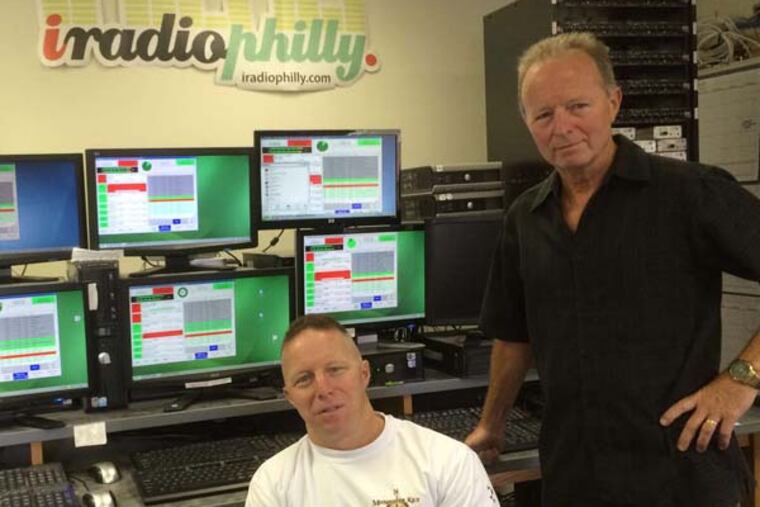
Tom and Paul Kelly still work in commercial radio, polling listeners and advising such stations as More FM Philadelphia on what music to play.
Big Daddy Graham is still happy holding down the overnight schmooze slot at Sportsradio 94WIP.
But for more pleasure and maybe their future, these guys are banking on Internet radio - the Kelly brothers are co-operators (with third partner, Al Clay) of the Havertown streaming service iRadioPhilly. And Graham is weekly host of a music party on Wildfire Radio, a streaming Internet radio operation based in Collingswood.
"The Thursday night thing I do on Wildfire is mostly a labor of love," said Graham of the program, which runs 8-9 p.m. "But I'm smart enough to also realize this could be the next big thing, as streaming radio takes over in connected cars."
With 23 curated specialty music stations playing around the clock, the free iRadioPhilly service has some stylistic kinship to satellite-delivered SiriusXM pay radio. And iRadio is doing pretty nicely, thanks; last year, it sparked 3.1 million-plus listener sessions, each averaging more than an hour.
There's also plenty of Philly attitude at play here, with iRadio stations named for hot spots of yore (Bandstand and the Plateau, as in Belmont), picking up the almost lost causes of Y-Not Radio and Martini Lounge music, and spotlighting unsigned local talents on BYO. And now with warm weather, it will be hard to miss these promotion-minded guys, as the iRadioPhilly van ventures out to webcast dozens of community concerts, from Bryn Mawr to Schwenksville (mainstage shows at the Philadelphia Folk Festival).
On Sunday, the Kellys will be wearing two hats, as both charity-minded presenters and live Internet radio streamers of the Haverford Spring Fest, an afternoon-into-early-evening event on Brookline Boulevard offering a terrific bundle of local talent. David Uosikkinen's all-star In the Pocket revue is top-billed, along with rockabilly legend Charlie Gracie, cool rapper Kuf Knotz, and Americana folkies End of America and Cabin Dogs.
With its mixed bag of talk shows and living-room-style studio in Collingswood, Wildfire Radio also oozes cozy vibes.
Visiting recently to vocalize on Berto Munoz's Scene Scene arts show, Jersey jazz popster Jessi Teich declared Wildfire "one of the coolest places I've ever performed." And that includes Paris, where Teich cut her savvy set "Twisted Soul."
Maybe coincidentally, Teich's album hit No. 1 on WRTI's "Jazz Hot 11 Countdown" just a few weeks later. "A great thing about doing Internet radio is that we also cache the show on hard drive as a podcast. So you can then send it to people as a link, inviting them to listen whenever, building your audience one stream at a time," Munoz said. He calculates his audience per episode at "more than 1,500."
Though many listeners use their Web address on a computer, iRadioPhilly and Wildfire Radio also show up on the tablet- and smartphone menus for streaming audio players from Sonos and Bose (SoundTouch.) The same holds true for the Germantown station G-town Radio, where WXPN's newly anointed Sunday night folk DJ, Ian Zolitor, cut his teeth. "The Internet radio menus put us on an equal plane with streaming versions of commercial Philadelphia stations," Paul Kelly mused.
Run with a "lean staff," iRadioPhilly turned a profit for the first time in 2014, after four years, said Tom Kelly. "It's onward and upward." The local team also owns the iRadio domain name in New York, San Francisco, L.A., and more.
Wildfire's owner, Marcus Darpino, says, "We're solvent, pay all our licensing fees, and still generate revenue." Sources include ads, studio rental, and network subleasing, "which means we build and run stations for other entities. All they do is provide the content."
In some ways, Web radio is ahead of the curve. Both stations can laser-focus ads to specific listeners using a tool called "Geo-Fencing." They also tout much lighter ad loads - no more than four 30-second spots per hour - versus 16 minutes of shilling on some commercial stations.
"We don't know who you are, but from your IP [Internet protocol] address and from what you're listening to, we can get a good idea of where you are and what kind of person you are," said Tom Kelly. "We'll even be able to target a neighborhood with ads. So, if a pizza shop just wants to advertise within a five-mile radius, on certain days and times, we can do that."