Sometimes, a mistake is just a mistake. A company bills a customer for the wrong amount, say, or a journalist pursues the wrong hypothesis - errors easily fixed with a refund or a rethink. But some offer windows onto larger issues. That's why I'm sharing the story of Margaret Martin and her errant Comcast bills, even if it's not quite the story I first suspected.
Martin's troubles began in February, when her monthly bill jumped nearly $10 - a lot for a "Limited Basic" client who buys cable mostly because of lousy TV reception at her Wynnewood apartment. The month before, she paid about $17 for two cable converters and a package of several dozen channels that omits cable's big draws but includes the local channels she chiefly wants.
Then came the whammy: a bill charging her $9.95 for an "additional outlet" service on top of $1.18 for her first cable box and its remote control, plus $7.35 more to prorate the new charge back to Jan. 25 because, her statement said, "we had already billed you when the latest changes were made to your account."
When daughter-in-law Jo-Ann Martin called to ask what changes had been made and why, a service rep apologized and said the new charge was in error. But after a credit on her March bill, the $9.95 was back again in April, and another service rep suggested that was the right amount for connecting her second TV.
"You can call two or three different times and get two or three different answers," Margaret Martin said when she contacted me to complain.
Here's where I concede my own error: I spent a couple days barking up the wrong tree, an occasional job hazard for someone whose duties include dogging the local cable giant. My suspicion: This is what happens when cable companies finally win release from the last, very limited regulations on cable-TV pricing - rules that for two decades have allowed local authorities to cap only the price of Limited Basic and the equipment needed to get it.
Comcast won such a release in Lower Merion last year, when the Federal Communications Commission agreed that the township enjoyed "effective competition" in its pay-TV market, and won a similar ruling for Philadelphia in January. This month, the FCC essentially flipped the switch nationwide: Now, every cable company is presumed subject to effective competition, unless a community challenges it.
So was Comcast simply doing what this latest deregulation allowed?
No - at least not for now. Comcast has again promised a refund and essentially blames operator error: Somebody entered the wrong code, and nobody fixed it the first time the Martins complained.
"We have apologized to her, updated her account and applied the appropriate credit," a spokeswoman said by e-mail.
Case closed? Well, Martin is happy enough. But her story raises other issues, particularly whether "effective competition" truly provides all the protection consumers need.
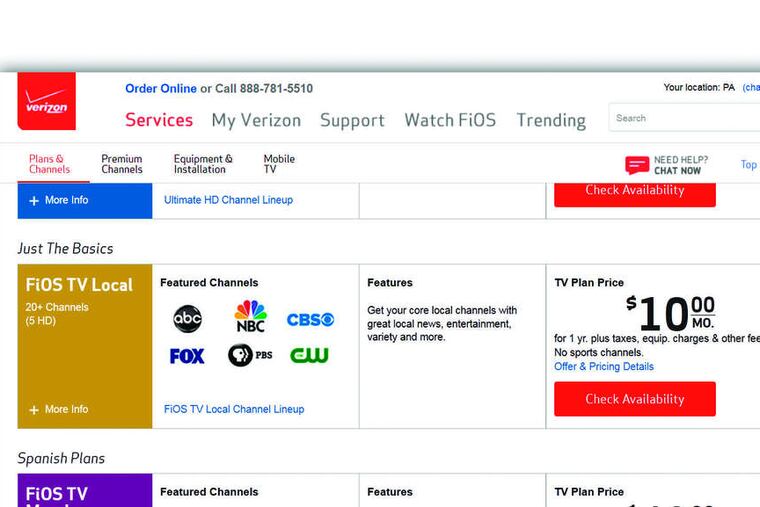
Does Martin have real alternatives? Satellite providers don't serve her apartment building, and they don't offer a comparable, low-end service anyway. But now that Verizon serves Lower Merion, she does have an option: its FiOS TV Local for $12.99 a month.
That's $2 a month more than Comcast Limited Basic, though two digital adapters would raise that to $25. But a Verizon spokesman says Martin might not need any adapters, because most TVs built after 2008 include digital tuners.
Public Knowledge attorney John Bergmayer, whose group opposed the FCC's change, says the cable industry's notorious problems - swiftly rising, confusing prices and lousy customer service - show that competition is a wishful myth.
Bergmayer says a key problem is that bills are so confusing that they border on deceptive. "You don't go to a restaurant and order a hamburger, and then see there's a bun fee, a napkin fee, and a health department compliance fee," he says.
Gerry Lederer has represented Boston and other communities fighting declarations of effective competition, and Montgomery County, Md., in its fight to force cable companies to sell set-top boxes rather than insist on renting them for exorbitant fees. The Washington lawyer says the FCC blew an opportunity.
The market has changed dramatically, as cable companies have morphed into primary broadband Internet providers. The FCC could have told Congress "that the standards of the 1992 Cable Act are no longer meaningful for today's marketplace," he says. Instead, it punted.
The whole cable industry, not just Comcast, has long focused on selling pricey, unregulated packages such as "Double Play" and "Triple Play" bundles, while a dwindling set of customers, many of them older and on fixed incomes, still rely on Limited Basic.
All they can do now is watch their bills more carefully than ever. No, Comcast didn't just raise Martin's prices. But today, any cable company can.
215-854-2776@jeffgelles