People often seem surprised when Gizmo Guy tells them he enjoys cleaning house. With the proper gadgets, the work goes fast, returns are gratifying, and brain power needed is zilch.
Cleaning up is doubly rewarded in warm weather when our agreeable test assistants - a tubby, tuxedoed boy cat and his calico-toned sister - shed fur like nobody's business. To whisk away their limitless supply, GG has been testing the Dyson V6 Absolute, latest in the maker's line of lightweight-yet-high-intensity cordless stick vacs.
Also, the brighter sun has made this homeowner aware and annoyed with just how dirty he'd let his windows get. A rechargeable, cordless, window-cleaning vacuum (really!) from Karcher has shown itself helpful, though a pricier and higher-tech option, the Winbot robotic window cleaner from Ecovacs, hasn't proved a great match.
"As good as . . ." Rivals often claim "our vacuum cleaner works as well as a Dyson and costs less than half the price."
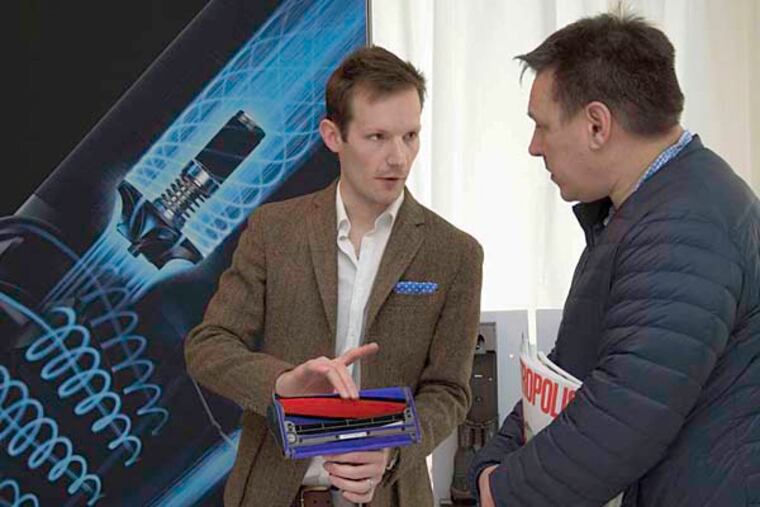
But get a Dyson demonstrator like Rob Green, a senior product designer, to put a Dyson V6 Absolute ($475-$599) stick vac up against, say, a Shark Rocket Ultralite ($199), and one key difference becomes obvious.
While the competition does a decent job on surface dirt, the Dyson's much more powerful motorized head and suction ability also parts the carpet fibers and pulls out deeply embedded fine-particle grit that a Rocket never touches.
And that can make a big difference in your home.
Dyson's patented, brushless digital motors are a major factor here, running cooler (saving energy) and with much less parts wear than conventional motors suffer, even while the Dyson's "impeller" is driving far faster to increase suction power. And while there's about 50 percent higher wattage/torque in the newly redesigned V6's main power head motors, battery run time "remains virtually the same as in older models," said the product designer, offset in part by smarter battery management.
Dyson's ceaseless R&D factors into the primo product price. Also, the V6 is the first Dyson stick vac packing a second (HEPA) washable filter plus a second motorized head dedicated to bare floors, which makes this lightweight cordless a fast staircase cleaner.
The kit also includes an effective spinning upholstery dehairing head, which really impressed the felines, and a duster for window blinds.
Be forewarned: A petite and bagless V6 needs regular trips to a trash can for bin emptying and to the recharging station after 17 to 20 minutes of run time.
That means that, to defuzz larger than a two-bedroom apartment, you need to ration use. Or invest in upstairs and downstairs Dysons. "We don't have a problem with people doing that," Green joked.
Window tech. I'm a longtime fan/user of Karcher power washers. The things are robust and virtually unbreakable, as long as you get one with a cranked, rotating drum system for storing/feeding the hose (otherwise it kinks up).
So I just had to see how their German engineering team would tackle the "inside job" of window cleaning, too.
Though it looks like a traditional hand vac (think Dustbuster), Karcher's battery- operated (rechargeable) WV50 Window Vacuum Power Squeegee ($70 direct at powersqueegee.com) is intended for use in wiping and lifting off only light amounts of the conventional window- cleaning liquid you've spritzed on windows, mirrors, and tiles. Within that operating limit, it works fast and well, saves a whole lot of trees.
Pricier ($100) "Plus" versions of the WV50 also pack a companion washer squirt bottle with attached wiper-pad head. Use it first to loosen and agitate the window dirt. Then, act fast (before the liquid dries) and work the squeegee+suction-powered vac head tightly into the corners.
Operating time is rated as 20 minutes per charge, enough time to do a mess of windows.
Karcher also offers (sometimes) a companion extension pole for the vac - up to 6 feet - with a rotatable head. It comes with a swappable (click on/click off) wiper pad, though switching between pad and the vac is tiresome. Amazon.co.uk ships one for about $56.
Robot vac. A vertical variation on "hands-free" robotic vacuum cleaners, the Ecovacs Winbot 7 Series ($399 at Bed, Bath & Beyond) does a magical job of sealing itself to an upright window (even Spider-Man would be impressed). Then it plots the territory, applies liquid cleaner, and wipes the glass clean.
While supplied with a remote control and an internal, rechargeable battery, both
are to be used only for emergencies. A Winbot won't start without its clunky 12-foot power line connected. And for safety's sake, a tether must also be attached if the thing is to be used above the ground floor.
A Winbot could be a godsend in houses with soaring floor-to-ceiling glass windows. Or to work the outside windows of a flat that gets cleaned only every five years (like clockwork).
But - and it's a big but - this robotic window vac is useless on any window glass smaller than 18 by 24 inches - as it can't then get its bearings, map out the territory. So in my circa-1850s abode, where all the window panes are divided, I had only one tiny testable surface - my shower door. Winbot took 7 minutes per side, with adult supervision. And left "cute" tire tread marks on the inside that appeared when the shower steamed, and multiple conventional cleanings have not removed.
Return to sender.
215-854-5960
@JTakiff