Bayer expands beyond aspirin to people, pets and plants
The U.S. Customs conversation is often the same for Kemal Malik, who carries a United Kingdom passport as a top executive for the German-based global giant Bayer AG. The agent will ask Malik what company he works for.
The U.S. Customs conversation is often the same for Kemal Malik, who carries a United Kingdom passport as a top executive for the German-based global giant Bayer AG. The agent will ask Malik what company he works for.
Malik: "Bayer."
Agent: "Oh, the aspirin company."
"That's what we are known for, and that's great," Malik said in Philadelphia recently at the American Association for Cancer Research meeting. "But we want to be known for other stuff and we have that opportunity."
Bayer Aspirin has remained a fixture on drugstore shelves for decades, although sales did not always go to Bayer. During World War I, its trademarks were confiscated in the United States. Decades later, Bayer bought back the trademark, and the website aspirin.com belongs to the company. One of Bayer's factories making aspirin is in Myerstown, between Harrisburg and Reading.
Today, the iconic aspirin has a renewed place in Bayer's corporate strategy. Under chief executive officer Marijn Dekkers since 2010, Bayer has more than doubled its stock price since 2012, pared disparate divisions, and now plans to spin off its plastics unit, called Covestro, by Sept. 15. As plastics exit the portfolio, the new focus will be on "people, pets, and plants," through health care and crop sciences. In human health, Bayer will sell everything from suntan lotion to cancer medicine. And don't forget about weeds.
"If you look at species, all of them, from plant to dog to human being, we all share DNA, and that commonality is strikingly apparent when you can sequence the genome," said Malik, who grew up and earned a medical degree in Britain. He is now responsible for innovation and the Americas as one of five people on Bayer's board of management, which includes Dekkers as chairman.
The common aspects involve basic survival functions at the cellular level, such as warding off fungal infections. "These are the things that tie Bayer together - the ability to come up with molecules that interfere with cellular processes across living species."
The plant part of the equation also could be in flux. however. Agricultural products giant Monsanto is trying to buy Syngenta AG, but if that $45 billion deal does not go through, Monsanto might be interested in Bayer's crop sciences division.
Bayer's streamlining includes human health care, which is headquartered in the North Jersey community of Whippany. (Some Philadelphia residents make the commute daily.) On June 10, Bayer sold its diabetes testing device unit for $1.15 billion to Panasonic Healthcare Holdings Co., a consortium funded by the electronics giant Panasonic and the private equity firm Kohlberg Kravis Roberts & Co.
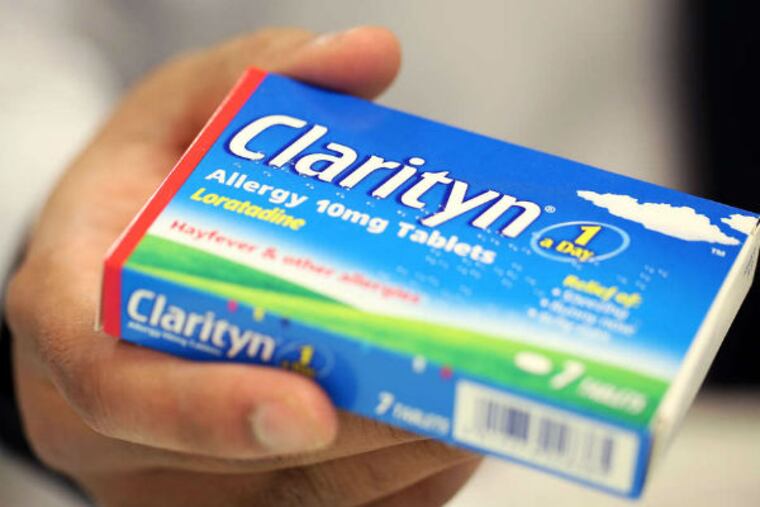
Bayer had $46.9 billion in revenue in 2014, the fifth straight year of increases, but the cash from the diabetes deal will go to pay debts incurred in the $14 billion purchase of the consumer products division of Merck & Co., in 2014. That deal brought Coppertone, Claritin, and Dr. Scholl's brands under the Bayer umbrella. Bayer's net income rose from $1.38 billion in 2010 to $2.76 billion in 2013, before dipping to $2.71 billion in 2014.
"Having huge, iconic brands, bundled together for shelf space is a huge advantage," Malik said. Bayer's competitors in over-the-counter drugs are the GlaxosmithKline-Novartis joint venture and Johnson & Johnson. "Now, there are big players and then some space," Malik said.
Bayer's best-selling prescription drug is the blood thinner Xarelto, though it sold U.S. marketing rights to J&J in 2010, a move that Bayer might not make now as it pushes more into U.S. pharmaceutical sales.
Like others, Bayer is looking for drug candidates beyond its labs in the tiny corners of biotech and halls of big research institutions. Besides touting 23 oncology research programs at the Philadelphia cancer meeting in April, Malik met with leaders of the Broad Institute of the Massachusetts Institute of Technology and Harvard University.
Bayer is pushing for bigger sales in the U.S. because that's where the money is, especially for high-priced cancer medicine. When Malik goes back to Britain, he encounters a different health-care world, where even conservative politicians don't try to scuttle the beloved National Health Service.
"It's just off limits. There will be a state-controlled, state-funded system. End of story," Malik said, adding that such innovative drugs as Xarelto are reimbursed in Britain as they are in the United States. "The one difference is cancer. There it becomes a more complicated debate because then it is a matter of what premium you put on life at the end of it. Everyone has a different perspective on this. Society has a different view of that in different countries. In the UK, there are 'cancer budgets,' but it is more restricted than in the United States. Ultimately, society has to decide where it's going to spend its money."
215-854-4506@phillypharma