Marken makes money by keeping drugs cool
When Big Pharma cuts jobs and outsources work, as it often does, that creates an opportunity for other firms to grow.
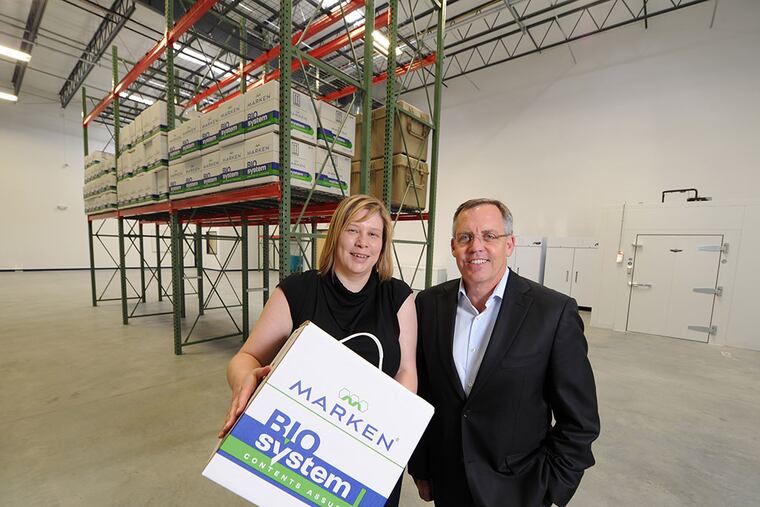
When Big Pharma cuts jobs and outsources work, as it often does, that creates an opportunity for other firms to grow.
Marken has jumped into such a breach, taking over a link in the vast drug supply chain that begins in the lab and ends with drugs going into a patient.
The company is focused on the delivery and care of temperature-sensitive products. About two-thirds of new drugs are expected to need cooling.
So the Durham, N.C.-based Marken is opening a site in Aston to be near Philadelphia International Airport.
"In the last three years, we've added 280-some people," said Dan Bell, Marken's vice president of regulatory compliance. Marken, which is privately held, employs about 600 people in 40 locations across the world. It will start with five here and hopes to grow to need 15 to 25 employees.
American Airlines has just opened a refurbished warehouse at the airport to handle the flow of temperature-sensitive drugs arriving or departing, often from overseas.
Marken is the next step in the chain, along with its competitors, which include World Courier, a subsidiary of the Valley Forge-based drug wholesaler AmerisourceBergen.
Bell called Philadelphia "a strategically important port for pharmaceutical products."
"And in the tri-state area, we have a number of pharmaceutical clients, including contract manufacturers," he said, referring to firms hired by name-brand companies to make pills. "We have FDA agents who are very familiar with drug products coming in and out of this port, so it makes sense to have a facility here that can handle temperature-controlled drugs."
A few degrees in the wrong direction can damage a specimen.
Indeed, Marken's facility will have one unit that keeps items from 36 to 46 degrees Fahrenheit and another for items that need to be kept at -4 to -112 F.
There are a temperature-controlled vehicle and plug-in stations for RKN units, the refrigerated cargo boxes that go on airplanes.
"About 63 percent of new drugs coming through the pipeline are going to be temperature-controlled, and most of them will be biologics," Bell said, medicine formed by living cells rather than chemicals.
Even though Big Pharma is doing more with biologics, firms have been outsourcing work for years.
"Some big companies had entire departments and divisions whose focus was temperature-controlled supply chain, and that has been outsourced," Bell said. "That's our bread and butter, what we do every day, so we look to hire people who have that experience and knowledge. I'm sure we'll find a number of people in this area, given the number of pharma clients."
Marken has its own history of turmoil. The British private-equity firm Apax Partners bought Marken in 2009, but then had to give Marken to its lenders. The reorganization was finished at the end of 2012.
Marken serves big pharmaceutical companies and small biotech start-ups, contract manufacturers and academic research groups.
"Every client is different, and they are all the same," said Mark Hembarsky, Marken's vice president for North American logistics, who managed capital projects for Exxon before moving to the drug industry. "They all want great service, they want great delivery, and they want to feel good about the experience."
Bell said employees coming to Marken from big companies must have specific knowledge, usually of temperature control and supply chains, but also an ability to adapt to changing market demands.
"Sometimes it is hard to move from a very silo-ed, large-company mentality to a smaller, dynamic, very customer-focused company," Bell said. "But most people pick it up very, very quickly and it is pervasive around our company.
215-854-4506 @phillypharma www.philly.com/phillypharma