Former engineers going for solutions to biking challenges
Three thirtysomething guys with mechanical- engineering degrees had well-paying jobs working in nuclear reactors, infant strollers, and the V-22 Osprey.
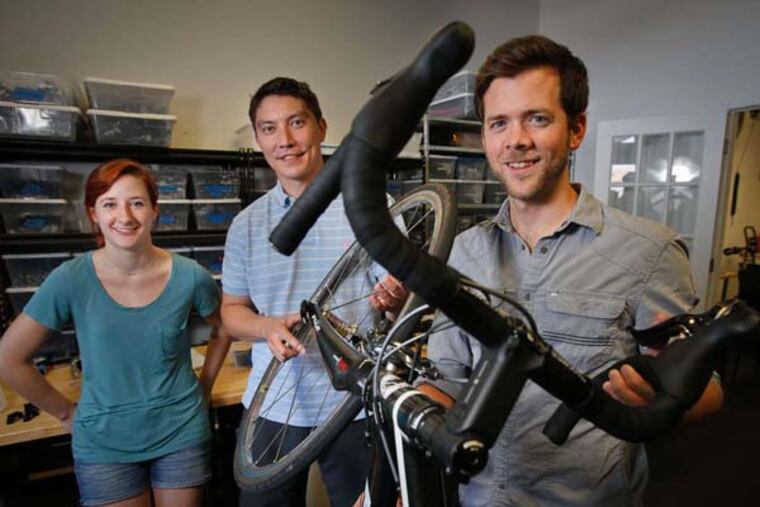
Three thirtysomething guys with mechanical- engineering degrees had well-paying jobs working in nuclear reactors, infant strollers, and the V-22 Osprey.
They left them to tinker with bicycles. No small leap of faith, one acknowledged.
"There's a saying in the bike business, 'The fastest way to end up with a million dollars is to start with two million,' " said Stephen Ahnert, cofounder of Philadelphia-based Redshift Sports. "It wasn't an easy decision to leave the salaries and stability of our jobs - I vacillated between extreme confidence and wild doubt, literally on an hourly basis. But, ultimately, I think the fear of not trying it trumped the fear of failure."
Kickstarter has proved an effective way for bike-gear companies to raise cash. So successful was the campaign for Redshift's first product, raising $49,563 to help bring to market an aerobar/adjustable-seat system to improve performance for competitive cyclists, that the company of four employees launched another Kickstarter initiative Aug. 25.
This time, they hope to raise $25,000 for a new suspension stem designed to enable smoother rides on road bikes.
As outsiders, Redshift's owners are bringing fresh perspective and solutions to a notoriously insular industry, biking experts said.
"You need people from the outside to take a look at what's going on. That's how we have progress," said Jim Manton, owner of ERO Sports in Los Angeles, specialists in bike fitting and aerodynamic testing. "I'm rooting for these guys."
What propelled Ahnert, Erik De Brun and Scott Poff, all cycling enthusiasts, on this entrepreneurial expedition? The same thing that drives so many out of career security into start-up uncertainty: recognizing an unserved or underserved niche.
For Redshift's first product, that niche was beginner triathletes; for the second product, it was the bigger demographic of road bikers seeking a less-jarring ride.
Poff, 33, of Northern Liberties, and De Brun, 35, of San Francisco, have known each other since they were children in Weston, Conn. Ahnert, 35, of New York, met De Brun when they were students at Princeton University, where they built a pool-playing robot for their senior thesis.
After college, Poff, a Carnegie Mellon graduate, joined Westinghouse to repair and upgrade nuclear power plants around the world. Ahnert initially worked on nuclear plants, then went to Graco in Exton to design strollers. De Brun landed at Boeing Co. in Ridley Park as a control-systems engineer, testing the V-22 Osprey.
In 2008, with Graco moving to Atlanta, Ahnert stayed here and partnered with De Brun to form Ripple Design, a small engineering company that shares space with Redshift on the border of Spring Garden and Northern Liberties. Poff, who quit Westinghouse and wanted to do something new, joined them in January 2009.
Helping other companies develop products and bring them to market inspired the Ripple team to do it for themselves, Ahnert said. They steered toward cycling, in part, for personal reasons: Ahnert was training for his first triathlon on an ordinary road bike in 2010, wishing he had the ability to switch his seat and arm positioning easily for better aerodynamics and performance.
Anything on the market at the time required tools and a laborious process of attaching, aligning and tightening the new equipment, he said. He and his partners developed a prototype that resulted in the Switch Aero System - quick-
release, clip-on aerobars and a dual-position seat post. It retails for $319.
"We were galvanized into action because of the growing popularity of Kickstarter," raising 247 percent of their $20,000 goal, Ahnert said.
Switch Aero is "a very easy-use system," said Tom Cusworth, director of retail operations and a bike fitter at Breakaway Bikes and Training Center in Philadelphia.
Redshift's gross sales this year are expected to reach $500,000, double last year's, Poff said.
For its latest product, Shockstop (see more at https://www.kickstarter.com/projects/redshiftsports/shockstop-the-shock-absorbing-bike-stem), Redshift already has surpassed its $25,000 goal, raising $25,125 from 234 backers in six days. The campaign ends Sept. 30.
The name Redshift is a classic from the minds of its engineer founders - a shift in wavelength of light as an object travels away from you.
"It also sounded cool," Poff said.
215-854-2466 @dmastrull