Experts: Charity cards can deceive you
Giving money to charity might be on your mind as the holidays near. Donating with a charity credit card? Not the best idea, experts say.
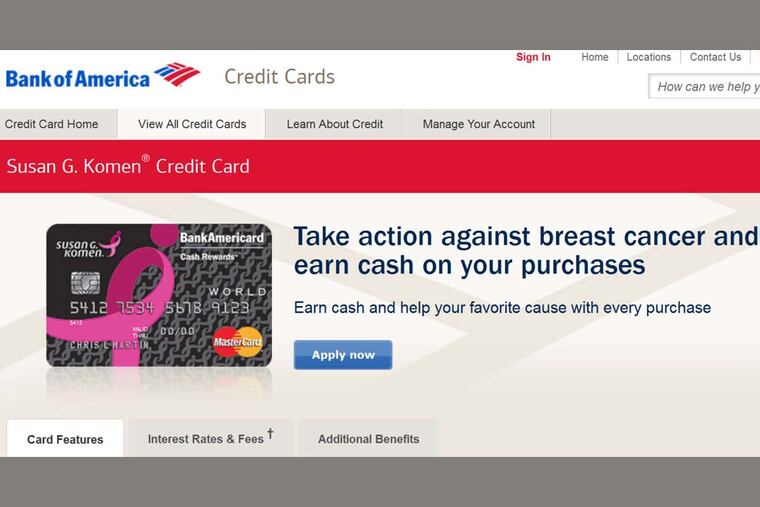
Giving money to charity might be on your mind as the holidays near.
Donating with a charity credit card? Not the best idea, experts say.
It's not that so-called affinity credit cards are evil. Charging purchases on a card with an endangered tiger or a pink breast cancer ribbon on the front might make you feel good - just realize that you could do far better for yourself and your favorite charity.
"If people read the fine print, they would probably not be that impressed with it," said Daniel Borochoff, president of watchdog group CharityWatch. "People should be careful not to feel too good, because you're helping in a very minuscule way."
For example, Bank of America offers a charity card with part of your purchase dollars going to the Susan G. Komen breast cancer organization. That sounds great until you realize the contribution is only 0.08 percent. If you pile up $10,000 in purchases over a year on that card, the charity gets a whopping $8, plus $3 when you open the account and $3 for renewing every year.
If you instead used a rewards card unaffiliated with a charity but paying 2 percent cash back, your annual reward on $10,000 would be $200. Your credit card spending alone means you could write a check for 25 times more to the same charity.
Bonus: You can report your charitable donation as a tax deduction because you're the one giving the money, not the bank.
"I don't like them," credit expert John Ulzheimer said of charity cards. "There should be a wall between credit cards and your philanthropic activities. Choosing a credit card should be more about the terms of the card and not about the design on the card."
Target took flak recently when it said it would end its donations to individual K-12 schools, funded by 1 percent from consumers' spending on its REDcard credit and debit cards. It will instead focus on philanthropic wellness programs, including those at schools.
Outraged card users might have had an inflated view of how much they were helping. Even though Target donated $432 million to schools since 1997, each school on average received just $370 a year, the company said.
Payment cards with charitable affiliations have a few upsides. For consumers, they are easy, automatic, and beat donating nothing at all.
"They're great for people who want to give donations without thinking about it," said Sean McQuay, credit card expert at NerdWallet.
Donations to charities in 2014 totaled $358.38 billion, up 7.1 percent over the previous year and driven most by donations from individuals, as opposed to corporations, foundations and bequests, according to an annual report by Giving USA Foundation. That's the highest total for donations in the history of the 60-year-old report.
"If you just know yourself and won't donate to that charity otherwise and that charity means a lot to you, I could see how it could make sense," said Curtis Arnold of card-comparison site CardRatings.com.
The pictures on the front of the cards also could have a certain public relations component. Perhaps the cashier asks about it or a friend sees you hand it to a waiter, and those people eventually become involved with the charity.
"You might have an opportunity to share about a charity that's near and dear to your heart," said Bill Hardekopf, founder of credit card comparison site Lowcards.com. "There are some PR benefits."
The Susan G. Komen organization is comfortable with its arrangement with Bank of America and its affinity card.
"The cards are free to the consumer, and give them an opportunity to show their support for the breast cancer movement and generate a donation to Komen at no cost to them," Komen spokeswoman Andrea Rader said.
Those donations of 0.08 percent add up, generating more than $6 million since 2009 for investment in research and community outreach, she said.
Still, as a smart consumer and individual philanthropist, you could do better, experts said. Interest rates on charity cards tend to be worse than average, some exceeding 20 percent for those with poor credit.
And you should know what you're really getting when you sign up.
Bank of America's Nature Conservancy card is even less lucrative for purchases than the Komen card, giving 0.05 percent, or $5 per $10,000 in spending - although it promises to contribute $100 for opening an account if the card is used once and remains open for 90 days.