In case you mist it: The best in humidifiers
Itch itch, scratch scratch. Snore snore. A lot of us don't need a weatherman - or a humidity readout on our smarter thermostat - to know when our house is suffering those wintertime, dried out, can't-get-no-sleep blues.
Itch itch, scratch scratch. Snore snore. A lot of us don't need a weatherman - or a humidity readout on our smarter thermostat - to know when our house is suffering those wintertime, dried out, can't-get-no-sleep blues.
Brought on by the low humidity output of a forced air heating system, and made worse by tightly sealing windows and doors, ultra-dry winter air is bad for plants, furniture and musical instruments and worst for you and me.
Unless you relish having skin so dry that it could crack like parchment paper. And nasal passages so constricted that breathing becomes a chore, throats grow sore, and we're snoring even when sleeping on our side.
Portable room humidifiers that spray a velvet fog of water particles back into the air are the traditional response. But if you haven't shopped the market lately, you may be surprised by how the category has matured.
No longer settling for "utilitarian and noisy" - what our moms would set up in our sick room with a dollop of pepperminty VapoRub on top - today's humidifiers pack modern, intriguing designs and high-tech functional finesse.
The curvy Crane SmartDrop Humidifier (EE-5303, $100-$170) - bulbous at the bottom, fluted at the top - resembles a vase or a planter.
The see-through Bionaire Warm and Cool Mist Ultrasonic Humidifier (BUL9500B-U, $90) favors a simple, modernistic form-follows-function look.
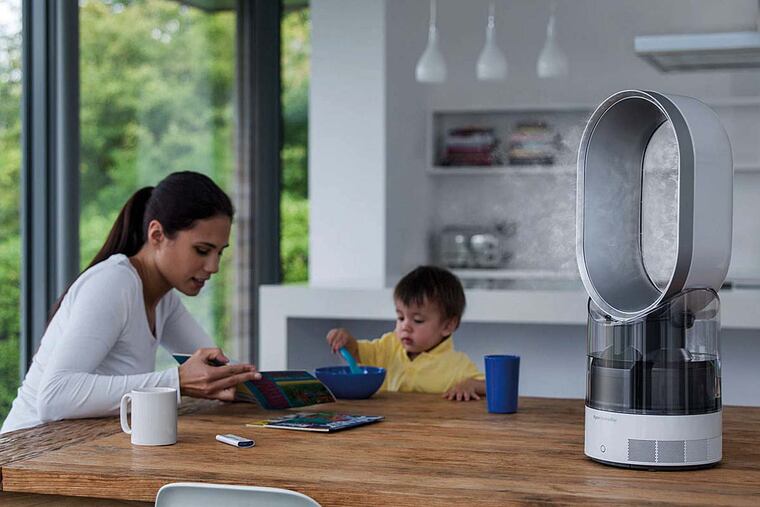
And the really space-age Dyson Humidifier ($499), splaying an oval of mist and air from the rim of its curvy "loop amplifier" cowl, seems to a piece of modern techno sculpture that would be welcome at the MoMA. And it might take flight if you dialed its fan speed up to 10.
All three answer to the calling "ultrasonic." Different from the old school (and still available) vaporizing models that use a heating element to boil a tank of water and disperse it as steam, ultrasonic humidifiers use a vibrating device, like the high-frequency piezoelectric transducer specified in the Dyson, to "nebulize" water - froth it up from a solid to a mist. And it's all done at a whisper, without that loud "pot boiling" noise.
(Don't like ultrasonics' traditional cool mist? The Bionaire also boasts a mist warming option.)
Ultrasonics are also preferable because they need no replacement parts: the $20-$30 worth of wicks and filters you must swap out every few months in cheaper-to-start evaporative tabletop models such as the Honeywell HCM-3500 ($60-$74), which blow unheated air over a wet wick.
Some evaporative models such as the Honeywell and water-boiling, bargain-priced ($10-$25) Vicks V150SGN Vaporizer claim their designs prevent bacteria from being emitted into the air, a major concern with any humidifier. That's why all models tell you to rinse out any old water in the holding tank and pat dry the base before refilling, and to periodically clean the whole system with a solution of vinegar and water or citric acid and water. Said cleaning also serves to eliminate mineral deposits left behind when hard tap water is used instead of the "suggested" bottled or filtered water.
But note that the Dyson demands only a monthly citric and water flushing, rather than a weekly purge. And claims the mist it's spraying into the air is "99.9 percent bacteria free," as it's been purified by a special, germicidal UV-C (ultraviolet) light hiding in the base. Given how massive and vulnerable Dyson might be to a lawsuit, I'm betting they've got the evidence to back up the claim. The company spent more than $60 million and went through 643 prototypes before settling on this, their first humidifier model.
Crane boasts of using "anti-microbial" plastic parts - so slippery that bacteria can't fester and cling to its innards.
More readily appreciated is the humidifier's onboard WiFi technology. Install the companion Crane app on your iOS (Apple) or Android phone, and wirelessly link the humidifier to your home network. Now you can control the humidifier from anywhere, turning it on and off, dialing up just the level of humidity you want.
And, brother, can this thing blow, cranking the most mist of the three models tested and fastest to raise the humidity count on a nearby Nest thermostat. But be forewarned, with the Crane's concentrated "smoke stack" distribution pattern, some of that fog invariably falls straight down, lightly moistening the floor around the humidifier stand.
Suited best for close installation to a bed, the Dyson spews the finest mist with widest dispersion and easily runs with a small, wireless remote control.
Thinking of gifting one of these devices for a loved one suffering the winter dries? Valentine's Day is just around the corner. But don't forget that these small things require a nightly (Dyson) or bi-nightly (Crane, Bionaire) rinse and refill of the (handle-equipped) water tank from a wide-open tub or kitchen sink faucet.
Your present should include a promissory note to regularly refill it. Plus a bottle of yummy body lotion you're happy to apply, to um, speed the skin healing process.
215-854-5960@JTakiff
