Target Pulls Up to Table
Target has a giant bull's-eye on food. Notice how the department store is a grocery store, too? Has been for a while, but it's stepping it up big time.
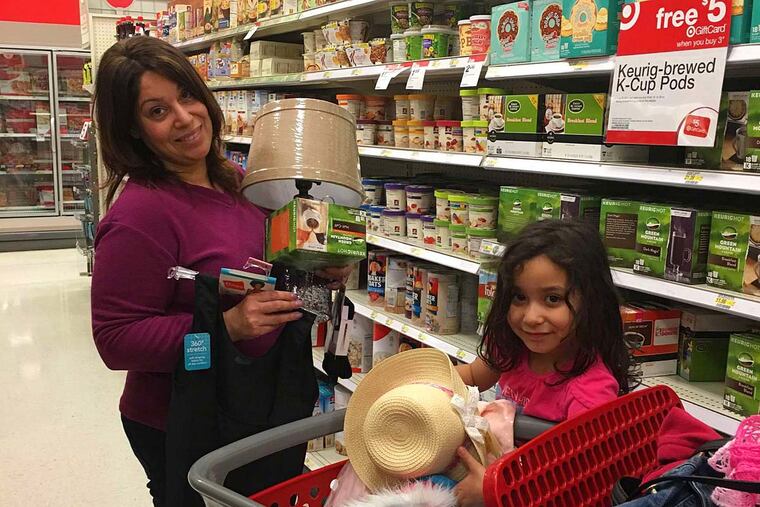
Target has a giant bull's-eye on food.
Notice how the department store is a grocery store, too? Has been for a while, but it's stepping it up big time.
With good reason: Shopping for food is the most consistent, and most frequent, visit that an American consumer makes.
It's convenient. I can walk into any Target, buy a blouse or sweatpants, and walk down a few aisles for breakfast food.
And the food fight is only getting started. CVS sells frozen pizzas. Rite Aid has ice cream.
Although no one can touch Walmart's food sales (not even Kroger and Safeway), Target is doing what it can to capture a bigger share of the food business.
The food shopper, according to retail surveys, shops twice a week, on average, as opposed to a general discount shopper, who shops once every two weeks.
"It's a rational move," said Howard Davidowitz, chairman of Davidowitz & Associates Inc., a national retail consulting and investment banking firm in New York. "About 56 percent of Walmart's business is food.
"Drugstores and dollar stores - Dollar General, Dollar Tree, and Family Dollar - are all making huge increases in space for food," he said. "Go into any of them, and you see freezers."
"The number-one thing that drives customer visits is food. That is fact," Davidowitz said. "Everyone is looking to capture as many of those footsteps as frequently as possible."
Indeed, Moody's lead retail analyst, Charlie O'Shea, said that although Target's gross margin was down 60 basis points (0.6 percent) year over year, according to fourth-quarter 2015 results, "the company was able to more than make up for this drop with solid control of operating expenses" and grocery receipts.
"Going forward, we believe Target's continuing efforts to strengthen its food business will resonate with consumers, and drive increased traffic through more frequent shopping visits," O'Shea said
Olga Harris, 49, a welfare caseworker in North Philadelphia, recently visited the Target in Langhorne with granddaughter Leanah Soto, 4.
"She made me come here," Harris said, smiling at Leanah. "She wanted toys, an Easter dress, and cookies, and she knew they would all be here."
Harris' Target cart last week was almost full and included a lamp shade ($14.99), girdle ($21.99), Leanah's Easter dress ($19.95) and hat ($7), panty hose ($9), Oreo cookies ($2.99), 18-cup Green Mountain coffee ($11.99), and Ocean Spray cranberry juice ($2.12).
Having all the items under one roof "saves me gas and time," Harris said. "I love it."
The nation's largest discount retailer, Walmart (Target is No. 2) sells everything, too, but is now also the largest food retailer in the United States. It generated $188 billion in food sales in 2015. Kroger, the largest traditional food chain, did $110 billion a year in food sales.
"Everybody is all over this since there is such a battle for market share," Davidowitz said. "There are too many stores, and there is a tremendous battle to capture that [food] customer."
Moody's O'Shea said Target has been selling food since it opened in 1963 and accelerated it in the mid-1990s, mostly on the nonperishable front.
"However, it expanded a few years ago into more fresh food via its PFresh efforts that added some perishables," he said. "This move has not resonated that well, with the company still selling disproportionate amounts of nonperishables, like cereal."
But the retailer is aiming to fix that.
On March 9, Target rolled out the third iteration of its two-year-old Made to Matter Program, to spur product innovation and make natural, organic, and sustainable products more accessible. Among the food criteria this year were dietary and allergen restrictions and reduced sugar.
Target Corp. CEO Brian Cornell devoted a chunk of his presentation to food at a Financial Community Meeting this month in New York City.
"Overall, our comps in grocery outpaced the rest of the store in both the third and fourth quarter," he said. "It's a big turnaround after lagging for several years."
Cornell said Target plans to improve freshness and is expanding organic offerings and specialty items this year.
"We will bring new food options into our Target cafes with some new partners," Cornell said, based on a transcript of the meeting. "At $18.5 billion in sales, [grocery] is already a huge business for Target, and last year, we promised we'd redefine our position in food.
"While our guests certainly have told us they appreciate the convenience of having fresh foods, we also heard that too often, they were leaving underwhelmed and disappointed," he said. "So over the last 12 months, we've talked to guests, done deep dives into the business, and we've been tearing down every category and every process. We know repositioning food is going to be a much bigger task . . . so we are doubling down on food fundamentals."
In October, the mega-retailer, which boasts 1,800 brick-and-mortar stores and 40 distribution centers, announced it had entered a partnership with design firm Ideo and MIT's Media Lab to explore the future of food sales. Whatever Target finds out it will use to reboot its grocery and wellness business.
"We are operating almost a $20 billion food business, and we know we haven't tapped the full potential," Cornell said. "We need to understand where the market is headed and ensure we get there first."
Heath Leamon, 40, of Burlington, frequents the same Target in Langhorne inasmuch as he works at a nearby Sleepy's. He stops in on his way home over the Burlington-Bristol Bridge.
"You can buy anything and everything," he said Sunday, while carrying a bar of Dove soap and a four-pack of Red Bull on his way to the movie section.
215-854-4184@SuzParmley