Loud protest, little progress as Verizon strike enters fourth week
At the elegant Hotel Albuquerque in New Mexico, miles and sunshine away from the gray and gloomy Northeast where 39,000 Verizon workers remained on strike Thursday, the telecom company held its annual meeting.
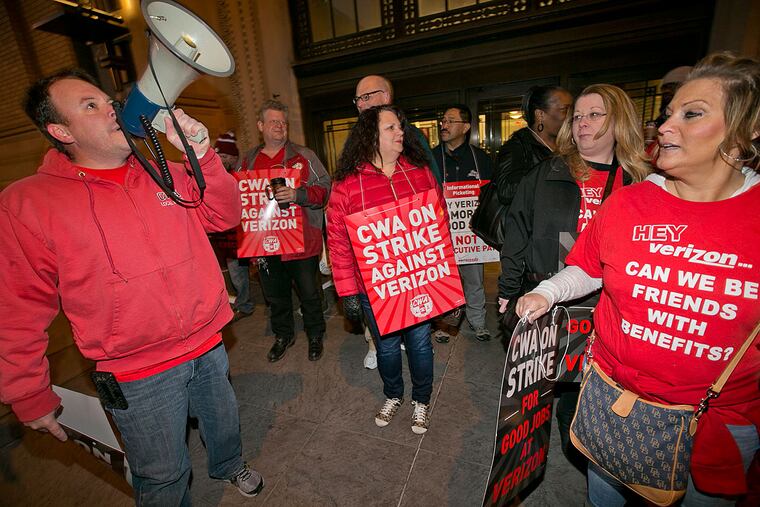
At the elegant Hotel Albuquerque in New Mexico, miles and sunshine away from the gray and gloomy Northeast where 39,000 Verizon workers remained on strike Thursday, the telecom company held its annual meeting.
Shareholders approved executive compensation, overwhelmingly re-elected Verizon chairman and CEO Lowell McAdam to the board, and easily defeated a half-dozen proposals promulgated by the unions and Verizon's retirees.
Meanwhile in Philadelphia and Rye, N.Y., both sides met Thursday for talks that have yielded few results as the strike enters its fourth week.
"Despite recent assertions from unions that the company's major shareholders were calling for change, all six of this year's shareholders proposals were defeated," Verizon said in a news release about the annual meeting.
"It was very calm," said Rob McFadden, 48, a striking systems technician from Yardley who attended the meeting as a shareholder. "We weren't there to kick up a ruckus, just to share our concerns."
The ruckus occurred outside the hotel, where about 200 union members, many in their trademark red shirts, blocked traffic and shouted slogans. Police escorted away protesters sitting in the road.
Around the nation, the two striking unions - the Communications Workers of America and the International Brotherhood of Electrical Workers - planned extra rallies, including morning events at Verizon Wireless stores in Center City, on Roosevelt Boulevard, near the University of Pennsylvania campus, and in Bensalem.
Job security remains the main issue, with workers opposing company proposals to close call centers, send call-center work to outside contractors in other states or abroad, mandate increased overtime, and assign technicians to work far from home for extended periods.
"It all goes back to a chronic understaffing," CWA district vice president Edward Mooney said.
Verizon has been shedding workers in its wired divisions and says it needs more flexibility to accommodate changes in its business.
While the CWA and IBEW work primarily in Verizon's wired business, two wireless units now are also unionized. The unions are pushing the company to negotiate a contract with those units, as well.
There have been reports of Verizon employees going back to work, particularly in Virginia, which is a right-to-work state, but they are the exceptions, Mooney said. "Morale is strong," he said. "The public has been great. We've gotten a lot of community support."
McFadden said that he did not know of any returning employees in the Philadelphia area, and that none were among his group of 28 technicians who take care of large city systems such as Philadelphia municipal government and "all the large corporate businesses" in Center City.
"Now, that work is being done by two managers," he said.
McFadden said he is weathering the strike because his wife works and he was able to enroll in her health plan. Verizon stopped funding employees' health plans on May 1.
The unions have strike funds for emergencies, Mooney said.
Last week, the company said it was deploying thousands of additional employees and outside contractors to serve customers.
"While we'd rather have our seasoned veterans in these positions, each day, more and more customers are giving us high marks in that their inquiries and issues are being successfully resolved in our call centers and in the field," Bob Mudge, president of Verizon's wireline-network operations, said in a statement.
The unions said basic safety practices are not being followed as unqualified managers and contractors hang cables, place poles, and operate heavy equipment.
The strike is unlikely to have an impact on Friday's monthly jobs report, said economist Ryan Sweet, a director at Moody's Analytics in West Chester.
That's because of the way the Labor Department's Bureau of Labor Statistics surveys households. A person would be considered employed, Sweet said, if he or she worked any time in the week ending April 16 - the so-called reference week.
Verizon workers left their posts April 13, so most would have worked part of that week.
"If they stay on the strike for all of [May's] reference week, it is going to skew the employment numbers" in June's report, Sweet said. May's "reference" week ends May 14, he said.
215-854-2769
@JaneVonBergen